




























Views
Downloads


Printable Segment Addition Postulate Worksheet | Grade 8

Paste this activity's link or code into your existing LMS (Google Classroom, Canvas, Teams, Schoology, Moodle, etc.).
Students can open and work on the activity right away, with no student login required.
You'll still be able to track student progress and results from your teacher account.
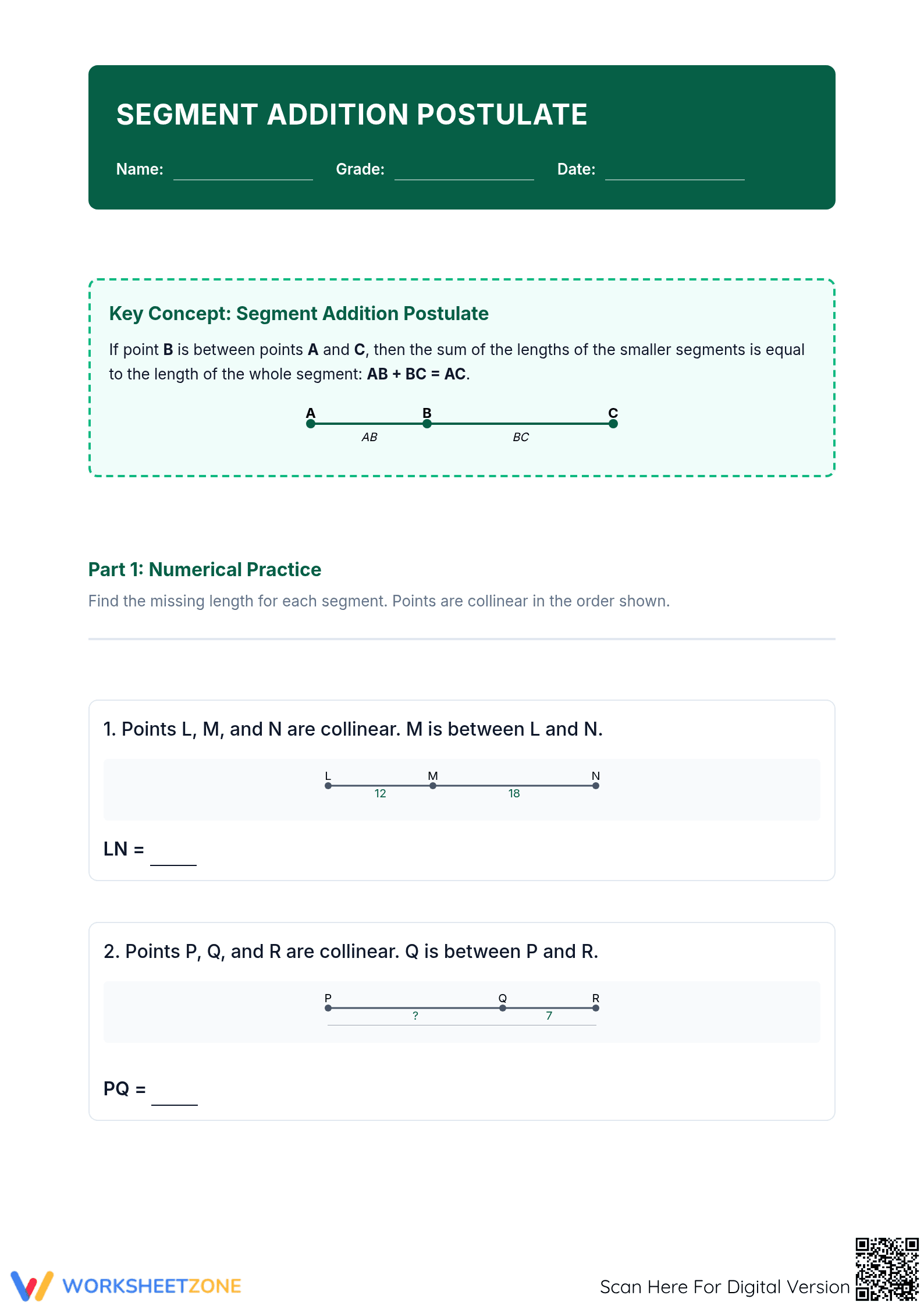
This worksheet provides comprehensive practice for students mastering the Segment Addition Postulate. By moving from numerical calculations to algebraic equations and midpoint properties, students develop a deep understanding of geometric axioms. This resource ensures learners can accurately determine segment lengths and solve for unknown variables in complex geometric figures.
At a Glance
- Grade: 8 · Subject: Geometry
- Standard:
CCSS.MATH.CONTENT.HSG-CO.A.1— Know precise definitions of line segments based on notions of point and distance- Skill Focus: Segment Addition Postulate
- Format: 3 pages · 7 problems · Answer key included · PDF
- Best For: Geometry skill building and algebraic modeling
- Time: 25–35 minutes
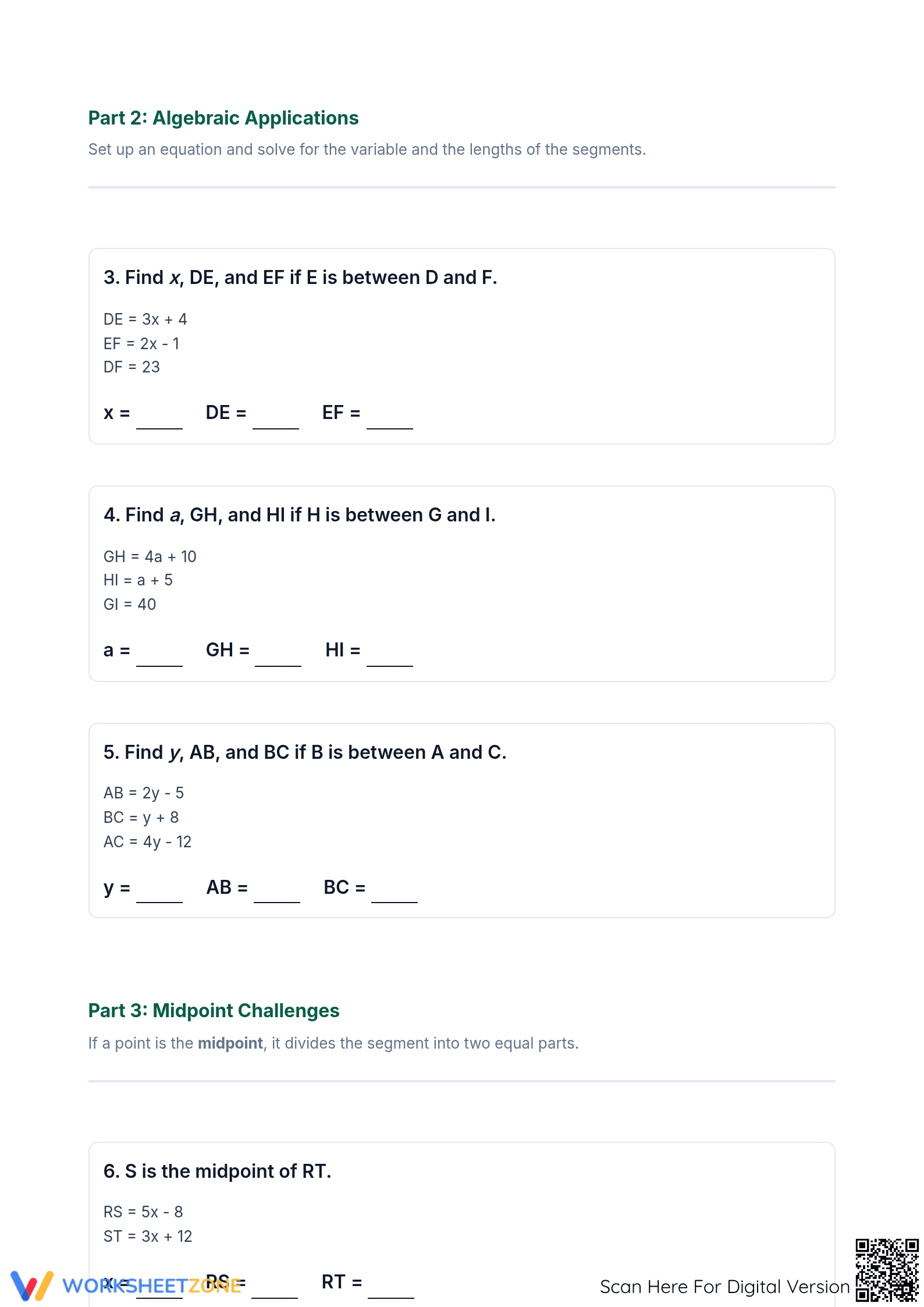
What's Inside: This 3-page resource features 7 tasks divided into three distinct sections. Part 1 covers basic numerical practice with collinear points. Part 2 introduces algebraic applications where students solve for variables like x, a, and y. Part 3 challenges students with midpoint definitions and equalities. A full answer key is included for immediate feedback.
Skill Progression
- Guided practice: Two introductory problems using visual segment diagrams to reinforce the basic AB + BC = AC relationship through direct numerical addition and subtraction of segment lengths.
- Supported practice: Three algebraic application problems requiring students to set up linear equations based on segment relationships and solve for variables and specific segment lengths simultaneously.
- Independent practice: Two midpoint challenge problems that require translating geometric definitions into algebraic equalities (JK = KL) to find missing dimensions without explicit segment sums provided in the prompt.
This sequence follows the gradual release of responsibility model, ensuring students successfully transition from visual recognition to abstract algebraic reasoning.
Standards Alignment
Primary Standard: `CCSS.MATH.CONTENT.HSG-CO.A.1` — Know precise definitions of angle, circle, perpendicular line, parallel line, and line segment, based on the undefined notions of point, line, distance along a line, and distance around a circular arc. This standard code can be copied directly into lesson plans, IEP goals, or district curriculum mapping tools.
How to Use It
Use this as a primary practice set after introducing the postulate through direct instruction. It serves as an excellent formative assessment tool to check if students can bridge the gap between simple arithmetic and algebraic modeling in geometry. Pair with a segment diagram anchor chart for additional scaffolding during the algebraic portion.
Who It's For
This resource is designed for Grade 8 and High School Geometry students. It is particularly effective for learners who require structured practice in translating verbal geometric descriptions into solvable mathematical equations.
According to the RAND AIRS 2024 report on mathematical proficiency, the ability to translate geometric relationships into algebraic expressions is a critical indicator of success in secondary mathematics. This worksheet addresses this need by focusing on CCSS.MATH.CONTENT.HSG-CO.A.1, specifically the segment addition postulate. By requiring students to navigate numerical, algebraic, and midpoint-based problems, the resource strengthens the cognitive connection between visual spatial reasoning and abstract symbolic manipulation. Research by Fisher & Frey (2014) highlights that scaffolding geometric axioms through a gradual release of responsibility—moving from concrete segment lengths to variable-dependent equations—improves long-term retention of Euclidean principles. Students who master these foundational collinear relationships demonstrate significantly higher accuracy in subsequent proofs and coordinate geometry tasks. This 7-problem set provides the structured repetition necessary for students to internalize the postulate while developing the algebraic fluency required for advanced high school geometry curricula and college-readiness standards.


