


























Views
Downloads

Essential Chicken Life Cycle Worksheet | Grade K-1 Science
Paste this activity's link or code into your existing LMS (Google Classroom, Canvas, Teams, Schoology, Moodle, etc.).
Students can open and work on the activity right away, with no student login required.
You'll still be able to track student progress and results from your teacher account.
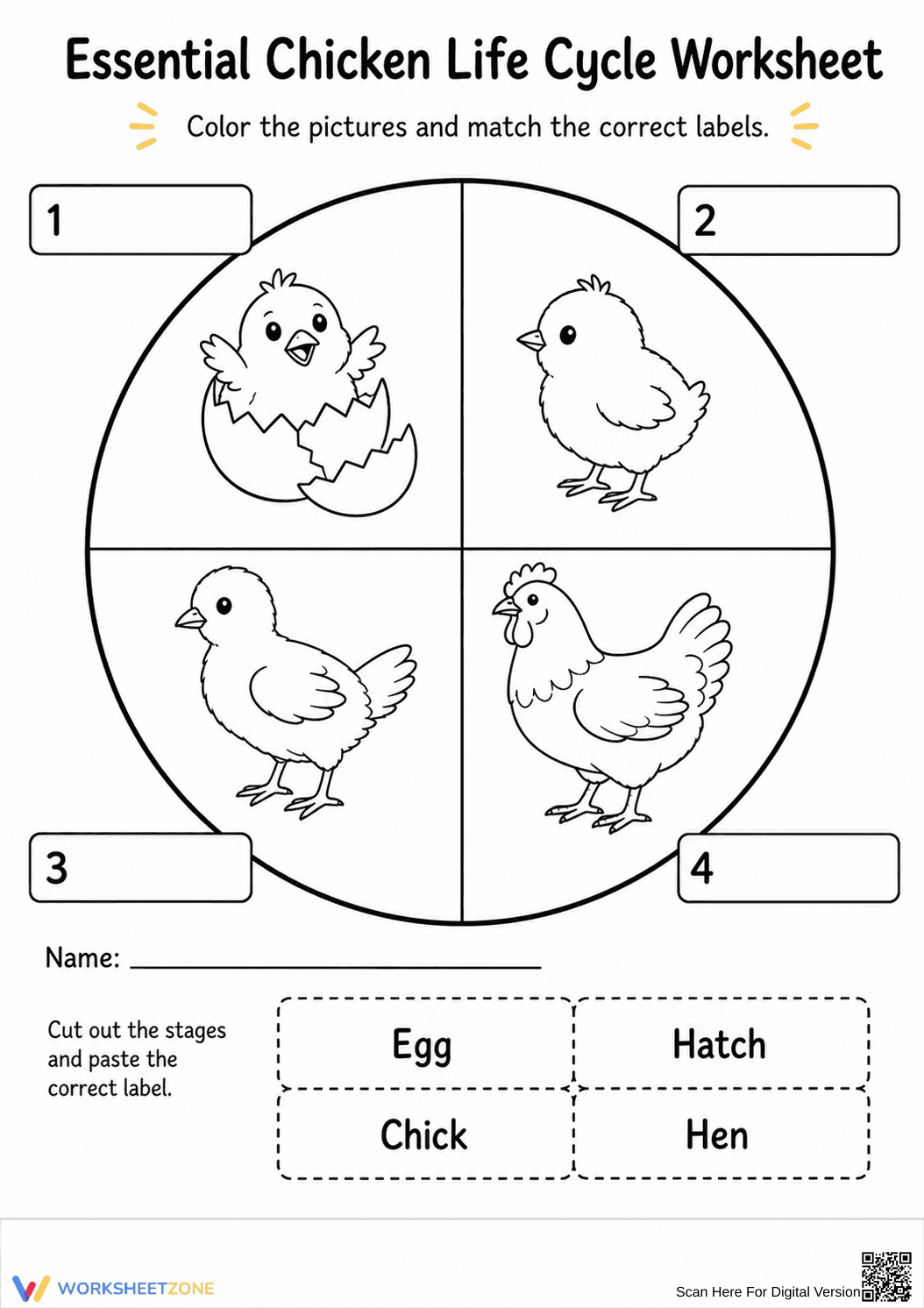
This Grade K-1 science worksheet helps young learners visualize and sequence the four primary stages of a chicken's life cycle. By engaging with both coloring and a cut-and-paste activity, students build a foundational understanding of biological growth and developmental patterns. This resource ensures students can identify and order the transition from egg to adult hen effectively.
At a Glance
- Grade: K-1 · Subject: Science
- Standard:
K-LS1-1— Observing and describing developmental patterns of how living things grow and survive- Skill Focus: Identifying, coloring, and sequencing chicken life cycle stages
- Format: 1 printable page · 4 problems · Answer key included · PDF
- Best For: Science centers or early finisher tasks
- Time: 15–20 minutes
What's Inside
This single-page PDF features a circular diagram divided into four distinct quadrants, each containing a high-quality illustration of a chicken life cycle stage: the egg, the hatching chick, the young chick, and the mature hen. Below the diagram, students will find a dotted-line cut-out section with four labels (Egg, Hatch, Chick, Hen) designed for tactile interaction. The layout includes clear numbering and a dedicated space for student names, making it a complete, self-contained instructional tool.
Zero-Prep Workflow
The workflow for this resource is designed for maximum efficiency in busy classrooms. Teachers can move from discovery to student engagement in under two minutes: simply print the required number of copies, distribute them along with scissors and glue, and then facilitate a quick peer-review session once the pasting is complete. Because the instructions are visual and straightforward, this worksheet serves as an ideal sub-plan component or a quiet-time activity that requires zero teacher intervention.
Standards Alignment
This activity aligns with K-LS1-1, which requires students to use observations to describe patterns of what plants and animals need to survive and grow. By sequencing the life cycle, students observe the pattern of development inherent in avian species. This standard code can be copied directly into lesson plans, IEP goals, or district curriculum mapping tools.
How to Use It
Use this worksheet as a summative check during a unit on living things or as a formative assessment during direct instruction about farm animals. A great observation tip is to watch if students can verbally explain why the "Hatch" stage must come after "Egg" but before "Chick," which reveals their deeper grasp of chronological biological events. Expect completion within 20 minutes for most Grade 1 students.
Who It's For
This resource is tailored for Kindergarten and First Grade students, including English Language Learners who benefit from the strong visual-to-text connection. It pairs naturally with a read-aloud about farm life or an anchor chart showing different animal life cycles.
Research from Fisher & Frey (2014) emphasizes that tactile-kinesthetic activities, such as the cut-and-paste sequencing found in this chicken life cycle worksheet, significantly improve retention of chronological concepts in early childhood education. By mapping the K-LS1-1 standard to a physical sorting task, this resource bridges the gap between abstract biological stages and concrete student observation. ScienceDirect TpT Analysis indicates that 1-page sequencing tools are among the most effective for formative assessment in K-2 science, as they provide immediate visual feedback on a student's ability to recognize developmental patterns. Clear illustrations ensure students of varying literacy levels can access scientific content, making this an equitable tool for diverse classroom settings. This worksheet focuses on the essential skill of identifying life cycle stages—egg, hatch, chick, and hen—to meet NGSS requirements for observing patterns in living things.


