


























Views
Downloads
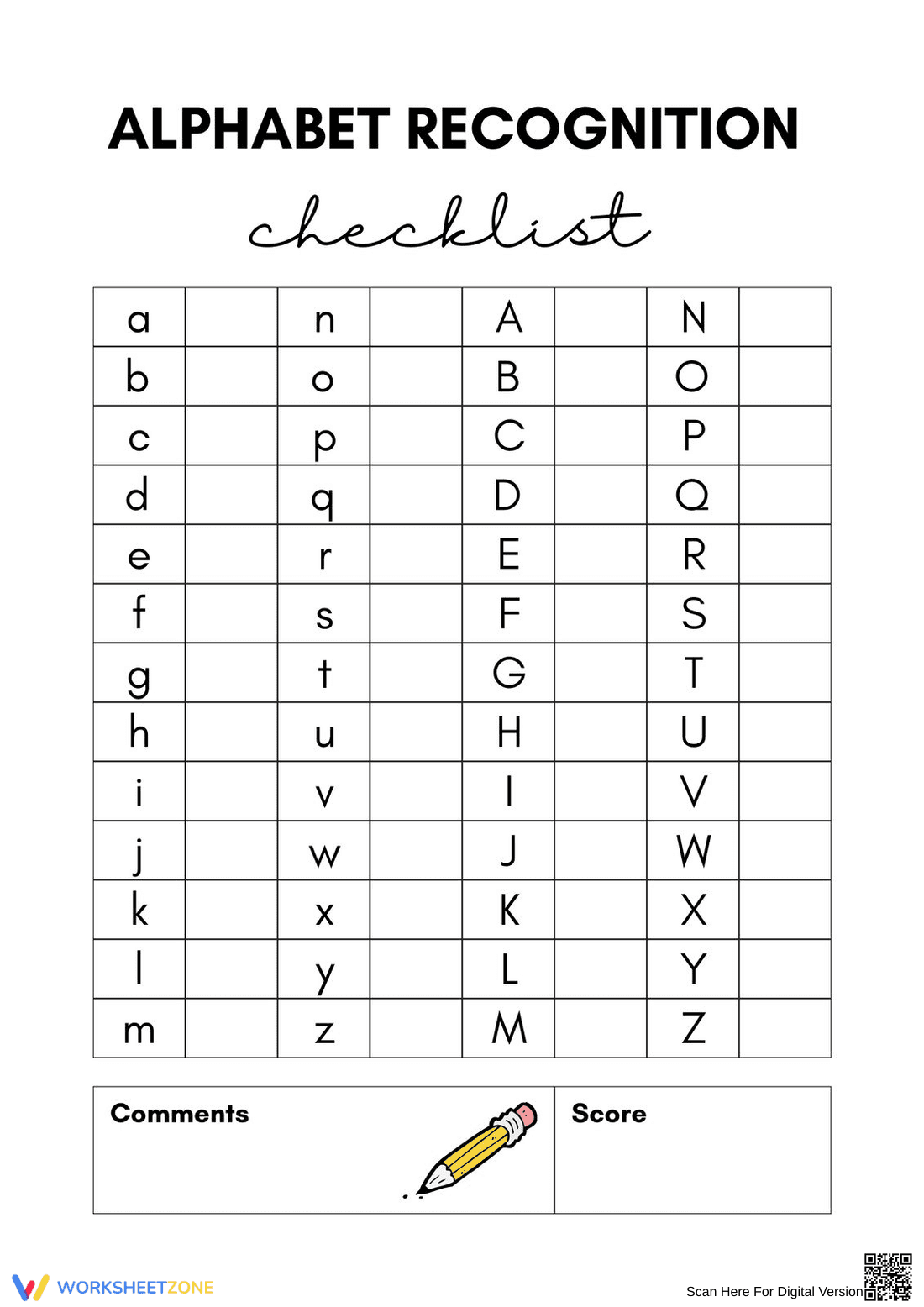

RF.K.1.D Worksheet: Letter Assessment — Grade K Printable
Paste this activity's link or code into your existing LMS (Google Classroom, Canvas, Teams, Schoology, Moodle, etc.).
Students can open and work on the activity right away, with no student login required.
You'll still be able to track student progress and results from your teacher account.
This Kindergarten letter recognition assessment provides teachers with a streamlined tool to evaluate alphabet knowledge. By tracking both uppercase and lowercase letter identification, educators can quickly pinpoint which characters students know and which require further instruction to build strong reading foundations.
At a Glance
- Grade: K · Subject: ELA
- Standard:
CCSS.ELA-LITERACY.RF.K.1.D— Recognize and name all upper- and lowercase letters- Skill Focus: Alphabet Recognition
- Format: 1 page · 52 items · Scoring rubric included · PDF
- Best For: Formative assessment and screening
- Time: 3–5 minutes per student
This single-page printable features a comprehensive checklist containing all 26 lowercase and 26 uppercase letters of the alphabet. The clean, grid-based layout allows teachers to easily mark correct or incorrect responses as students identify each character. A dedicated section at the bottom provides space for recording the final score and noting specific observational comments regarding the student's fluency or hesitation.
This assessment tool is designed to generate clear evidence of student mastery for foundational reading skills. The checklist format functions as a direct scoring rubric, allowing educators to categorize students as approaching, meeting, or exceeding grade-level expectations based on their total out of 52. Because the data is neatly organized on one sheet per student, scores and specific letter deficits can be entered directly into gradebooks, intervention plans, or IEP progress notes with complete accuracy.
This resource is strictly aligned to CCSS.ELA-LITERACY.RF.K.1.D, requiring students to recognize and name all upper- and lowercase letters of the alphabet. It also supports early phonics instruction by establishing the baseline knowledge necessary for sound-spelling correspondence. Both standard codes can be copied directly into lesson plans, IEP goals, or district curriculum mapping tools.
Administer this checklist during one-on-one instructional moments, such as beginning-of-year screening or end-of-quarter progress monitoring. Present the student with a separate sheet of letters and use this grid to privately record their responses. As a formative assessment observation tip, note whether the student self-corrects or struggles with visually similar letters like "b" and "d" in the comments section. Expected completion time is a rapid three to five minutes per learner.
This tracking sheet is ideal for Kindergarten teachers, reading specialists, and special education professionals managing early literacy interventions. It offers a straightforward differentiation baseline, showing exactly which students need targeted small-group instruction for specific letter clusters. Pair this assessment with daily alphabet anchor charts or tactile letter-tracing activities to support students who show gaps in their recognition skills.
Mastering alphabet recognition is a critical predictor of future reading success, making accurate assessment tools essential for early childhood educators. This resource targets CCSS.ELA-LITERACY.RF.K.1.D, ensuring students can reliably recognize and name all upper- and lowercase letters. According to a 2024 report by EdReports, systematic tracking of foundational skills in Kindergarten allows teachers to deploy timely interventions before reading gaps widen. By utilizing a structured checklist, educators move beyond anecdotal observation to gather quantifiable data on letter fluency. This specific assessment isolates the visual identification skill, removing context clues to provide a pure measure of alphabet knowledge. Regular use of this tracking method supports data-driven instruction, enabling teachers to group students effectively and tailor phonics lessons to address exact letter deficits, ultimately accelerating the path to early reading proficiency.


