


























Views
Downloads

Number 8 Tracing Worksheet | Essential Kindergarten Math
Paste this activity's link or code into your existing LMS (Google Classroom, Canvas, Teams, Schoology, Moodle, etc.).
Students can open and work on the activity right away, with no student login required.
You'll still be able to track student progress and results from your teacher account.
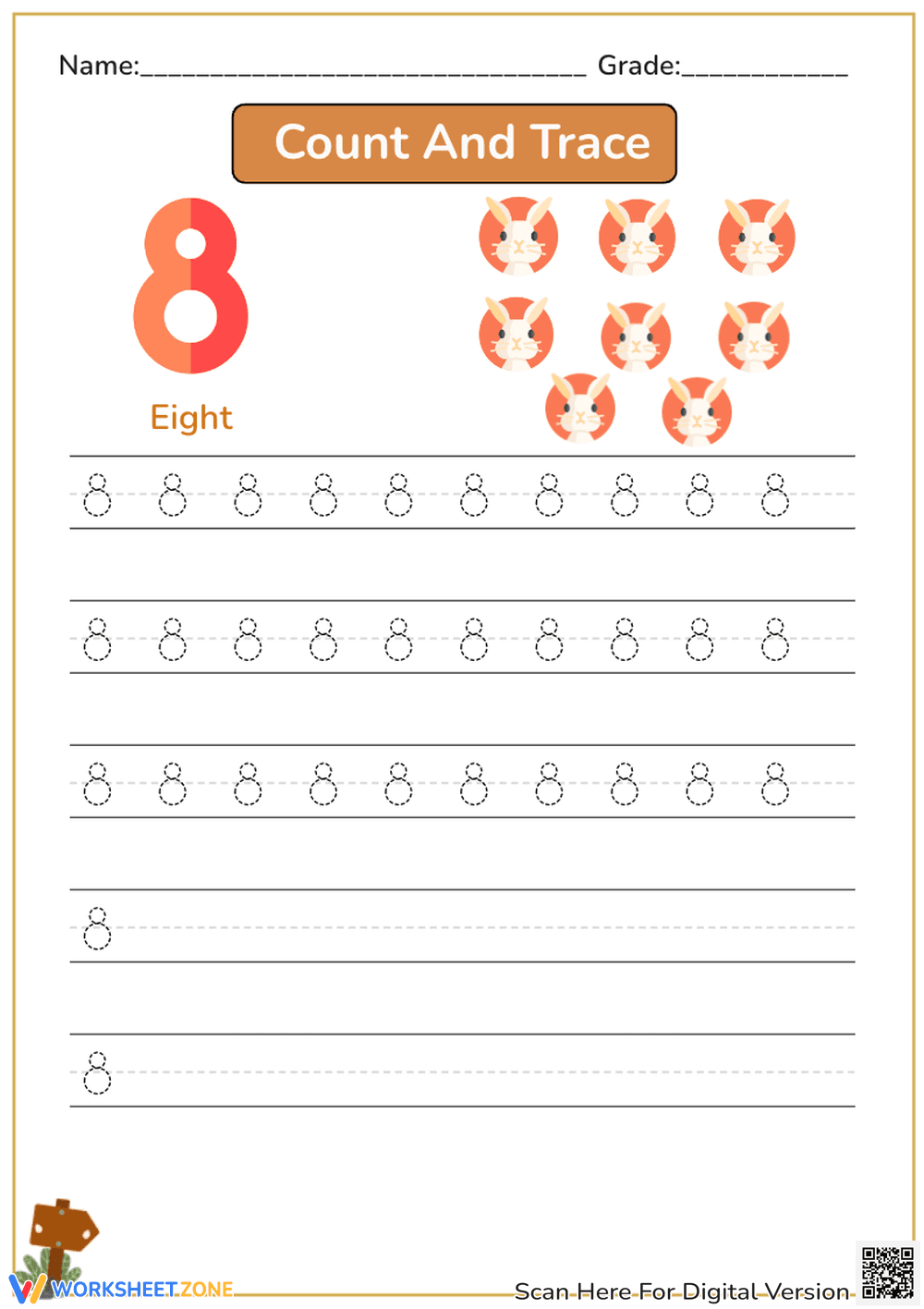
This Kindergarten number 8 worksheet provides a structured approach to numeral formation and one-to-one correspondence. Students practice the complex curve of the number 8 through repetitive tracing and visual counting of rabbit illustrations. It ensures early learners build the muscle memory required for legible handwriting and mathematical fluency during their first years of school.
At a Glance
- Grade: Kindergarten · Subject: Handwriting
- Standard:
CCSS.MATH.CONTENT.K.CC.A.3— Write numbers from 0 to 20 and represent a number of objects- Skill Focus: Number 8 formation
- Format: 1 page · 32 problems · Answer key included · PDF
- Best For: Early math centers and morning work
- Time: 10–15 minutes
What's Inside
The worksheet features a large visual anchor of the number 8 alongside eight friendly rabbit icons to reinforce counting skills. Below the header, five horizontal lines provide 32 specific tracing points. The first three rows offer full support with dashed outlines, while the final rows transition toward independent placement. This single-page PDF is designed for high-contrast printing to ensure clarity for young eyes.
Zero-Prep Workflow
- Print: Select the single-page PDF and print enough copies for your cohort in under 30 seconds.
- Distribute: Hand out the sheets during your math block or as a quiet morning activity requiring only a pencil.
- Review: Quickly scan for proper stroke direction and grip, providing immediate verbal feedback to students.
Total teacher prep time is under two minutes, making this an ideal resource for emergency sub plans or transition periods.
Standards Alignment
Primary alignment is `CCSS.MATH.CONTENT.K.CC.A.3`, which requires students to write numbers from 0 to 20. It also supports K.CC.B.4 by connecting counting to cardinality through the rabbit graphics. Both standard codes can be copied directly into lesson plans, IEP goals, or district curriculum mapping tools to document student progress toward mastery.
How to Use It
Use this during the independent practice phase of a gradual release lesson on number writing. It serves as an excellent formative assessment tool; observe if students start the 8 at the top or bottom to correct stroke order. Completion typically takes 10 to 15 minutes depending on fine motor development. It can also be laminated for use in a dry-erase math center.
Who It's For
This resource is ideal for Preschool and Kindergarten students, especially those struggling with the "cross-over" motion of the number 8. It provides the high-repetition practice needed for students with fine motor delays. Pair this with a tactile sand tray or a number 8 anchor chart to provide a multi-sensory learning experience for diverse learners in the classroom.
According to the RAND AIRS 2024 report on early childhood numeracy, repetitive tracing of numerals is a foundational step in developing the cognitive link between symbolic representation and quantity. This worksheet utilizes the trace-to-write method, which Fisher & Frey (2014) identify as a key component of the gradual release of responsibility. By providing 32 distinct tracing opportunities, the resource ensures that students move from heavy scaffolding to independent production within a single session. Research from EdReports 2024 suggests that integrating visual counting aids, such as the rabbit illustrations used here, significantly improves cardinality retention in learners aged 4 to 6. This specific design addresses the fine motor challenges inherent in the number 8, which is often cited by NAEP as one of the most difficult digits for Kindergarteners to master. The structured layout facilitates rapid feedback, allowing educators to correct grip and stroke direction before poor habits become ingrained.


