




























Views
Downloads

Law of Sines and Cosines Essential Word Problems

Paste this activity's link or code into your existing LMS (Google Classroom, Canvas, Teams, Schoology, Moodle, etc.).
Students can open and work on the activity right away, with no student login required.
You'll still be able to track student progress and results from your teacher account.
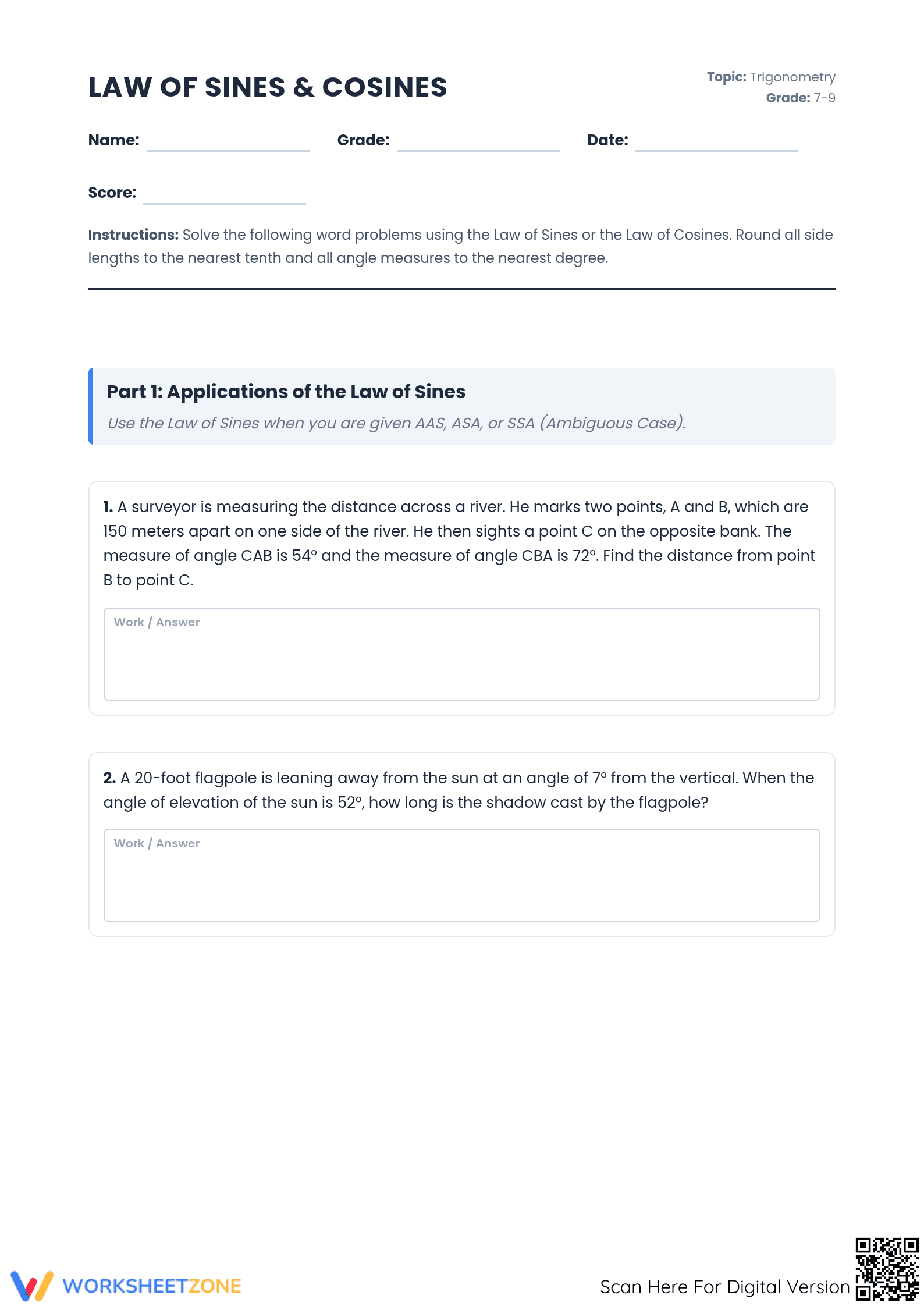
This comprehensive Law of Sines and Cosines worksheet provides students with 12 rigorous word problems designed to bridge the gap between abstract trigonometric formulas and real-world applications. By solving complex scenarios involving navigation, surveying, and construction, learners develop the critical thinking skills necessary to determine which mathematical law applies to non-right triangles.
At a Glance
- Grade: 9 · Subject: Math
- Standard:
CCSS.MATH.CONTENT.HSG.SRT.D.11— Understand and apply the Law of Sines and the Law of Cosines to find unknown measurements- Skill Focus: Trigonometric Word Problems
- Format: 4 pages · 12 problems · Answer key included · PDF
- Best For: High school geometry or trigonometry practice
- Time: 45–60 minutes
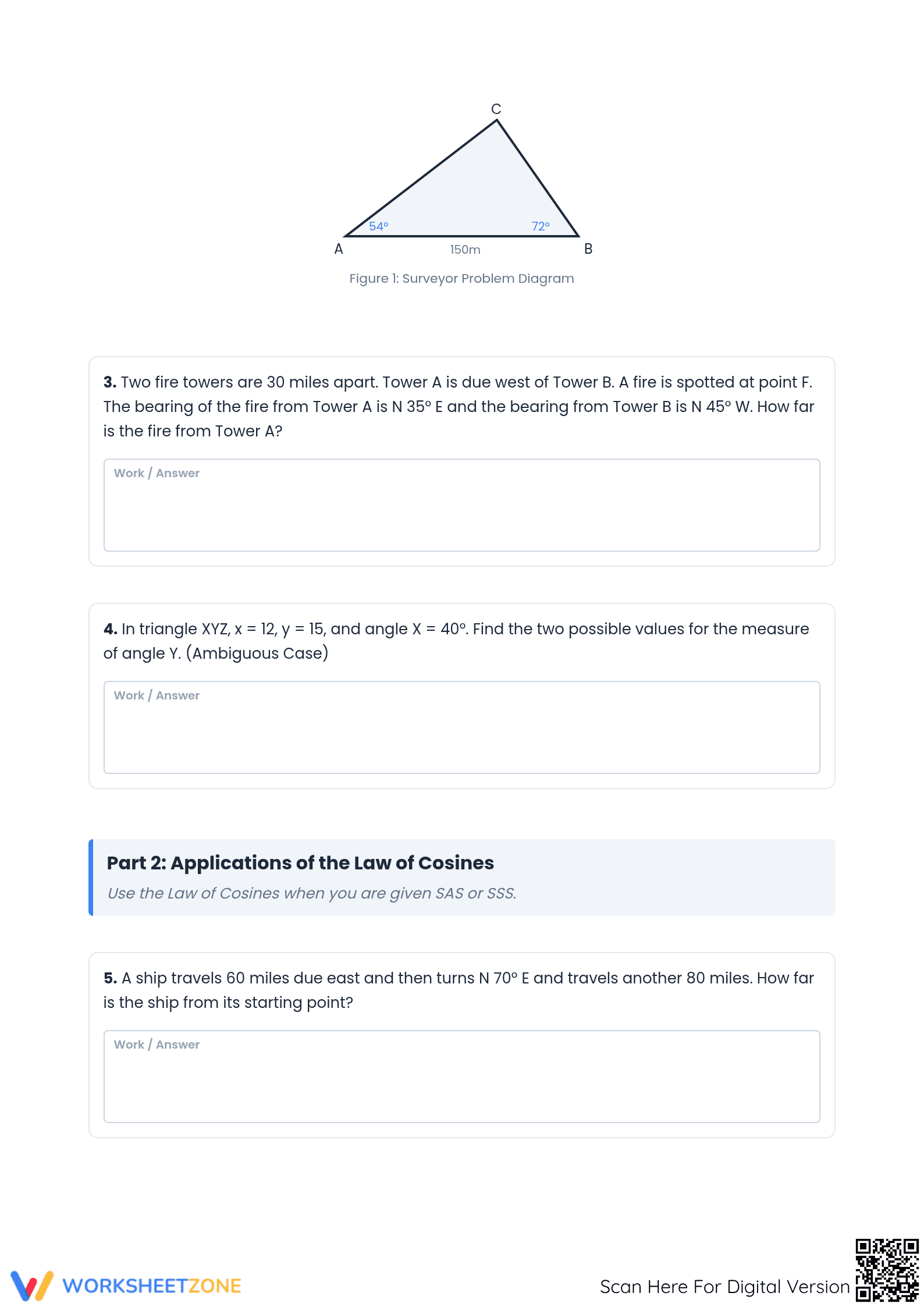
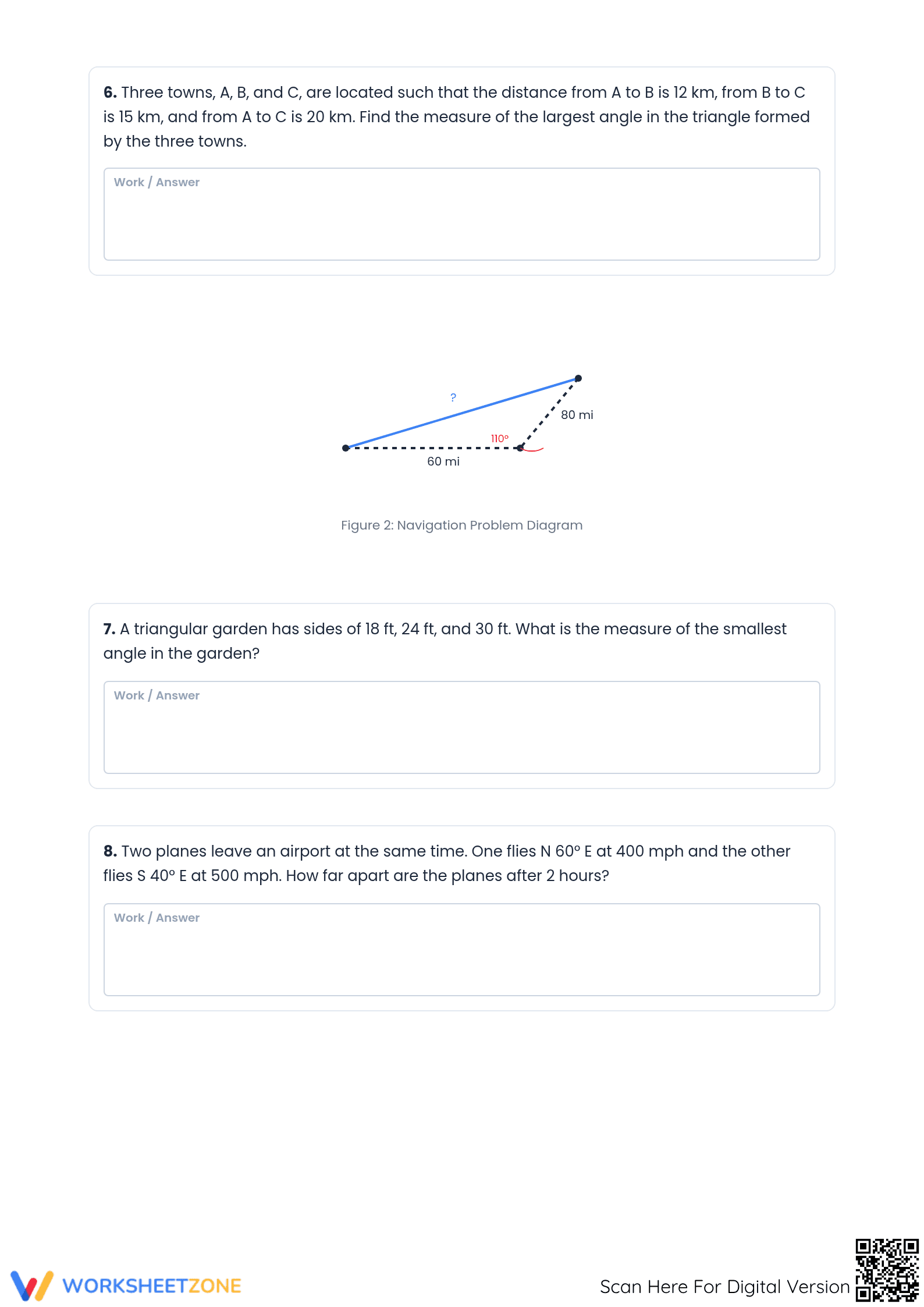
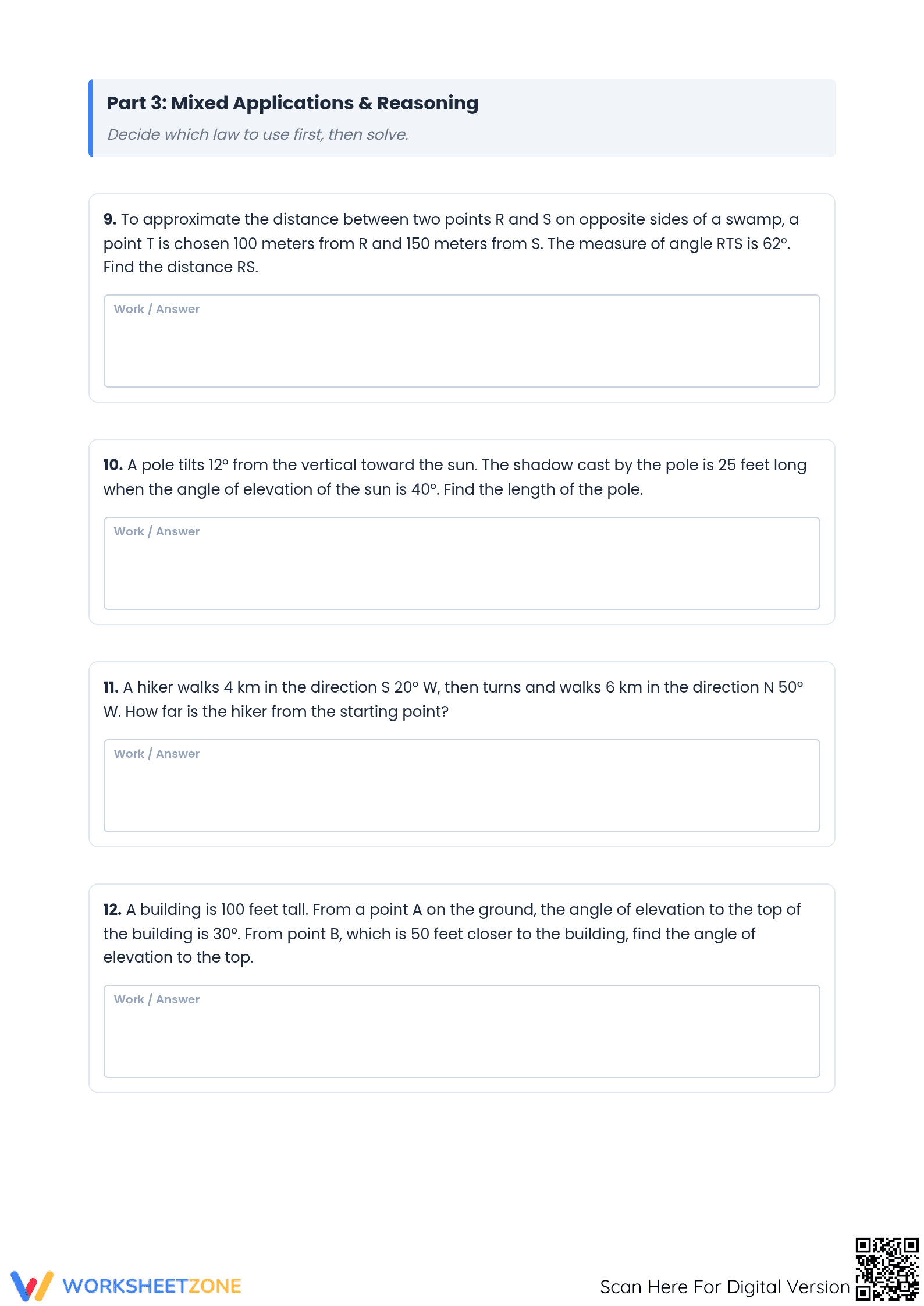
The packet contains four distinct pages of practice, totaling 12 multi-step word problems. The first section focuses on the Law of Sines, including the ambiguous case (SSA). The second section transitions to the Law of Cosines, while the final section challenges students with mixed applications where they must independently choose the correct strategy. A complete four-page answer key provides step-by-step solutions for every problem.
Skill Progression
- Guided Practice: The first two problems provide visual diagrams and explicit instructions to use the Law of Sines, helping students identify AAS and ASA patterns.
- Supported Practice: Problems 3 through 8 introduce more complex navigation and surveying contexts, requiring students to draw their own diagrams based on bearings and distances.
- Independent Practice: The final four problems are "mixed," forcing students to analyze the given information (SSS, SAS, etc.) to decide which law is appropriate without teacher prompting.
This sequence follows a gradual-release model, moving from scaffolded identification to autonomous problem-solving.
Standards Alignment
This resource is aligned to CCSS.MATH.CONTENT.HSG.SRT.D.11: "Understand and apply the Law of Sines and the Law of Cosines to find unknown measurements in right and non-right triangles." It specifically addresses the application of these laws in modeling contexts. Both standard codes can be copied directly into lesson plans, IEP goals, or district curriculum mapping tools.
How to Use It
Use this worksheet as a summative assessment after teaching both laws, or as a collaborative group activity where students must justify their choice of formula. For formative assessment, observe students during the "Mixed Applications" section to see if they can correctly identify when to use the Law of Cosines versus the Law of Sines. Completion typically takes 50 minutes.
Who It's For
This is designed for Grade 9-11 geometry or pre-calculus students. It is particularly effective for learners who struggle with word problem translation. Pair this with a trigonometric ratio anchor chart or a scientific calculator tutorial for maximum student success.
According to the RAND AIRS 2024 report on secondary mathematics, the ability to translate verbal descriptions into geometric models is a primary indicator of college readiness. This worksheet addresses that need by providing 12 high-depth word problems that require students to apply the Law of Sines and Law of Cosines (CCSS.MATH.CONTENT.HSG.SRT.D.11) to non-right triangles. Research by Fisher & Frey (2014) emphasizes that "mixed practice" sections, like the one included here, are essential for long-term retention because they prevent students from simply mimicking a single formula. By requiring learners to choose between AAS, ASA, SAS, and SSS configurations, this resource builds genuine procedural fluency. The inclusion of a step-by-step answer key ensures that students receive immediate feedback, a practice shown to reduce mathematical anxiety in high-stakes STEM environments. This resource serves as a robust tool for mastering complex trigonometric applications.


