




























Views
Downloads
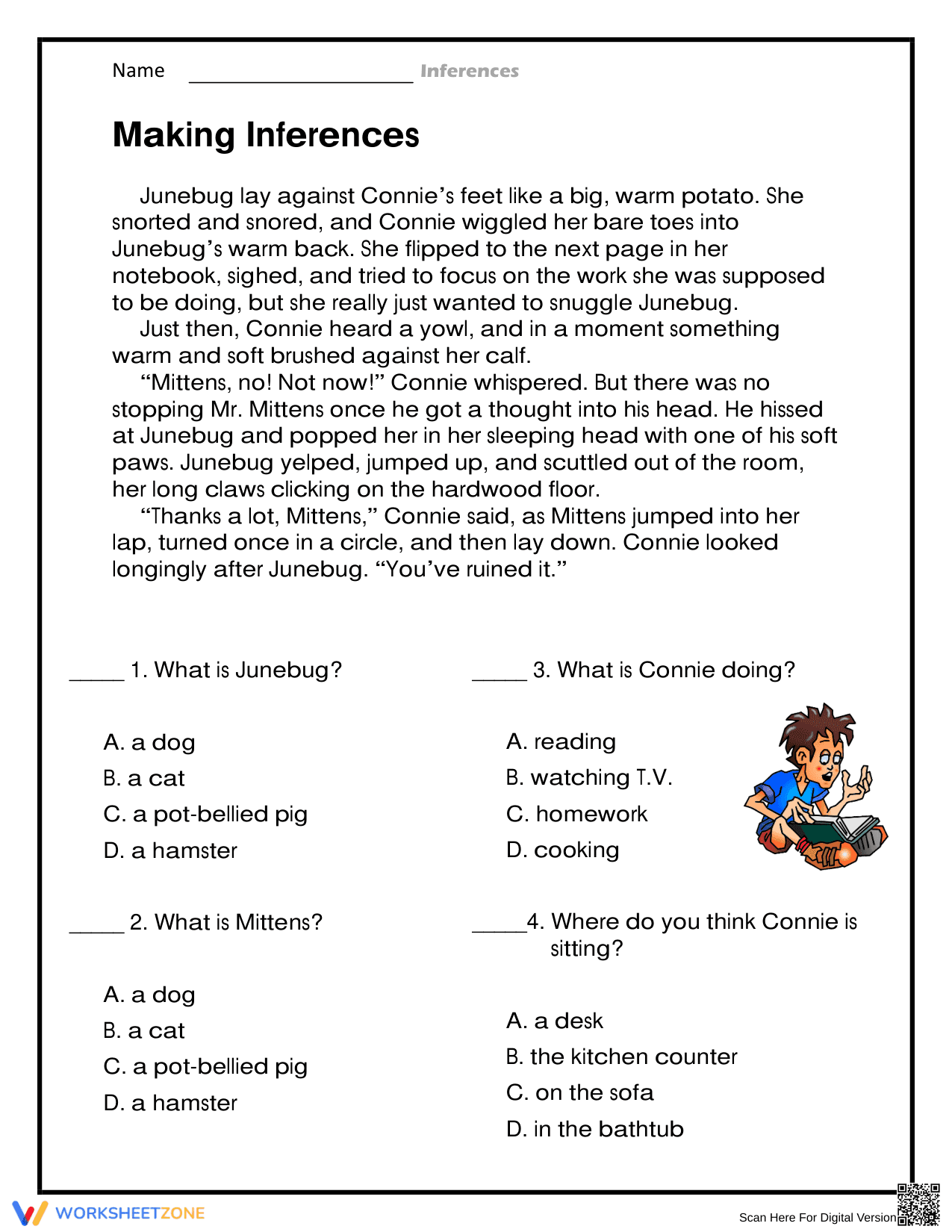

Grade 4 Making Inferences — Printable No-Prep Worksheet

Paste this activity's link or code into your existing LMS (Google Classroom, Canvas, Teams, Schoology, Moodle, etc.).
Students can open and work on the activity right away, with no student login required.
You'll still be able to track student progress and results from your teacher account.
This Grade 4 making inferences worksheet helps students master critical reading skills through a focused short story titled "Junebug and Connie." By analyzing character actions and sensory details, students learn to draw logical conclusions that aren't explicitly stated. This resource ensures immediate student engagement and measurable skill growth.
At a Glance
- Grade: 4 · Subject: ELA
- Standard:
CCSS.ELA-LITERACY.RL.4.1— Refer to details in a text when drawing inferences from the text- Skill Focus: Making Inferences
- Format: 1 page · 4 problems · Answer key included · PDF
- Best For: Independent reading practice or quick assessment
- Time: 10–15 minutes
What's Inside: This single-page PDF features a high-interest narrative about a girl and her pets. Following the passage, four multiple-choice questions challenge students to infer character identities, current activities, and physical settings based on textual clues. The layout is clean and distraction-free, including a helpful illustration to support visual learners. A complete answer key is provided to ensure rapid and accurate grading.
Zero-Prep Workflow
- Print: Generate the single-sheet PDF in under 30 seconds for immediate use.
- Distribute: Hand out to students for a 10-minute independent reading and analysis activity.
- Review: Check the four multiple-choice answers as a whole class or through peer-grading in less than 2 minutes.
This streamlined process makes it an ideal choice for emergency sub plans, morning work, or bell-ringers.
Standards Alignment
This worksheet aligns with CCSS.ELA-LITERACY.RL.4.1, requiring students to refer to details in a text when drawing inferences. It also supports RL.3.1 and RL.5.1 by focusing on evidence-based conclusion reaching. Both standard codes can be copied directly into lesson plans, IEP goals, or district curriculum mapping tools to ensure compliance with state and national frameworks.
How to Use It
Use this worksheet as a formative assessment after a direct instruction lesson on "show, don't tell." Observe how students handle question 4, which requires synthesizing multiple clues to determine the setting; this provides an excellent observation tip for identifying student needs. It also works perfectly as a quiet transition activity or a quick check for understanding.
Who It's For
This resource is tailored for upper elementary students in grades 3 through 5 developing literary analysis skills. It is particularly effective for students who benefit from short, manageable passages with high-context vocabulary. Pair this worksheet with a "Making Inferences" anchor chart or a short video lesson on character motivation for a complete and effective instructional cycle.
Mastery of inferential reasoning is a primary predictor of long-term reading comprehension success. According to Fisher & Frey (2014), the "gradual release of responsibility" model is most effective when students are provided with high-quality, focused practice tasks that bridge the gap between teacher modeling and independent application. This worksheet provides that bridge by using a relatable narrative to anchor the abstract skill of inferring. By targeting CCSS.ELA-LITERACY.RL.4.1, this resource addresses the core requirement of using textual evidence to support logical extensions of a story. Research indicates that frequent, short-burst practice with evidence-based questions significantly improves performance on standardized ELA assessments. This 4-task set allows for rapid feedback loops, ensuring that misconceptions about character perspective or environmental clues are corrected immediately, fostering a more resilient and analytical reading habit in young learners during their formative elementary years.


