


























Views
Downloads
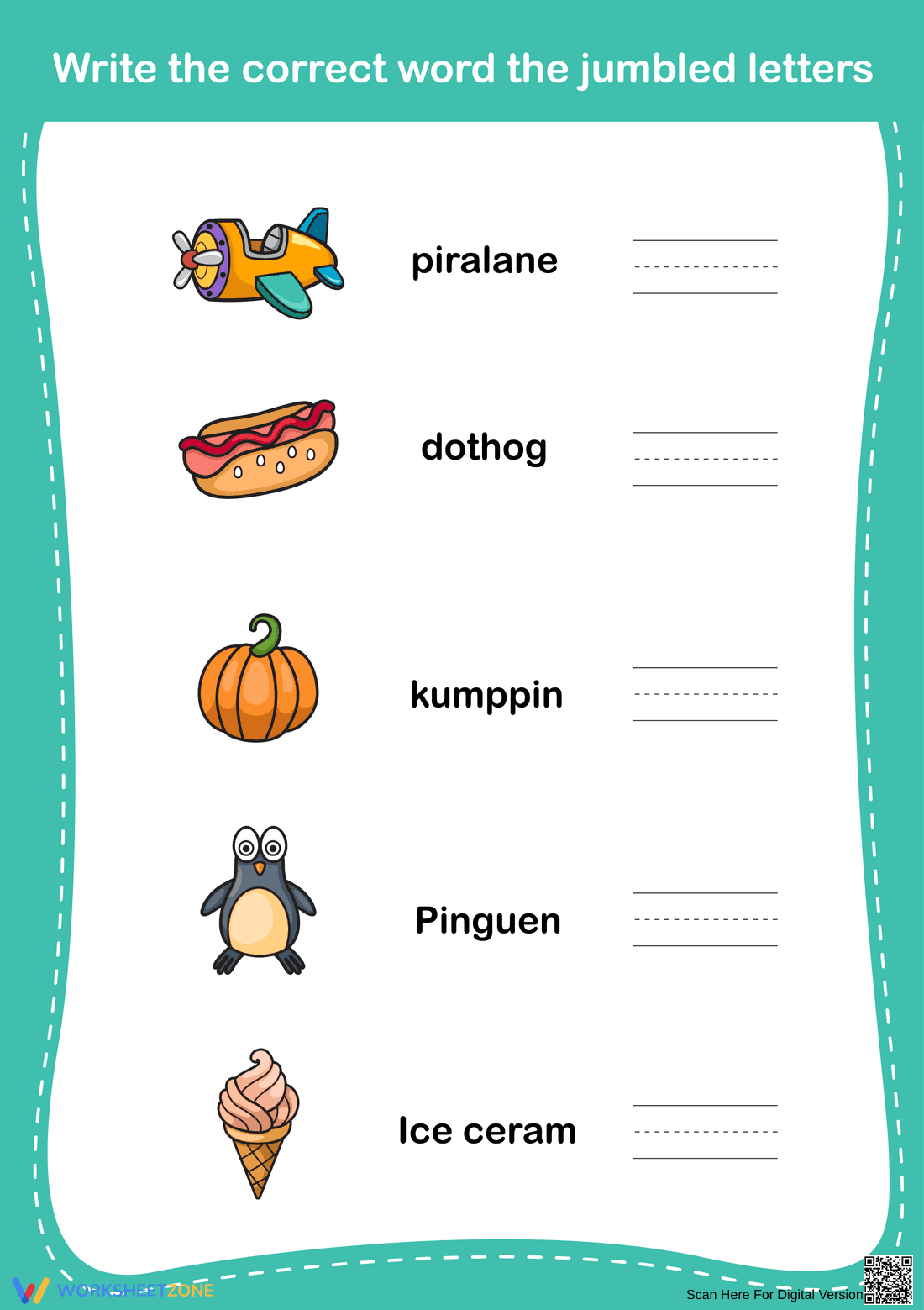

Jumbled Words Worksheet | Essential Preschool ELA
Paste this activity's link or code into your existing LMS (Google Classroom, Canvas, Teams, Schoology, Moodle, etc.).
Students can open and work on the activity right away, with no student login required.
You'll still be able to track student progress and results from your teacher account.
This Preschool jumbled words worksheet helps early learners develop foundational spelling and letter-sequencing skills. By unscrambling letters to match vibrant illustrations, students strengthen their phonemic awareness and visual processing. This activity provides a structured way for young children to practice word construction while building confidence in their emerging literacy abilities.
At a Glance
- Grade: Preschool · Subject: ELA
- Standard:
CCSS.ELA-LITERACY.L.K.2— Spell simple words phonetically by drawing on knowledge of sound-letter relationships- Skill Focus: Spelling and letter sequencing
- Format: 1 page · 5 problems · Answer key included · PDF
- Best For: Literacy centers and morning work
- Time: 10–15 minutes
What's Inside
The worksheet features 5 distinct word-scramble tasks, each paired with a high-quality color illustration to provide context clues. The layout includes clear primary writing lines to support proper letter formation. A single-page PDF format ensures easy distribution, and the clear visual cues allow students to work with minimal teacher intervention.
Zero-Prep Workflow
- Print: Generate the single-page PDF in approximately 30 seconds.
- Distribute: Hand out to students during literacy centers or as a quiet morning activity.
- Review: Spend 5 minutes reviewing the five correct spellings as a group to reinforce phonetic patterns.
Total teacher preparation time is under 2 minutes, making it an ideal resource for busy classrooms or unexpected sub plans.
Standards Alignment
This resource aligns with `CCSS.ELA-LITERACY.L.K.2`, which focuses on demonstrating command of the conventions of standard English spelling when writing. Specifically, it supports the phonetic spelling of simple words through visual scaffolding. Both standard codes can be copied directly into lesson plans, IEP goals, or district curriculum mapping tools.
How to Use It
Use this worksheet during small-group instruction to observe how students approach letter sequencing. It serves as an excellent formative assessment for identifying which students struggle with specific consonant-vowel patterns. Expected completion time ranges from 10 to 15 minutes depending on the student's familiarity with the vocabulary words like "airplane" or "penguin."
Who It's For
This activity is designed for Preschool and Pre-K students who are beginning to recognize that letter order determines word meaning. It is particularly effective for English Language Learners who benefit from the direct image-to-word association. Pair this worksheet with a picture dictionary or an anchor chart featuring common objects to provide additional support.
According to research by Fisher & Frey (2014) on the gradual release of responsibility, providing visual scaffolds like the illustrations in this `CCSS.ELA-LITERACY.L.K.2` worksheet is critical for early literacy development. The task of unscrambling jumbled letters requires students to engage in orthographic processing, a key predictor of future reading fluency. By limiting the set to 5 targeted vocabulary words, the worksheet prevents cognitive overload while still challenging the student to apply phonetic knowledge. This specific skill focus on word construction helps bridge the gap between letter recognition and independent writing. Educational analysis from RAND AIRS 2024 suggests that high-quality, printable resources that combine visual cues with motor-skill practice significantly improve retention in early childhood settings. This worksheet provides a structured, evidence-based approach to foundational ELA skills that is both accessible for students and efficient for educators.


