




























Views
Downloads

Ions and Charge Worksheet | Grade 9 Printable Science

Paste this activity's link or code into your existing LMS (Google Classroom, Canvas, Teams, Schoology, Moodle, etc.).
Students can open and work on the activity right away, with no student login required.
You'll still be able to track student progress and results from your teacher account.
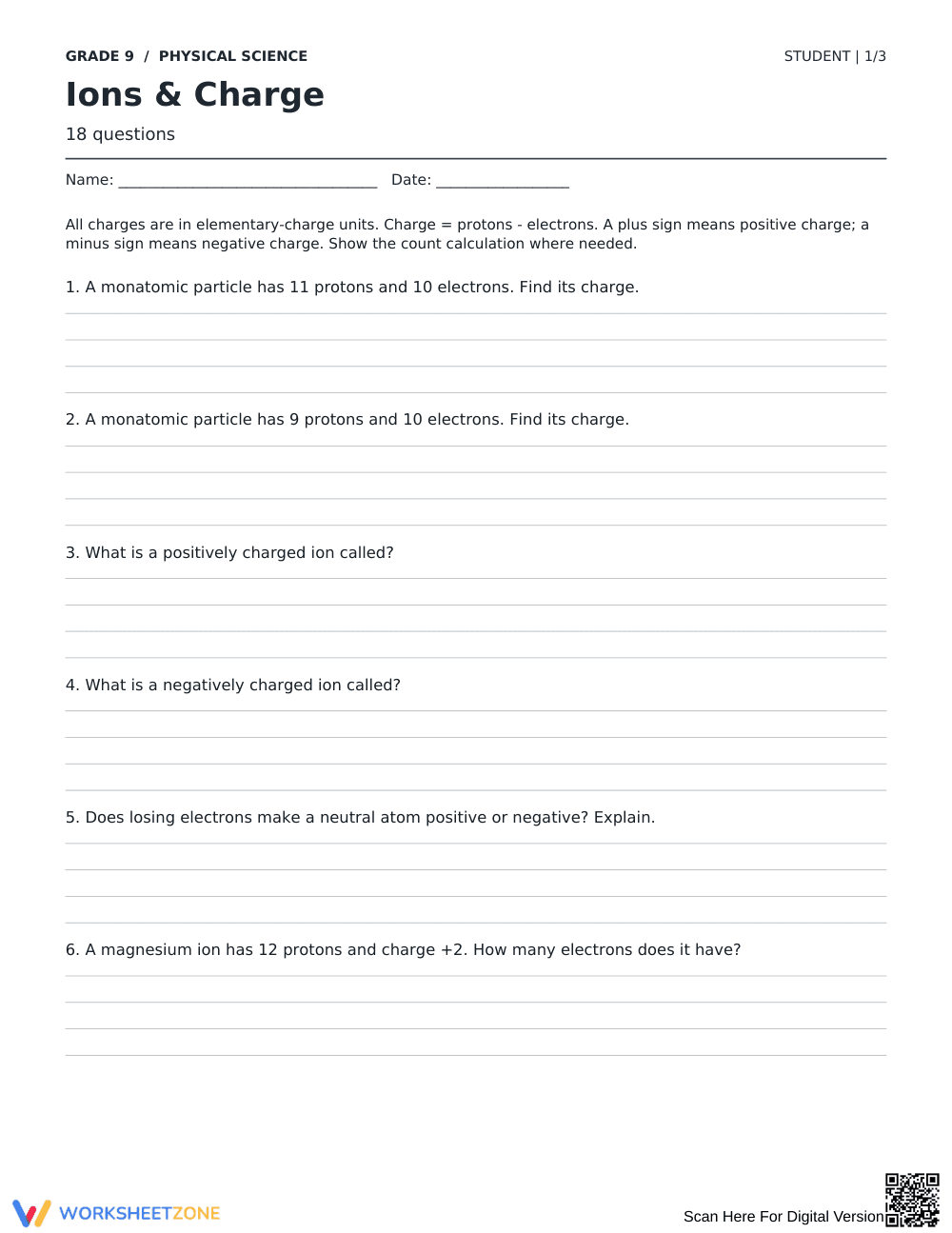
Mastering ionic charges requires students to connect subatomic particle counts directly to net electrical charge. This physical science worksheet provides 18 targeted practice problems that guide high school learners to calculate net charge, identify cations and anions, and determine electron totals for monatomic ions, establishing core chemistry skills.
At a Glance
- Grade: Grade 9 · Subject: Science
- Standard:
HS-PS1-1— Use subatomic particle counts to determine net electrical charge and ion formation- Skill Focus: Calculating net ionic charge and electron counts
- Format: 3 pages · 18 problems · Answer key included · PDF
- Best For: Independent practice and homework reinforcement
- Time: 25–40 minutes
What's Inside
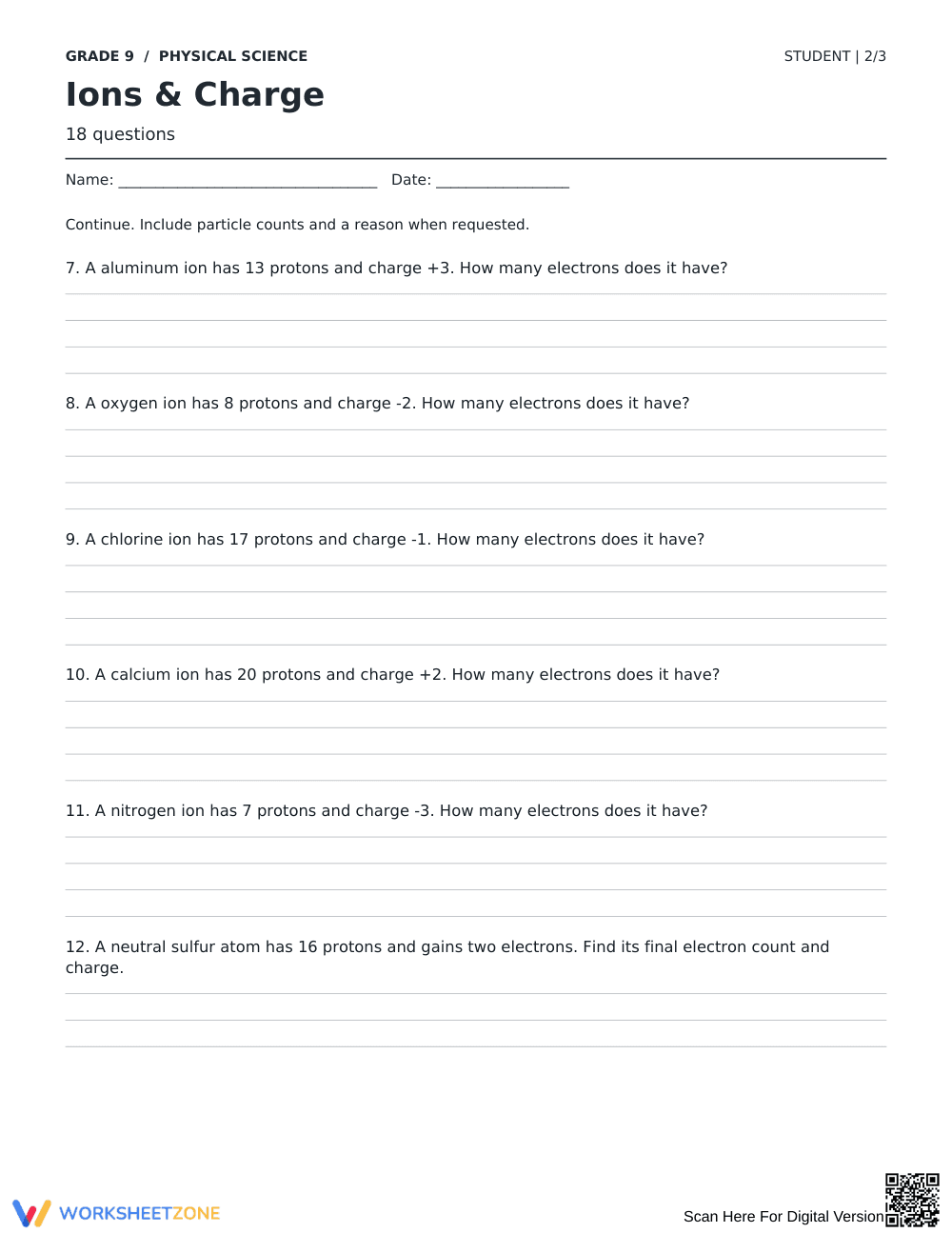
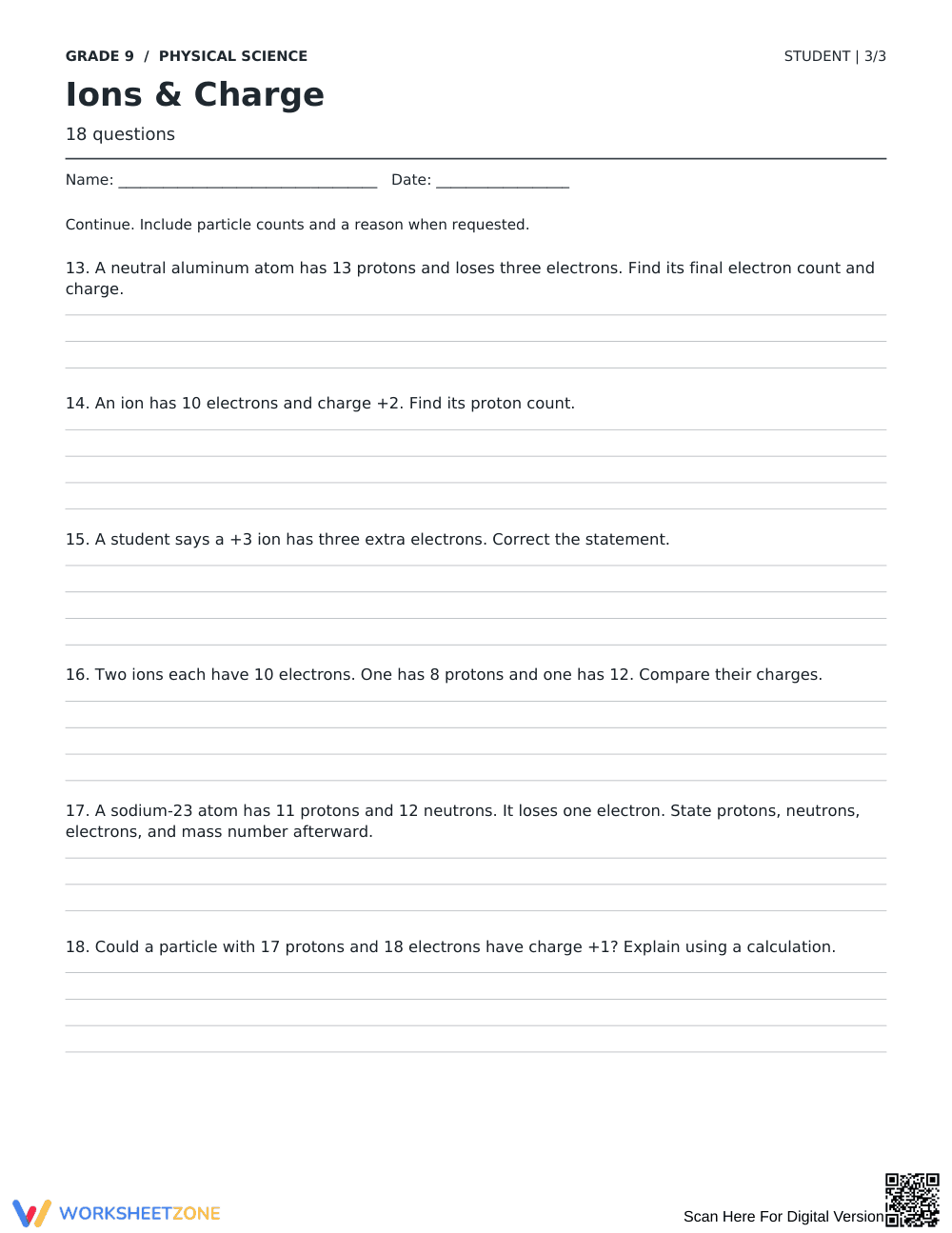
This 3-page printable resource delivers 18 structured problems arranged across clear thematic sections. Students apply the elementary charge formula, differentiate between cations and anions, calculate missing electron quantities for elements like magnesium and aluminum, and analyze conceptual scenarios. A complete 2-page answer key provides worked calculations and point guidance for rapid grading.
Skill Progression
- Guided practice (Problems 1–6): Introduces the core formula where charge equals protons minus electrons, reinforcing essential vocabulary including cation and anion through basic count calculations.
- Supported practice (Problems 7–12): Prompts students to solve for unknown electron totals in common ions, noting sign changes when atoms lose or gain valence electrons.
- Independent practice (Problems 13–18): Engages learners in error analysis, comparison of isoelectronic particles, and isotope calculations combining mass numbers with net charge.
This sequence follows a gradual-release instructional model, transitioning students from fundamental calculations to nuanced atomic reasoning.
Standards Alignment
This worksheet aligns directly with `HS-PS1-1`: “Use the periodic table as a model to predict the relative properties of elements based on the patterns of electrons in the outermost energy level of atoms.” As foundational prerequisite practice, this task targets Disciplinary Core Idea PS1.A by examining how net electrical charge results from subatomic imbalances. Both standard codes can be copied directly into lesson plans, IEP goals, or district curriculum mapping tools.
How to Use It
Assign this worksheet during the independent practice phase immediately following direct instruction on atomic structure, or use it as an individual homework assignment after introducing ions. During guided practice, check whether students erroneously add electrons for positive charges when calculating ion counts. Student completion typically requires 25 to 40 minutes.
Who It's For
This worksheet serves Grade 9 physical science and introductory high school chemistry students mastering atomic structure. It supports general education classes and provides targeted reinforcement for learners requiring computational scaffolds. Pair this resource with an annotated periodic table or atomic tile manipulatives for enhanced tactile support.
According to research highlighted by Fisher & Frey (2014), structured gradual-release frameworks substantially improve conceptual retention and problem-solving automaticity in secondary physical science education. Mastering ionic charge calculations under NGSS standard HS-PS1-1 requires high school students to coordinate proton tallies with electron transfers, converting abstract atomic models into verifiable mathematical expressions. When students advance methodically from single-step arithmetic to complex conceptual evaluations—such as articulating why shedding negatively charged particles yields a positive cation—they confront and correct persistent misconceptions before tackling complex polyatomic compounds or advanced stoichiometric chemical ratios. By engaging with 18 progressive questions that integrate arithmetic calculations, vocabulary synthesis, and misconception analysis, learners build durable, measurable fluency in subatomic structure. This systematic practice directly reinforces Disciplinary Core Idea PS1.A while providing teachers with reliable diagnostic evidence to support summative assessment benchmarks across physical science units.


