


























Views
Downloads

Character Strengths Sentence Scramble | Essential ELA
Paste this activity's link or code into your existing LMS (Google Classroom, Canvas, Teams, Schoology, Moodle, etc.).
Students can open and work on the activity right away, with no student login required.
You'll still be able to track student progress and results from your teacher account.
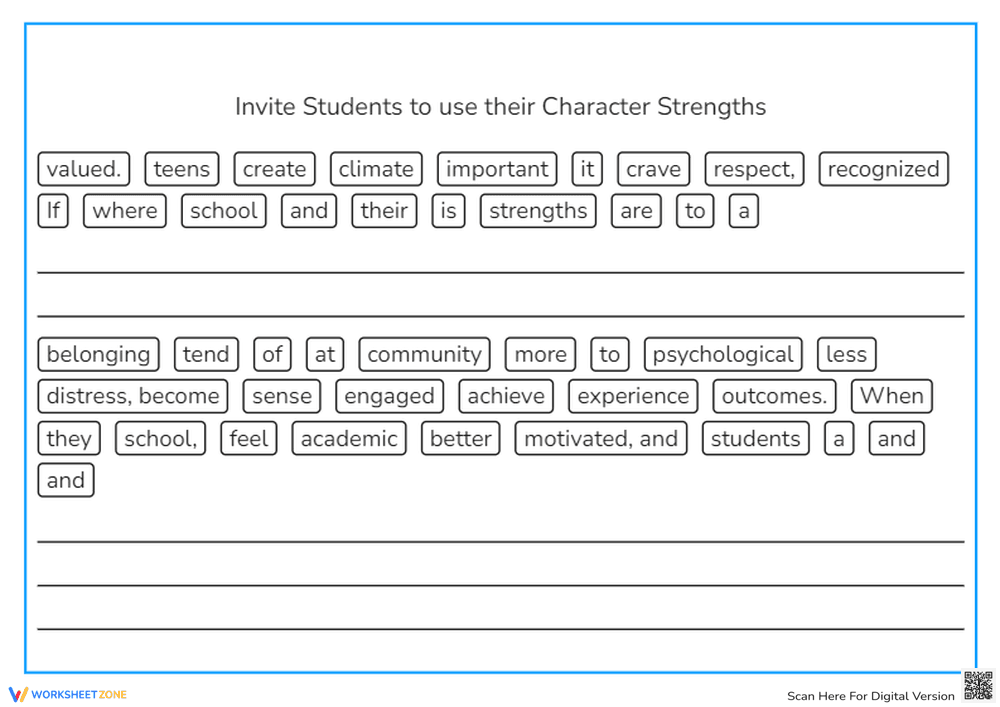
This advanced sentence scramble worksheet challenges students to reconstruct complex academic statements regarding character strengths and psychological well-being. By manipulating word order to form coherent sentences, students refine their understanding of sophisticated syntax while reflecting on social-emotional concepts. This resource provides a rigorous exercise in grammatical conventions and thematic synthesis.
At a Glance
- Grade: College · Subject: English Language Arts
- Standard:
CCSS.ELA-LITERACY.L.11-12.1— Demonstrate command of the conventions of standard English grammar and usage when writing.- Skill Focus: Syntax and Character Education
- Format: 1 page · 2 problems · Answer key included · PDF
- Best For: Advanced syntax practice and SEL integration
- Time: 15–20 minutes
The worksheet features two distinct, high-density word blocks that require careful analysis to unscramble. Each task is designed to produce a multi-clause sentence that discusses the impact of character strengths on student motivation and academic outcomes. The layout includes ample lined space for students to draft and finalize their responses, ensuring a clean and professional presentation of their work.
Zero-Prep Workflow
- Print: Select the single-page PDF and print enough copies for your cohort in under 30 seconds.
- Distribute: Hand out the materials at the start of a seminar or as a transition activity; setup takes less than 1 minute.
- Review: Use the provided answer key to facilitate a 10-minute group discussion on syntax choices and the psychological themes presented.
This resource is aligned with CCSS.ELA-LITERACY.L.11-12.1, focusing on the ability to produce clear and coherent writing in which the development, organization, and style are appropriate to task, purpose, and audience. Both standard codes can be copied directly into lesson plans, IEP goals, or district curriculum mapping tools.
To use this effectively, assign it as a warm-up during a unit on educational psychology or advanced composition. Instructors should observe how students handle the punctuation cues within the word blocks to assess their formative understanding of sentence boundaries. Expect completion within a 15 to 20-minute window depending on the students' familiarity with complex sentence structures.
This activity is ideal for college-level students, adult learners, or advanced high school seniors. It serves as an excellent pairing for introductory psychology lectures or as a supplemental resource for writing centers focusing on sentence variety. The content specifically supports students who are exploring the intersection of personal development and academic success.
The CCSS.ELA-LITERACY.L.11-12.1 standard requires students to demonstrate a sophisticated command of English grammar and usage, particularly in complex sentence construction. This worksheet facilitates that mastery by requiring students to manipulate syntax to reveal meaningful content regarding character strengths and psychological well-being. According to Fisher & Frey (2014), the use of sentence-level manipulation tasks helps bridge the gap between isolated grammar instruction and functional writing application. By unscrambling these specific prompts, students engage in cognitive processing that reinforces both linguistic structure and social-emotional concepts. This dual-purpose approach ensures that students are not merely memorizing rules but are applying them to synthesize complex ideas. Research indicates that such integrated practices lead to higher retention of grammatical conventions compared to traditional rote memorization. This resource provides a structured environment for students to practice these essential skills while reflecting on personal and academic growth within a higher education context.


