


























Views
Downloads
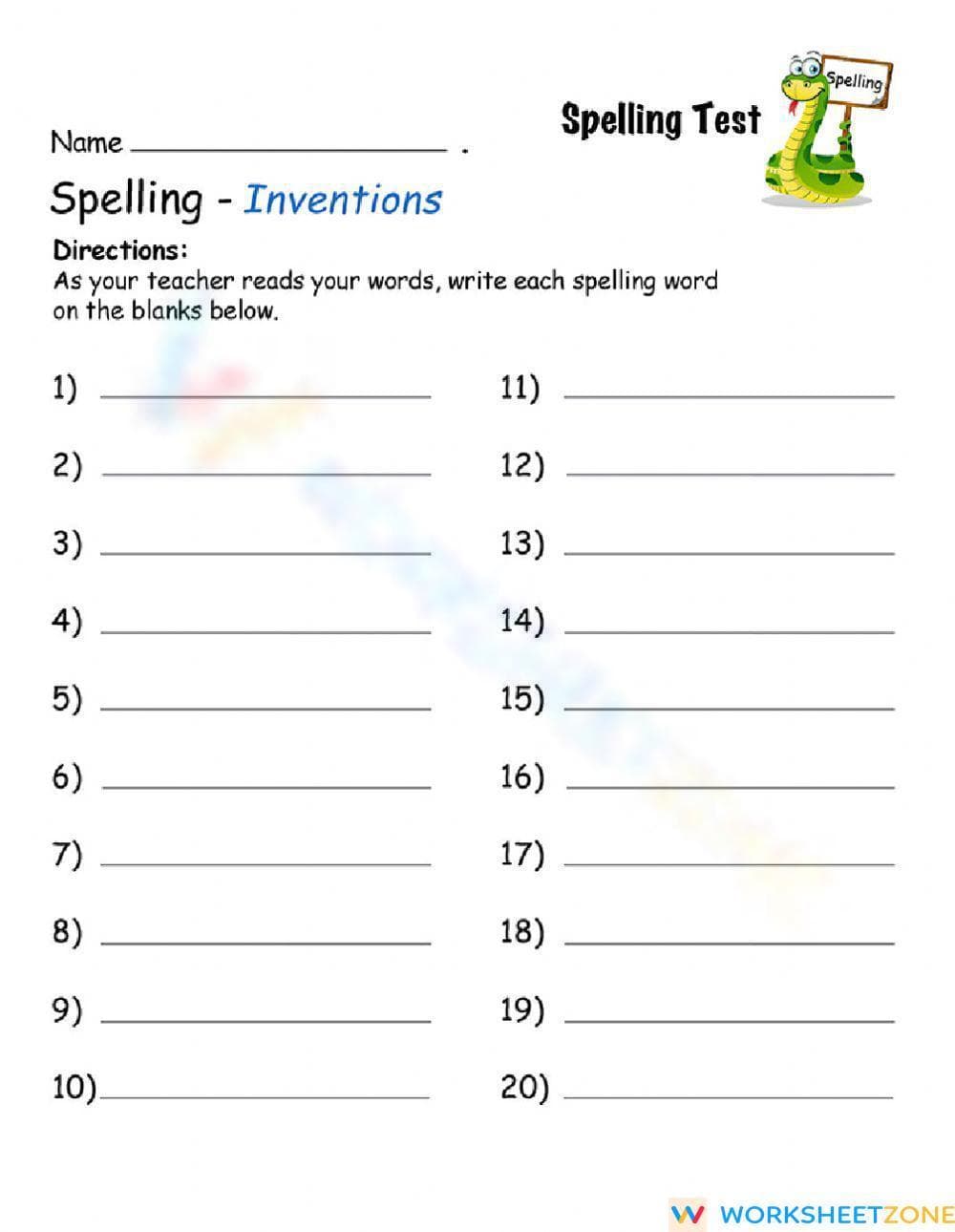

Essential Grade 5 Inventions Spelling Test Worksheet
Paste this activity's link or code into your existing LMS (Google Classroom, Canvas, Teams, Schoology, Moodle, etc.).
Students can open and work on the activity right away, with no student login required.
You'll still be able to track student progress and results from your teacher account.
This Grade 5 Inventions spelling test worksheet provides a structured assessment tool for measuring student mastery of thematic vocabulary. By using a teacher-led dictation format, students demonstrate their ability to apply conventional spelling patterns to complex words associated with historical and modern innovations. It ensures a clear record of student progress.
At a Glance
- Grade: 5 · Subject: ELA
- Standard:
CCSS.ELA-LITERACY.L.5.2.E— Spell grade-appropriate words correctly while demonstrating command of conventional spelling patterns- Skill Focus: Thematic Spelling Mastery
- Format: 1 page · 20 problems · Answer key included · PDF
- Best For: Weekly summative assessment and progress monitoring
- Time: 10–15 minutes
What's Inside
This assessment resource features a clean layout containing 20 numbered blanks arranged in two columns. The design includes a "Spelling Test" header with thematic "Inventions" labeling and clear directions. The single-page PDF is optimized for high-volume printing, and the answer key allows for rapid, consistent grading across multiple student groups.
Zero-Prep Workflow
Implementing this assessment follows a simple three-step workflow. First, print the required copies (taking less than 1 minute). Second, distribute worksheets and read the word list aloud, including context sentences (approximately 10 minutes). Finally, use the answer key to grade submissions (under 2 minutes). This streamlined process makes it an ideal candidate for emergency sub plans or routine weekly testing.
Standards Alignment
The primary alignment for this resource is CCSS.ELA-LITERACY.L.5.2.E, which requires students to "Spell grade-appropriate words correctly, consulting references as needed." By assessing spelling within a specific thematic context like Inventions, teachers can evaluate if students are successfully transferring general spelling rules to more sophisticated, content-specific vocabulary. Both standard codes can be copied directly into lesson plans, IEP goals, or district curriculum mapping tools.
How to Use It
The most effective use of this worksheet is as a summative assessment at the end of a weekly spelling unit. Before beginning, ensure students have a clear line of sight. As a formative tip, watch for students who hesitate on vowel combinations, as this indicates a need for targeted phonics intervention. Completion time ranges from 10 to 15 minutes.
Who It's For
This resource is tailored for Grade 5 but applies to Grade 3-4 students working with advanced lists. It serves general education classrooms, RTI groups, and special education settings where structure is beneficial. It pairs naturally with an "Inventions" reading passage or vocabulary anchor charts displayed during the instructional week.
According to the RAND AIRS 2024 report on elementary literacy, frequent low-stakes assessments like the Inventions spelling test are critical for reinforcing long-term lexical retention. By requiring students to produce words from auditory cues, this worksheet addresses the standard CCSS.ELA-LITERACY.L.5.2.E, which focuses on grade-level spelling accuracy. This method aligns with the "Science of Reading" framework, emphasizing that systematic spelling instruction directly supports decoding and overall reading fluency. Research indicates that when students master thematic vocabulary—such as words related to innovation and technology—they develop a deeper semantic network that enhances their comprehension of informational texts. This 20-task assessment provides the necessary repetition and structure to verify that students can move beyond mere recognition to active orthographic production. Such data-driven check-ins allow educators to identify specific phoneme-grapheme gaps and adjust their small-group instruction accordingly to ensure every learner achieves grade-level proficiency in written communication.


