


























Views
Plays


Intro to Psychological Research Worksheet | Essential Guide
Paste this activity's link or code into your existing LMS (Google Classroom, Canvas, Teams, Schoology, Moodle, etc.).
Students can open and work on the activity right away, with no student login required.
You'll still be able to track student progress and results from your teacher account.
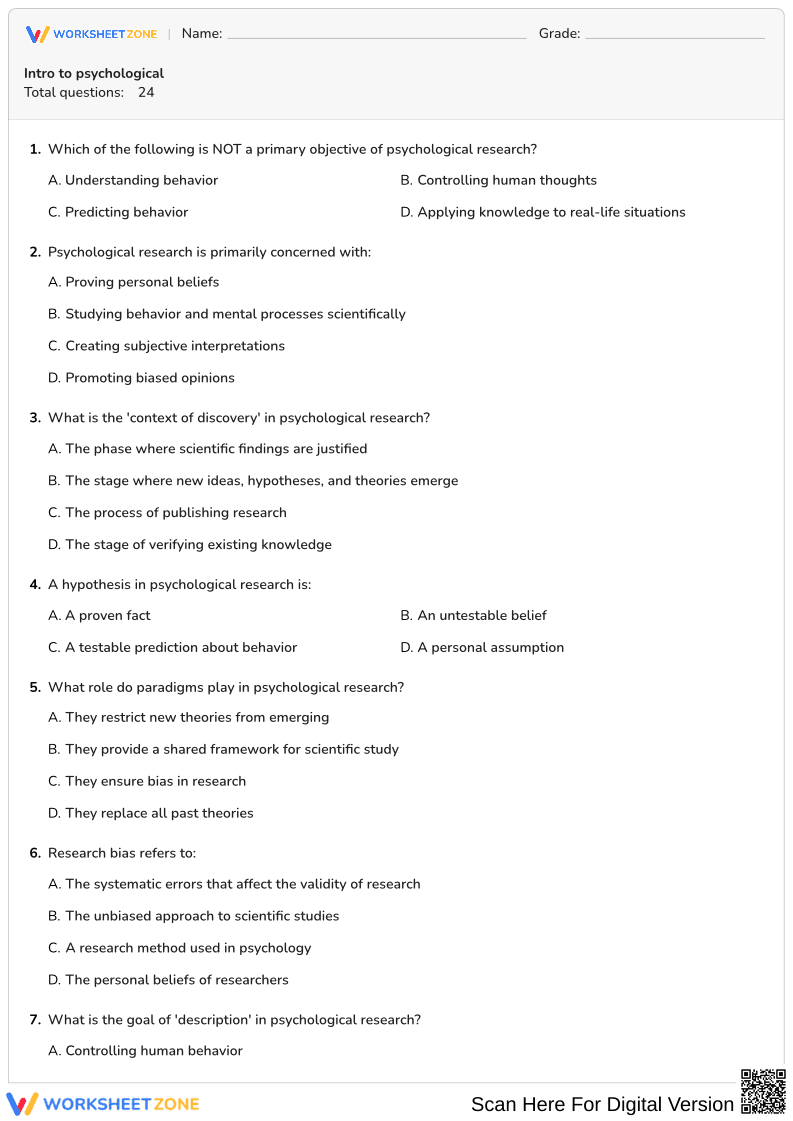
This introductory psychological research worksheet provides a comprehensive assessment of foundational scientific inquiry skills. Students will demonstrate mastery of research objectives, variable classification, and the scientific method through 24 targeted multiple-choice questions. It is designed to bridge the gap between theoretical concepts and practical application in undergraduate behavioral science courses.
At a Glance
- Grade: College · Subject: Science
- Standard:
APA.UG.1.2— Interpret, design, and conduct basic psychological research using scientific inquiry- Skill Focus: Research Methods & Variables
- Format: 3 pages · 24 problems · Answer key included · PDF
- Best For: Introductory Psychology formative assessment
- Time: 30–45 minutes
What's Inside: This 3-page PDF contains 24 high-quality multiple-choice questions. The assessment covers the primary objectives of psychological research, the "context of discovery," hypothesis formulation, and the role of paradigms. It further explores the five goals of psychology—description, explanation, prediction, application, and control—before concluding with a rigorous section on variable classification (independent vs. dependent) and measurement scales.
Zero-Prep Workflow: This resource is designed for immediate classroom implementation. First, print the 3-page document (1 minute). Second, distribute the worksheets to students for an in-class quiz or independent study session (1 minute). Third, use the included answer key to review results or facilitate peer-grading (5 minutes). Total teacher preparation time is under 2 minutes, making it an ideal sub-plan or last-minute assessment.
Standards Alignment: The primary standard addressed is APA.UG.1.2, which requires students to demonstrate scientific literacy and the ability to interpret basic psychological research. The worksheet also supports broader scientific inquiry frameworks by requiring students to identify manipulated variables and experimental controls. This standard code can be copied directly into lesson plans, IEP goals, or district curriculum mapping tools.
How to Use It: Use this worksheet as a summative quiz after completing a unit on research methodology. Alternatively, assign it as a pre-assessment to gauge student familiarity with scientific variables before beginning a lab project. During the session, observe if students struggle with the distinction between independent and dependent variables. Completion typically ranges from 30 to 45 minutes depending on student level.
Who It's For: This resource is tailored for undergraduate students in Introductory Psychology or Research Methods courses. It provides necessary scaffolding for learners new to the behavioral sciences while maintaining the rigor required for college-level credit. It pairs naturally with standard psychology textbooks or APA-style research manuals used during direct instruction.
According to the RAND AIRS 2024 analysis of undergraduate STEM education, frequent low-stakes retrieval practice significantly improves long-term retention of complex procedural knowledge, such as the scientific method. This worksheet facilitates that process by targeting the APA.UG.1.2 standard, which focuses on the student's ability to interpret and design psychological research. By breaking down the research process into 24 distinct tasks—ranging from identifying research bias to classifying variables by unit of measurement—the resource ensures that students move beyond rote memorization toward conceptual mastery. Research from Fisher & Frey (2014) suggests that structured assessments like this one provide the necessary evidence for formative feedback, allowing instructors to identify specific misconceptions in experimental design early in the semester. This alignment with evidence-based instructional strategies makes the worksheet a reliable tool for achieving measurable student outcomes in the behavioral sciences.


