




























Views
Downloads


Physics Intro & Units Printable Worksheet | High School

Paste this activity's link or code into your existing LMS (Google Classroom, Canvas, Teams, Schoology, Moodle, etc.).
Students can open and work on the activity right away, with no student login required.
You'll still be able to track student progress and results from your teacher account.
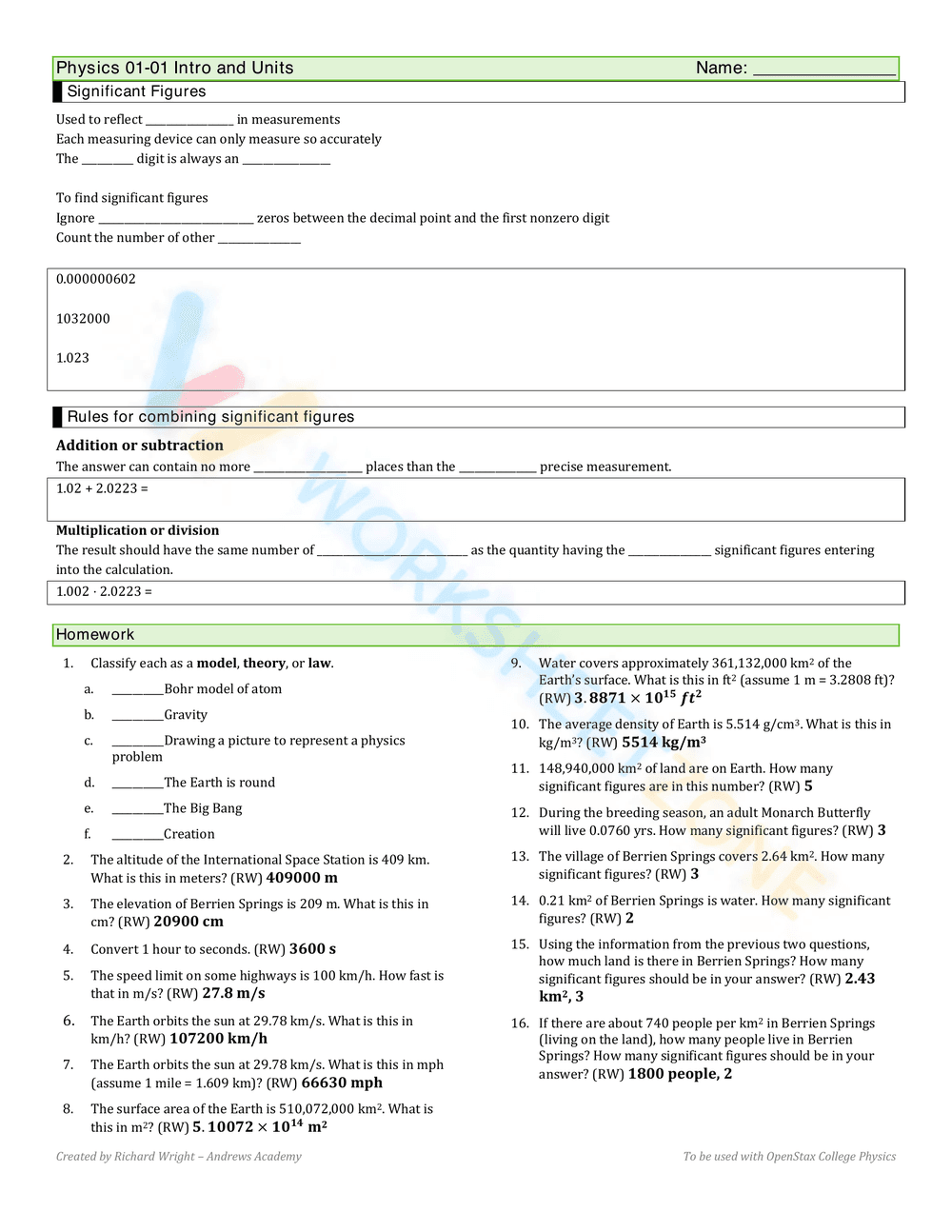
This comprehensive high school physics worksheet introduces students to foundational measurement skills. By completing guided notes and practice problems, students will master SI units, unit conversions, accuracy versus precision, and significant figures, ensuring they are fully prepared for advanced scientific calculations and laboratory data analysis.
At a Glance
- Grade: High School · Subject: Science
- Standard:
CCSS.MATH.CONTENT.HSN.Q.A.3— Choose an appropriate level of accuracy for measurements- Skill Focus: SI Units and Significant Figures
- Format: 2 pages · 16 problems · Answer key included · PDF
- Best For: Introductory physics lessons
- Time: 30–45 minutes
This two-page resource features a structured layout that combines guided fill-in-the-blank notes with direct application tasks. The first page provides clear reference tables for metric prefixes and visual targets to explain accuracy and precision. The second page outlines the rules for significant figures before transitioning into a 16-question homework section. A built-in answer key for the calculation problems allows students to verify their work immediately.
- Guided practice: Students begin by filling in essential vocabulary and definitions regarding the scientific method, SI base units, and metric prefixes.
- Supported practice: Learners apply unit conversion factors and significant figure rules to short, targeted examples with clear formulas provided.
- Independent practice: The 16-question homework section challenges students to classify scientific statements, convert complex units, and calculate area and density using the correct number of significant figures.
This gradual-release approach ensures students build confidence before tackling multi-step physics word problems independently.
Aligned to primary standard CCSS.MATH.CONTENT.HSN.Q.A.3: Choose a level of accuracy appropriate to limitations on measurement when reporting quantities. It also supports NGSS science and engineering practices related to analyzing and interpreting data. Both standard codes can be copied directly into lesson plans, IEP goals, or district curriculum mapping tools.
Deploy this worksheet during the first week of a physics or advanced chemistry course as part of direct instruction. Teachers can project the guided notes section on the board while students follow along, then assign the 16 calculation problems as independent classwork or homework. As a formative assessment tip, monitor how students round their answers in the multiplication and division problems to quickly gauge their grasp of significant figure rules. Expected completion time is 30 to 45 minutes.
This resource is designed for high school physics and chemistry students mastering foundational measurement skills. The structured notes provide excellent scaffolding for students who struggle with organization or require accommodations for note-taking. Pair this worksheet with a hands-on measurement lab where students use rulers, calipers, and scales to collect real-world data and apply their new significant figure knowledge.
Mastering measurement rules is a critical prerequisite for success in all quantitative science courses. Aligned with CCSS.MATH.CONTENT.HSN.Q.A.3, this resource helps students choose an appropriate level of accuracy for measurements. According to a ScienceDirect TpT Analysis, explicit instruction in foundational skills like unit conversions and significant figures significantly reduces cognitive load during complex problem-solving later in the semester. When students do not have to struggle with basic metric prefixes or rounding rules, they can focus their working memory on understanding advanced physics concepts like kinematics and dynamics. Providing structured, guided notes alongside immediate practice ensures these essential procedures are encoded into long-term memory, setting a strong foundation for the entire academic year.


