


























Views
Downloads


Printable Interjections Worksheet | Grade 5 ELA Grammar
Paste this activity's link or code into your existing LMS (Google Classroom, Canvas, Teams, Schoology, Moodle, etc.).
Students can open and work on the activity right away, with no student login required.
You'll still be able to track student progress and results from your teacher account.
Mastering the use of interjections is essential for expressive writing in the middle grades. This Grade 5 ELA worksheet provides targeted practice to identify and apply these emotional markers effectively. By focusing on both recognition and replacement, students develop a deep understanding of how specific word choices influence sentence tone and authorial voice.
At a Glance
- Grade: 5 · Subject: English Language Arts (ELA)
- Standard:
CCSS.ELA-LITERACY.L.5.1.A— Explain the function of interjections in general and their function in particular sentences- Skill Focus: Identifying and contextually applying interjections
- Format: 3 pages · 12 problems · Answer key included · PDF
- Best For: Small group grammar instruction or independent review
- Time: 15–20 minutes
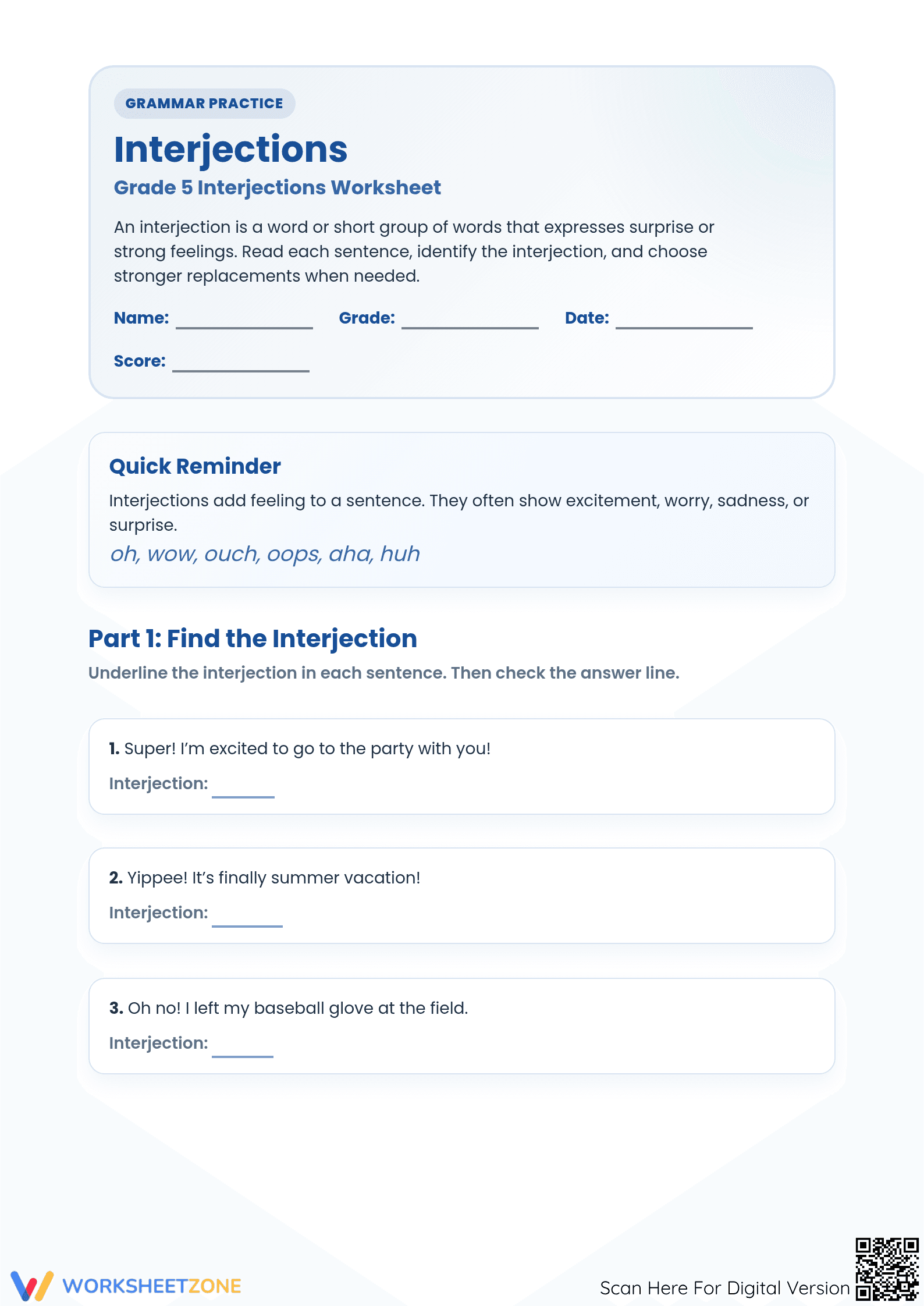
This comprehensive 3-page PDF resource includes a concise instructional header followed by two distinct practice sections. The first page features a Quick Reminder box that serves as a mini-anchor chart, providing definitions and a selection of common interjections like wow and oops to support student recall. A full answer key is included to ensure easy grading and immediate student feedback.
Skill Progression
- Guided practice: The Quick Reminder box establishes a foundation by providing clear definitions and multiple examples to establishes foundational understanding before starting the exercises.
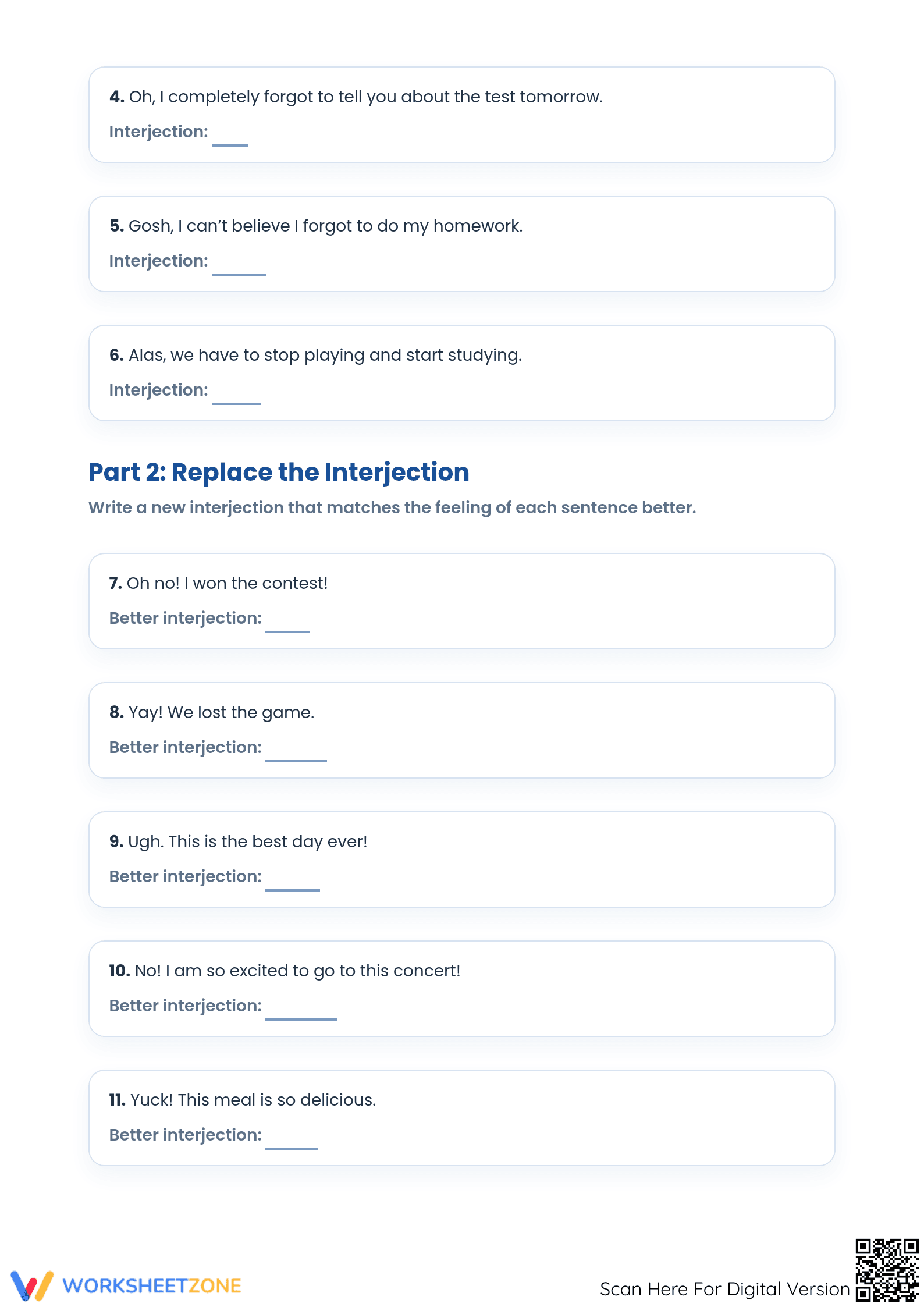
- Supported practice: Part 1 features 6 tasks where students underline and transcribe interjections from sentences to build recognition confidence in controlled contexts.
- Independent practice: Part 2 includes 6 problems requiring students to analyze sentiment and replace mismatched interjections with contextually appropriate alternatives, requiring evaluative thinking.
This structured layout supports a gradual-release model, moving students from basic identification to sophisticated grammatical application.
Standards Alignment
The primary focus of this resource is CCSS.ELA-LITERACY.L.5.1.A, which requires students to explain the function of interjections in particular sentences. This worksheet isolates this skill to ensure deep mastery of this specific part of speech. This standard code can be copied directly into lesson plans, IEP goals, or district curriculum mapping tools.
How to Use It
Use this worksheet during the independent practice phase of a direct instruction lesson. Teachers can assign Part 1 as a quick check for understanding and use Part 2 as a formative assessment to gauge student grasp of context clues. It is also well-suited for a literacy center activity or a reliable sub plan.
Who It's For
This resource is perfect for Grade 5 students or for remedial support in higher grades. The clear font and spacious layout accommodate students with diverse learning needs, including those with IEPs that require reduced visual clutter. It pairs naturally with direct instruction or anchor charts on expressive language.
Effective instruction in grammar requires students to move beyond rote identification toward functional application in varied contexts. This Grade 5 ELA resource targets CCSS.ELA-LITERACY.L.5.1.A, focusing on the specific skill of using interjections to convey nuance, surprise, and strong emotion. According to the RAND AIRS 2024 report on literacy instruction, explicit practice in identifying and substituting grammatical components within sentences significantly improves a student's ability to maintain authorial voice and emotional resonance in their own writing. By requiring learners to evaluate whether a specific interjection—such as "yay," "ouch," or "ugh"—matches the intended sentiment of a sentence, this worksheet bridges the gap between mechanical recognition and sophisticated stylistic choice. Such targeted exercises are essential for mastering the subtle shifts in tone required for middle-grade composition. Educators can utilize these 12 focused problems to provide the high-repetition practice necessary for long-term retention of language standards within any comprehensive English curriculum framework.


