


























Views
Downloads
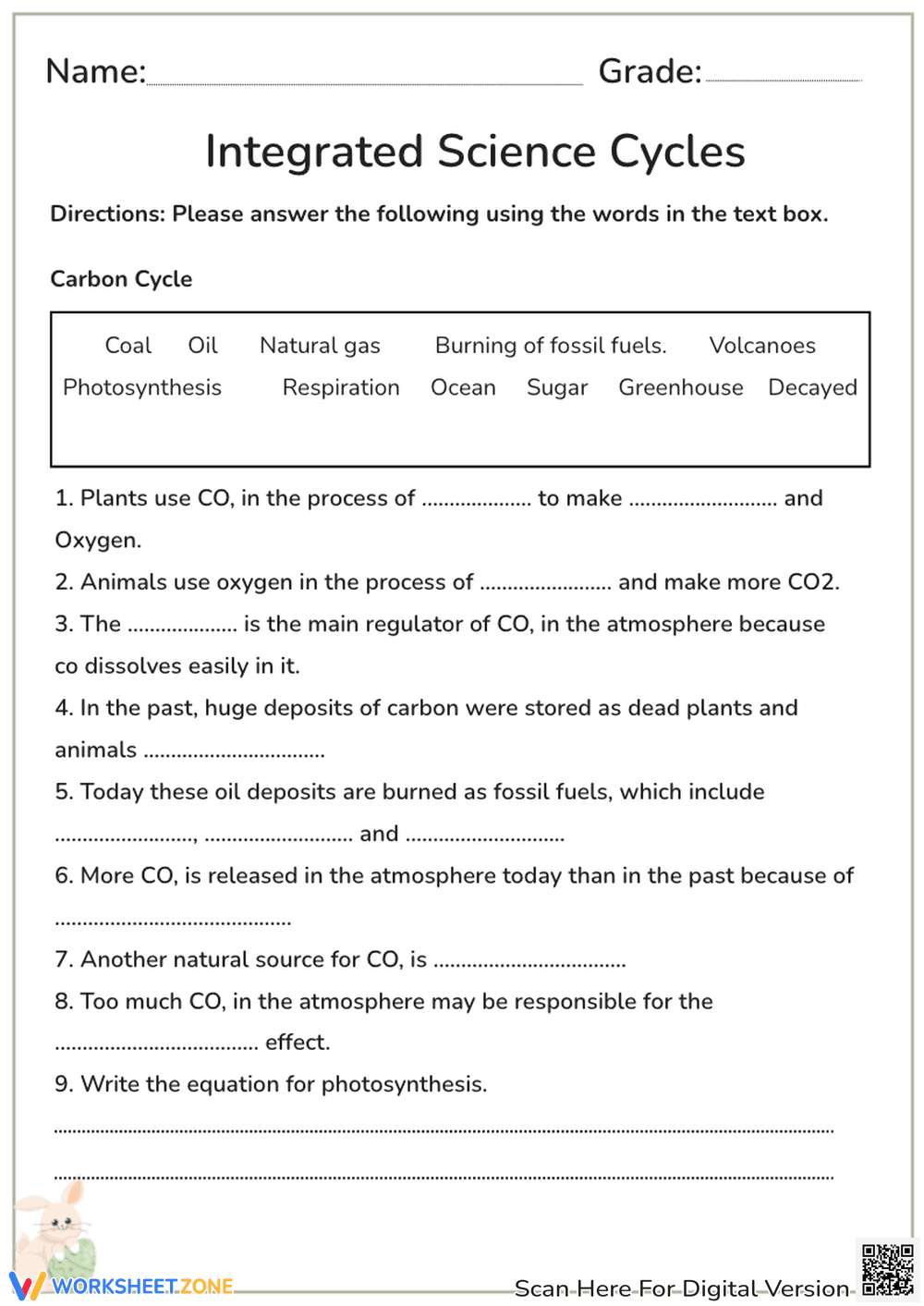


Carbon Cycle Worksheet | Grade 9-10 Essential Science
Paste this activity's link or code into your existing LMS (Google Classroom, Canvas, Teams, Schoology, Moodle, etc.).
Students can open and work on the activity right away, with no student login required.
You'll still be able to track student progress and results from your teacher account.
This Grade 9-10 carbon cycle worksheet provides a comprehensive review of how carbon moves through the atmosphere, biosphere, and geosphere. Students identify key processes like photosynthesis and respiration while exploring human impacts such as fossil fuel combustion. It ensures learners grasp the chemical and biological foundations of Earth's nutrient cycles.
At a Glance
- Grade: 9-10 · Subject: Integrated Science
- Standard:
HS-LS2-5— Illustrate the role of photosynthesis and respiration in the cycling of carbon- Skill Focus: Carbon reservoirs and flux processes
- Format: 2 pages · 10 problems · Answer key included · PDF
- Best For: Independent practice or sub plans
- Time: 20–30 minutes
This two-page PDF features a structured word bank to support vocabulary. The first page contains eight fill-in-the-blank sentences targeting reservoirs like the ocean and processes like decay. It also requires students to write the chemical equation for photosynthesis. The second page provides a dedicated workspace for students to synthesize their knowledge by drawing a complete carbon cycle diagram.
Zero-Prep Workflow
- Print: Select double-sided printing for the 2-page spread (30 seconds).
- Distribute: Hand out to students as a standalone activity or homework (1 minute).
- Review: Use the included answer key for rapid grading or peer-review sessions (1 minute).
Total teacher preparation time is under two minutes, making this an ideal resource for emergency sub plans or busy instructional days.
Standards Alignment
The primary focus is `HS-LS2-5`, which requires students to develop a model illustrating the role of photosynthesis and cellular respiration in carbon cycling. It also supports HS-ESS2-6 regarding carbon in Earth's systems. Both standard codes can be copied directly into lesson plans, IEP goals, or district curriculum mapping tools.
How to Use It
Use this worksheet as a mid-unit check after introducing the greenhouse effect. During the drawing phase, observe if students correctly link the ocean reservoir to atmospheric CO2 dissolution. This formative data helps identify if students confuse respiration with photosynthesis before the final unit exam. Completion typically takes 25 minutes.
Who It's For
This resource is designed for high school biology or integrated science students. It is effective for visual learners who benefit from diagramming and for students requiring literacy support through the word bank. Pair this with a short video on the greenhouse effect for a complete lesson.
According to the NAEP Science Framework, understanding the movement of matter through Earth's systems is a foundational requirement for scientific literacy at the secondary level. This worksheet addresses these requirements by forcing students to reconcile biological processes with geological storage. Research from Fisher & Frey (2014) emphasizes that "gradual release of responsibility" is most effective when students move from scaffolded vocabulary tasks to independent modeling, such as the diagramming required in task 10. By requiring the photosynthesis equation alongside the visual model, the worksheet ensures students connect microscopic chemical reactions to macroscopic environmental changes. This dual-modality approach is a proven method for increasing long-term retention of complex scientific cycles. The inclusion of human-driven factors like the burning of fossil fuels aligns with modern NGSS expectations for climate-literate citizens.


