


























Views
Downloads




Essential Comparing Integers Worksheet | Grade 5 Printable
Paste this activity's link or code into your existing LMS (Google Classroom, Canvas, Teams, Schoology, Moodle, etc.).
Students can open and work on the activity right away, with no student login required.
You'll still be able to track student progress and results from your teacher account.
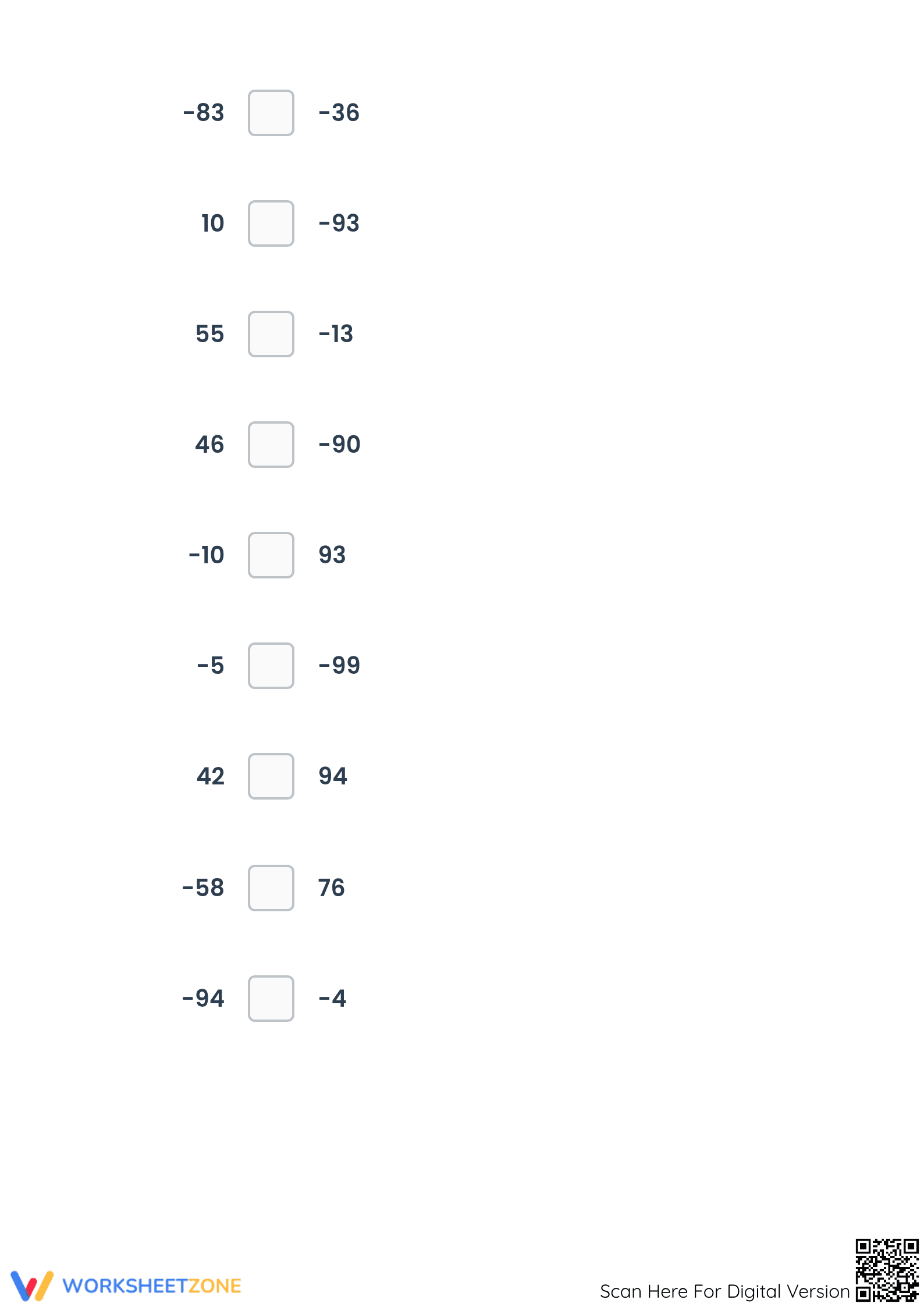
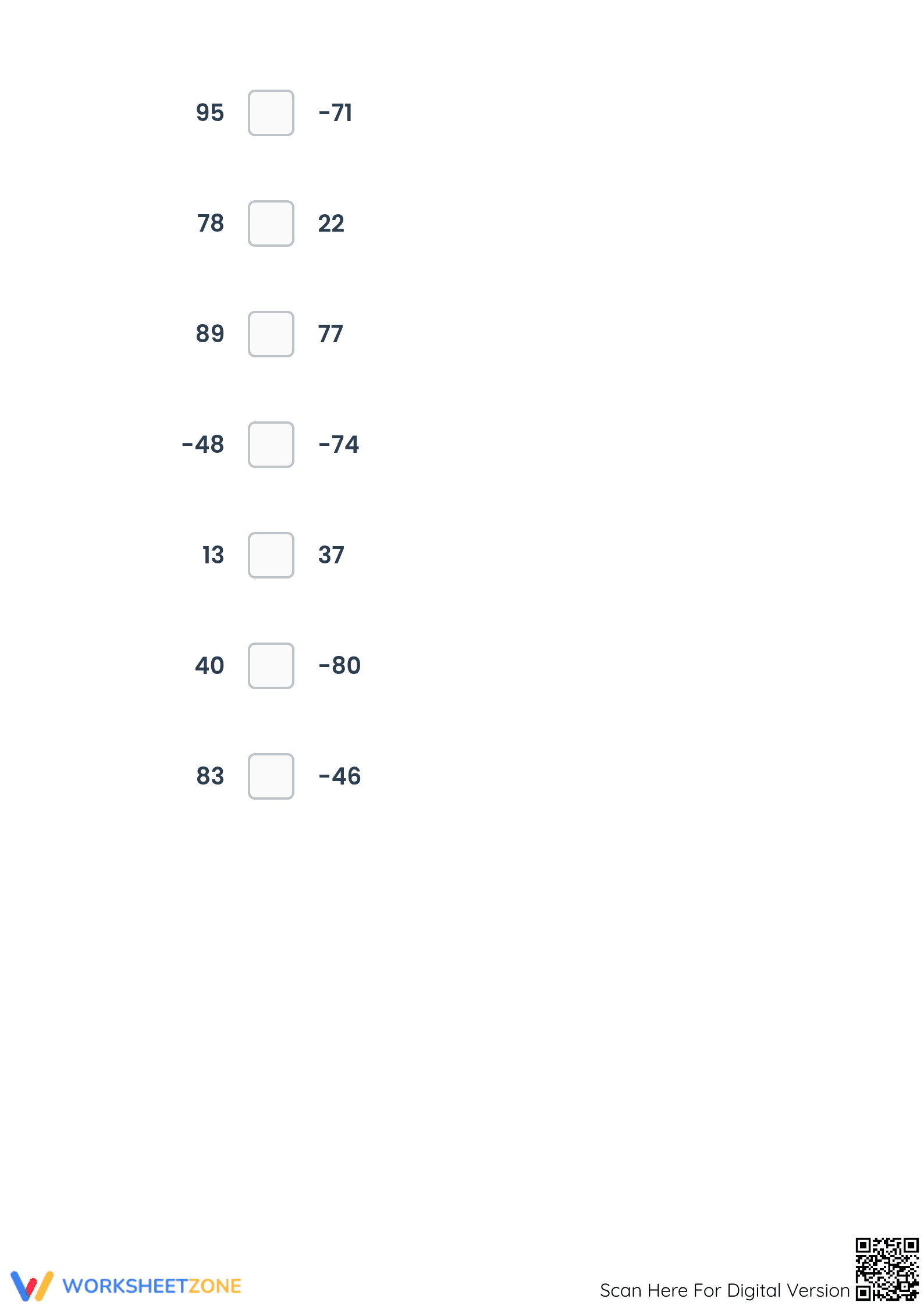
This Grade 5 Math worksheet focuses on comparing integers within the range of -99 to 99, providing students with essential practice in understanding the relative value of positive and negative numbers. By utilizing a clear number line reference and structured problem sets, learners develop the fluency needed to accurately apply inequality symbols in various mathematical contexts.
At a Glance
- Grade: Grade 5 · Subject: Math
- Standard:
CCSS.MATH.CONTENT.6.NS.C.7— Interpret statements of inequality as statements about the relative position of two numbers on a number line- Skill Focus: Comparing Integers (-99 to 99)
- Format: 5 pages · 40 problems · Answer key included · PDF
- Best For: Independent practice and formative assessment
- Time: 15–25 minutes
This comprehensive 5-page PDF contains 40 unique integer comparison tasks. Each page features a clear number line at the top to serve as a visual scaffold, helping students visualize the distance of negative numbers from zero. The set includes a complete answer key for rapid grading and immediate student feedback, making it ideal for self-directed learning or classroom stations.
This resource is designed for immediate classroom integration with a total teacher prep time of under two minutes. Simply print the five-page packet (30 seconds), distribute the copies to your students (1 minute), and utilize the included answer key for a quick review or peer-grading session (10 minutes). Its structured layout makes it an excellent choice for sub plans or unexpected schedule shifts.
The primary standard addressed is CCSS.MATH.CONTENT.6.NS.C.7, which requires students to understand ordering and absolute value of rational numbers. While typically introduced in Grade 6, this worksheet provides the necessary extension for advanced Grade 5 learners. Both standard codes can be copied directly into lesson plans, IEP goals, or district curriculum mapping tools.
Deploy this worksheet during the independent practice phase of your lesson after students have been introduced to the number line. It serves as a strong formative assessment; observe students as they compare two negative numbers, such as -92 and -90, to ensure they understand that the value increases as you move right. Completion typically takes 20 minutes, allowing for a short closing discussion.
This resource is tailored for Grade 5 and Grade 6 students who are solidifying their understanding of number systems. It is particularly beneficial for students who require visual scaffolds like number lines to internalize the concept that a larger absolute value for a negative number represents a smaller total value.
Mathematics education research emphasizes that the transition from natural numbers to integers represents a significant cognitive shift for middle-grade students. According to a RAND AIRS 2024 analysis of instructional materials, successful integer acquisition depends heavily on the consistent use of visual models, such as the horizontal number line provided in this worksheet. This tool helps students overcome the whole number bias, where they mistakenly assume that -71 is greater than -2 because 71 is greater than 2. By providing 40 targeted practice problems aligned to CCSS.MATH.CONTENT.6.NS.C.7, this resource ensures students move beyond procedural matching to a conceptual understanding of relative position. Educators can cite this worksheet as a foundational component of a balanced math curriculum that prioritizes both fluency and visual reasoning. The inclusion of a comprehensive answer key further supports its role as a reliable tool for classroom-based evidence of student progress.


