


























Views
Downloads



Printable Comparing Integers Worksheet | Grade 5 Math
Paste this activity's link or code into your existing LMS (Google Classroom, Canvas, Teams, Schoology, Moodle, etc.).
Students can open and work on the activity right away, with no student login required.
You'll still be able to track student progress and results from your teacher account.
Master Integer Comparisons with Precision
This comprehensive three-page worksheet helps students master the essential skill of comparing integers ranging from -99 to 99. Through structured exercises, learners develop a concrete understanding of how negative values relate to zero and positive numbers. This resource ensures students achieve true fluency in ordering rational numbers.
At a Glance
- Grade: 5 · Subject: Math
- Standard:
CCSS.MATH.CONTENT.6.NS.C.7— Understand ordering and absolute value of rational numbers using number line models.- Skill Focus: Comparing integers with inequality signs
- Format: 3 pages · 40 problems · Answer key included · PDF
- Best For: Independent practice or formative skill assessment
- Time: 30–45 minutes
What's Inside
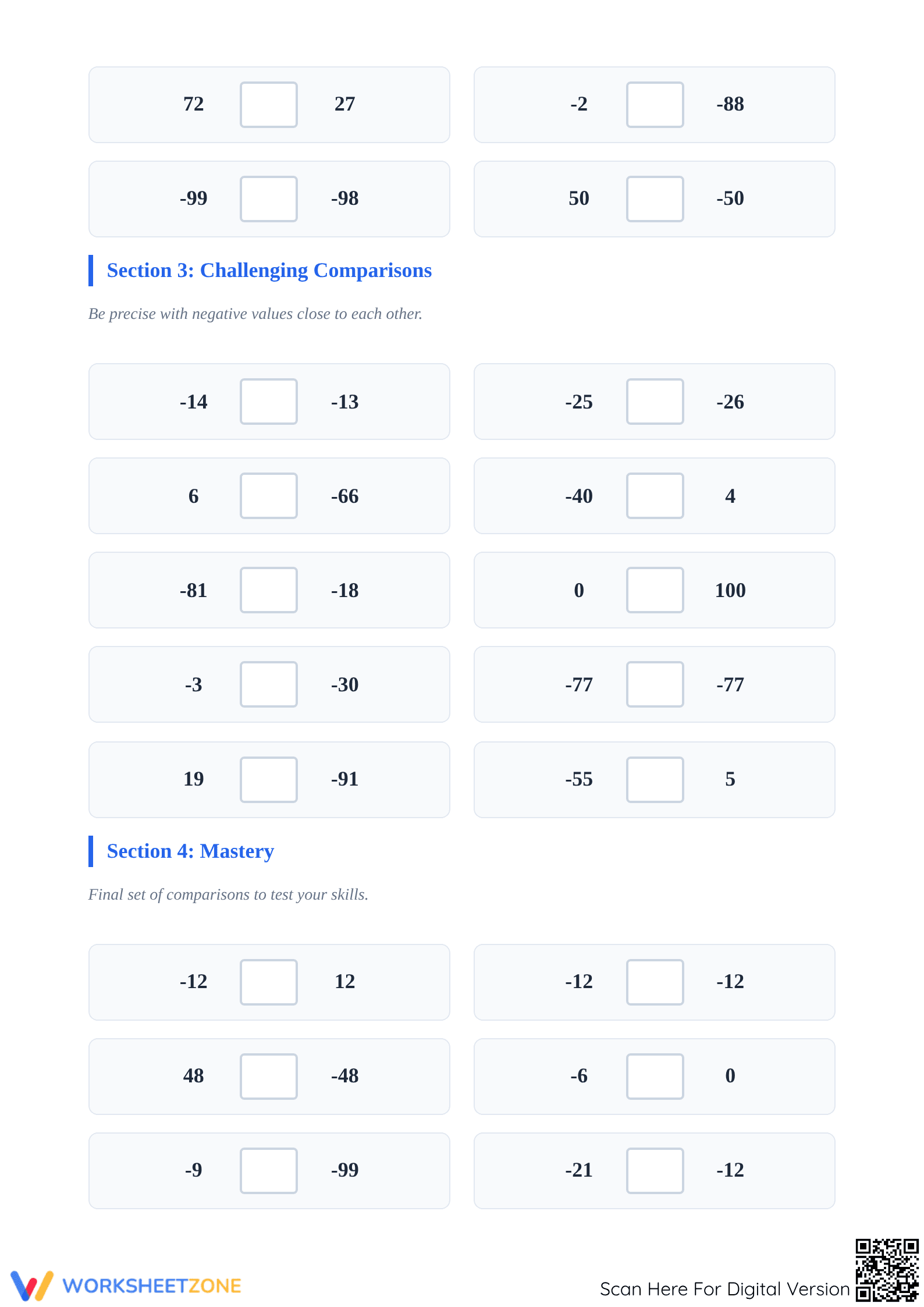
This high-quality printable includes 40 distinct comparison tasks across four progressive sections: Warm Up, Practice, Challenging Comparisons, and Mastery. Each page provides ample white space for student notation, and the final page features a Number Line Visualization tool. A complete answer key is provided for quick grading or student self-correction.
Skill Progression and Scaffolding
- Guided Warm-Up: The first 10 problems provide immediate success by pairing clear positive and negative opposites, allowing students to establish basic logic of "greater than" and "less than."
- Supported Practice: 10 mid-range problems introduce zero and larger absolute values, encouraging careful thought about number line directionality.
- Independent Mastery: The final 20 tasks include challenging pairs like -99 versus -98, requiring students to demonstrate that a larger absolute value does not always equate to a larger integer value in the negative realm.
This gradual-release approach follows the Proven I Do, We Do, You Do instructional model, ensuring students build confidence before tackling high-complexity comparisons.
Standards Alignment
This resource is primarily aligned to `CCSS.MATH.CONTENT.6.NS.C.7`, focusing on the ability to write, interpret, and explain statements of order for rational numbers. While integers are traditionally introduced in 6th grade, this Grade 5 version serves as an essential extension for advanced learners or a core component of accelerated elementary curricula. This standard code can be copied directly into lesson plans or curriculum mapping tools.
How to Use It
Deploy this worksheet during the practice phase of your lesson to reinforce direct instruction. It works exceptionally well as a formative assessment tool; observe students during the "Challenging Comparisons" section to identify those who still confuse absolute value with integer magnitude. Most students will complete the 40-problem set within 35 minutes, making it ideal for a standard math block or a rigorous homework assignment.
Who It's For
This worksheet is designed for Grade 5 students ready for middle-school readiness skills and 6th-grade students requiring targeted intervention. It is particularly effective for learners who struggle with the abstract nature of negative numbers. Pair this resource with a physical number line or digital manipulatives for multi-sensory learning.
Early exposure to the ordering of rational numbers is a critical predictor of success in middle school algebra. This worksheet addresses that need by providing 40 high-repetition opportunities for students to internalize the relationship between magnitude and direction. Research emphasizes that specific number line visualizations, like the one included on page three, significantly reduce cognitive load during initial integer logic acquisition. Utilizing this resource provides a complete and essential tool for building number sense. The structured sections ensure students apply a consistent mathematical framework to every comparison, supporting long-term retention and preparing them for more complex operations with signed numbers.


