


























Views
Downloads

Advanced Integer Comparison Worksheet | Essential Grade 5 Math
Paste this activity's link or code into your existing LMS (Google Classroom, Canvas, Teams, Schoology, Moodle, etc.).
Students can open and work on the activity right away, with no student login required.
You'll still be able to track student progress and results from your teacher account.
Students master the complexities of negative numbers and absolute value with this comprehensive advanced math resource. By moving beyond basic arithmetic, learners develop a structural understanding of the number line, specifically how magnitude and value diverge in the negative realm. This worksheet ensures students can confidently compare, order, and apply integers to real-world contexts like altitude and temperature.
At a Glance
- Grade: 5 · Subject: Math
- Standard:
CCSS.MATH.CONTENT.6.NS.C.7— Understand ordering and absolute value of rational numbers in real-world contexts- Skill Focus: Integer Comparison and Ordering
- Format: 4 pages · 43 problems · Answer key included · PDF
- Best For: Advanced Grade 5 enrichment or Grade 6 mastery
- Time: 30–45 minutes
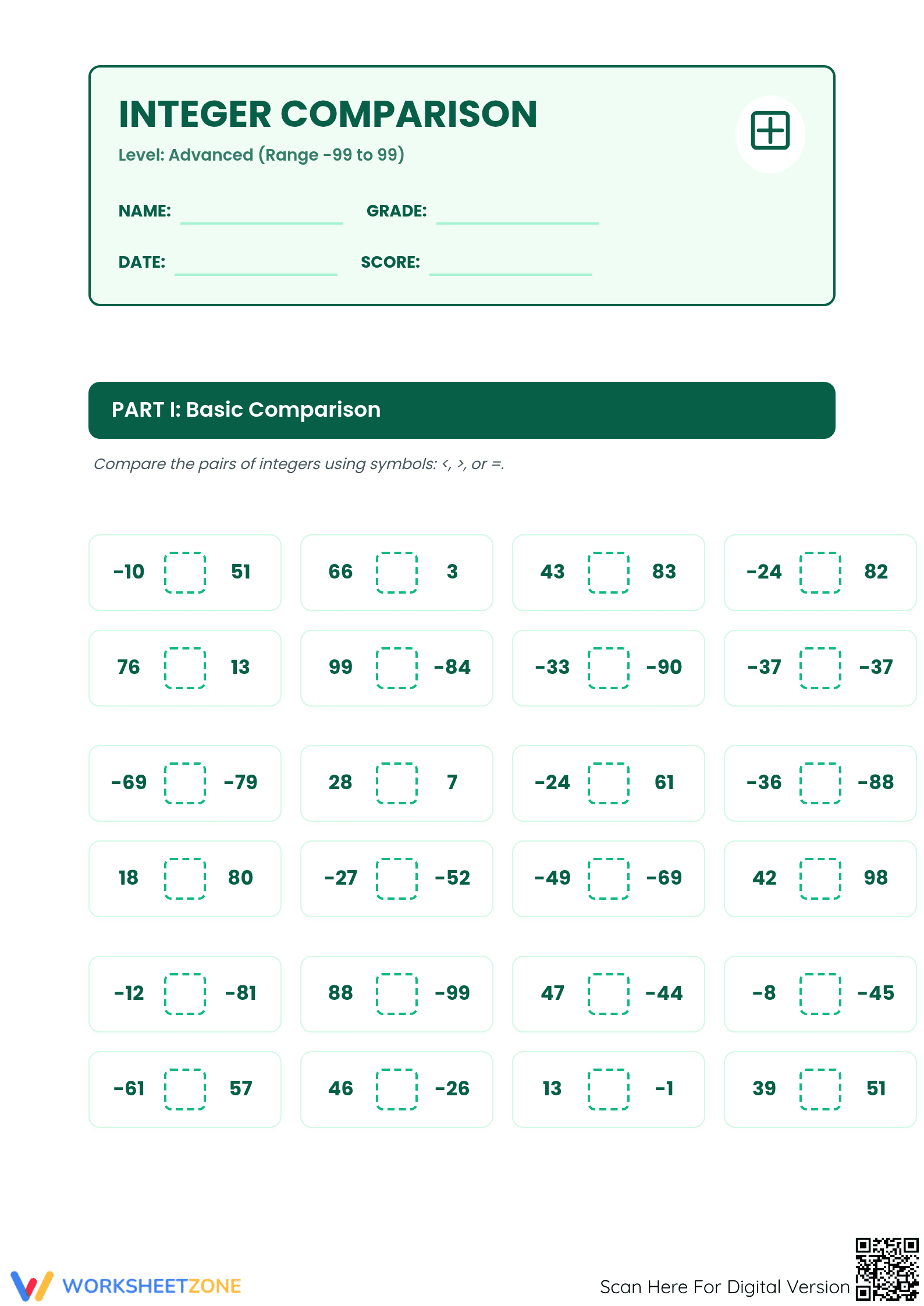
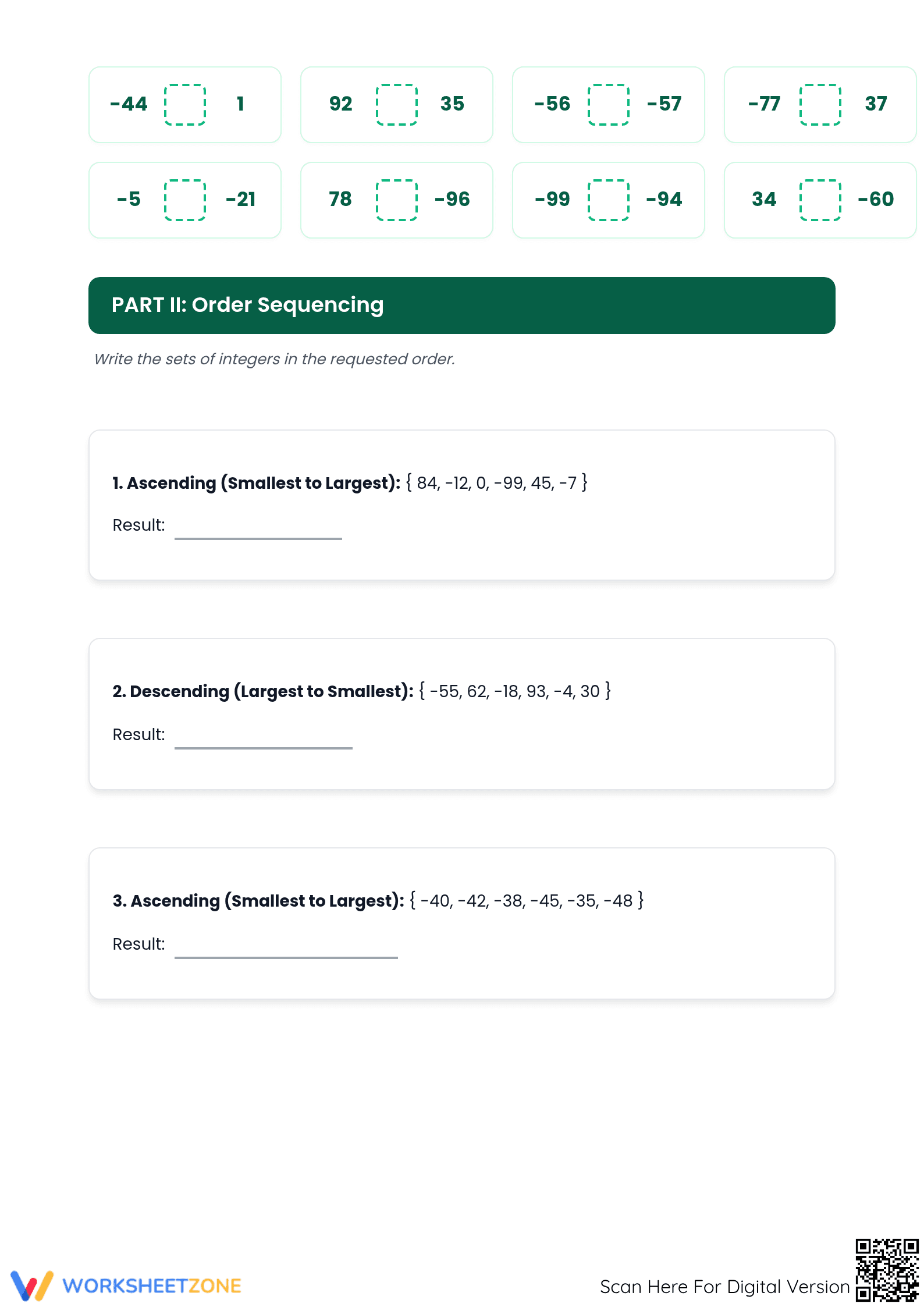
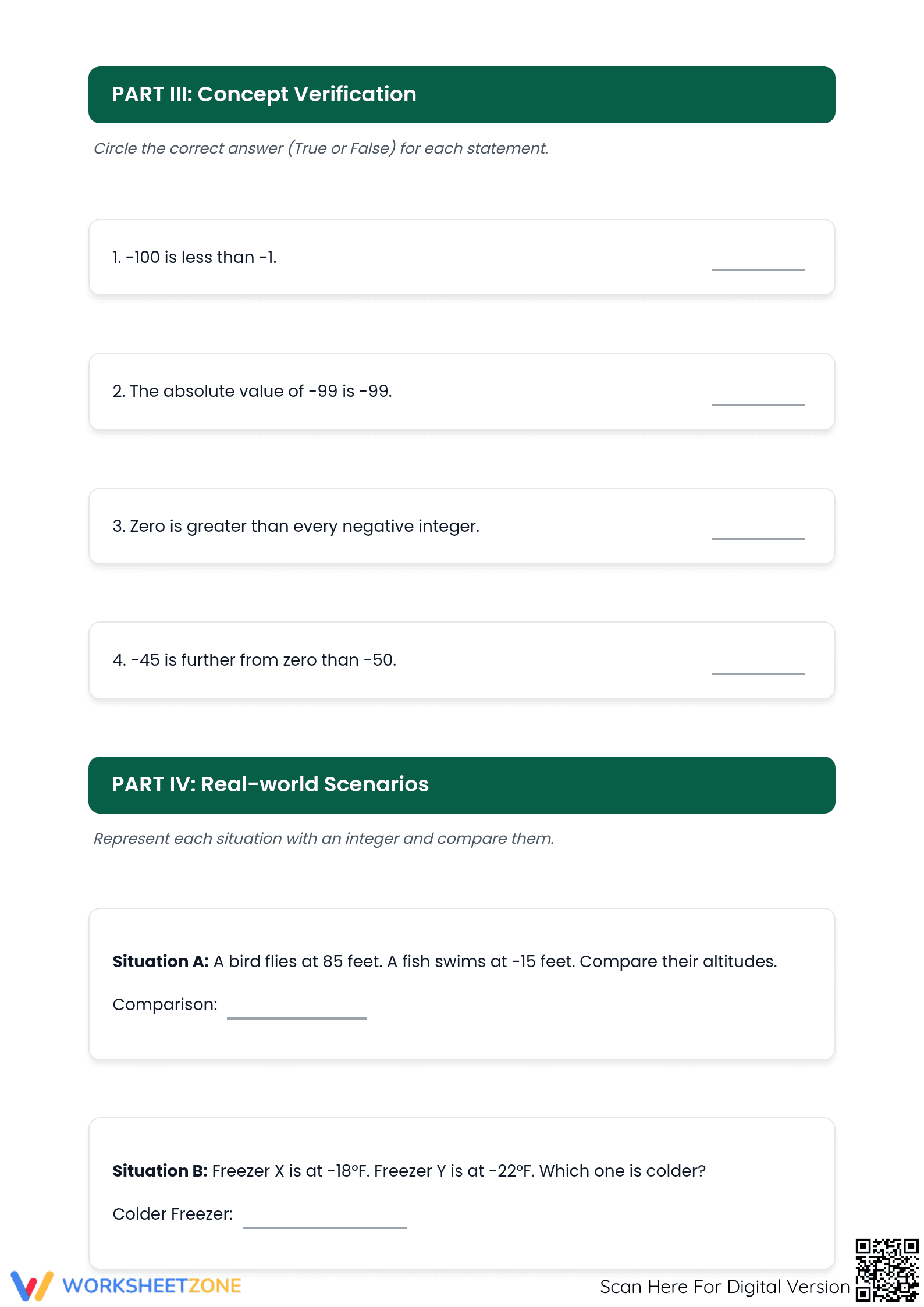
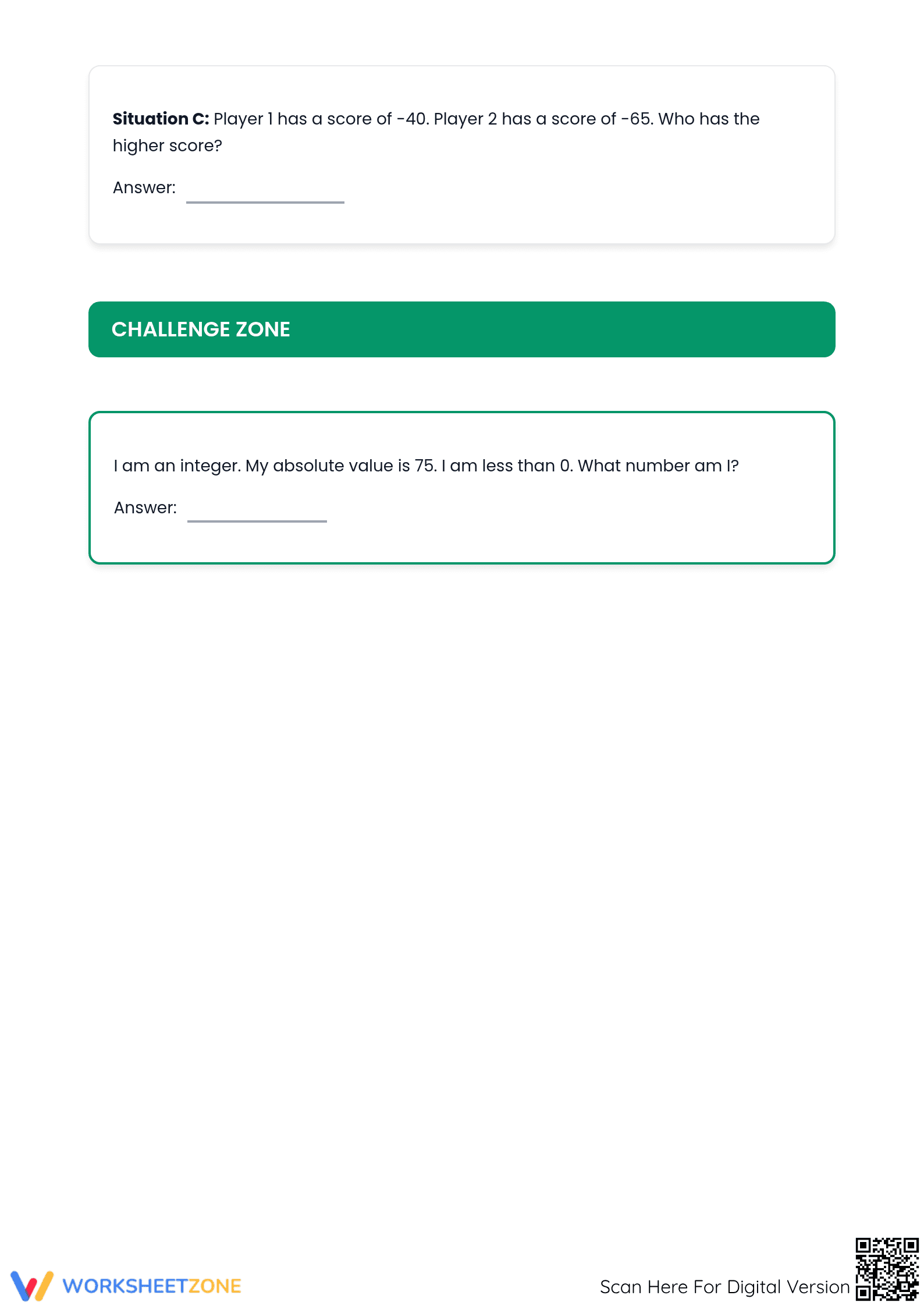
This four-page instructional packet contains 43 strategically designed tasks, including 32 basic comparison problems, 3 sequencing sets, 4 concept verification statements, and 4 high-level application scenarios. The structure includes a dedicated "Challenge Zone" to test conceptual depth regarding absolute value. A full answer key is provided to facilitate rapid feedback and student self-correction during independent practice sessions.
Each section of this worksheet maps directly to evidence of mastery for integer standards. The basic comparison tasks establish fluency with inequality symbols, while the sequencing sets require students to coordinate multiple values across zero. The concept verification section demands higher-order reasoning to validate properties of negative numbers. Finally, the real-world scenarios provide empirical evidence that students can translate abstract mathematical symbols into concrete situational data, such as comparing freezer temperatures or scoring systems.
This resource is strictly aligned to `CCSS.MATH.CONTENT.6.NS.C.7`, which requires students to understand the ordering and absolute value of rational numbers. The tasks specifically address sub-standard 6.NS.C.7.A (interpreting inequality as position on a number line) and 6.NS.C.7.C (understanding absolute value as distance from zero). Both standard codes can be copied directly into lesson plans, IEP goals, or district curriculum mapping tools to ensure rigorous instructional alignment.
Teachers should utilize this worksheet as a summative assessment after introductory lessons on the number line or as a challenging enrichment activity for high-performing Grade 5 students. During the "Real-world Scenarios" section, observe whether students correctly assign negative signs to descriptors like "below sea level" or "colder." Expected completion time is roughly 40 minutes, making it an ideal choice for a comprehensive mid-unit check or a robust homework assignment that bridges conceptual gaps.
This packet is designed for Grade 5 students ready for advanced algebraic thinking or Grade 6 students working toward core mastery. It serves as an excellent pairing with physical number line manipulatives or vertical thermometer charts to help visual learners internalize the relationship between negative magnitude and total value. The varied task types ensure that students with different learning strengths can demonstrate their understanding through computation, logic, and prose.
Research from the RAND AIRS 2024 report emphasizes that conceptual understanding of integers in late elementary school is a primary predictor of success in middle school algebra. This worksheet utilizes a gradual-release model, transitioning from isolated numerical comparisons to complex situational analysis, which aligns with the scaffolding strategies recommended by EdReports 2024. By requiring students to verify conceptual statements about zero and absolute value, the resource forces a confrontation with common misconceptions—such as the belief that a larger absolute digit always represents a larger total value. The inclusion of the CCSS.MATH.CONTENT.6.NS.C.7 standard ensures that students are performing at the depth of knowledge (DOK) level 3 required for modern state assessments. This approach to integer education focuses on distance-based logic rather than mere rote memorization of rules, fostering a durable mathematical foundation that persists through higher-level coordinate geometry and rational number operations.


