


























Views
Downloads

Essential Comparing Integers Worksheet | Grade 5 Math
Paste this activity's link or code into your existing LMS (Google Classroom, Canvas, Teams, Schoology, Moodle, etc.).
Students can open and work on the activity right away, with no student login required.
You'll still be able to track student progress and results from your teacher account.
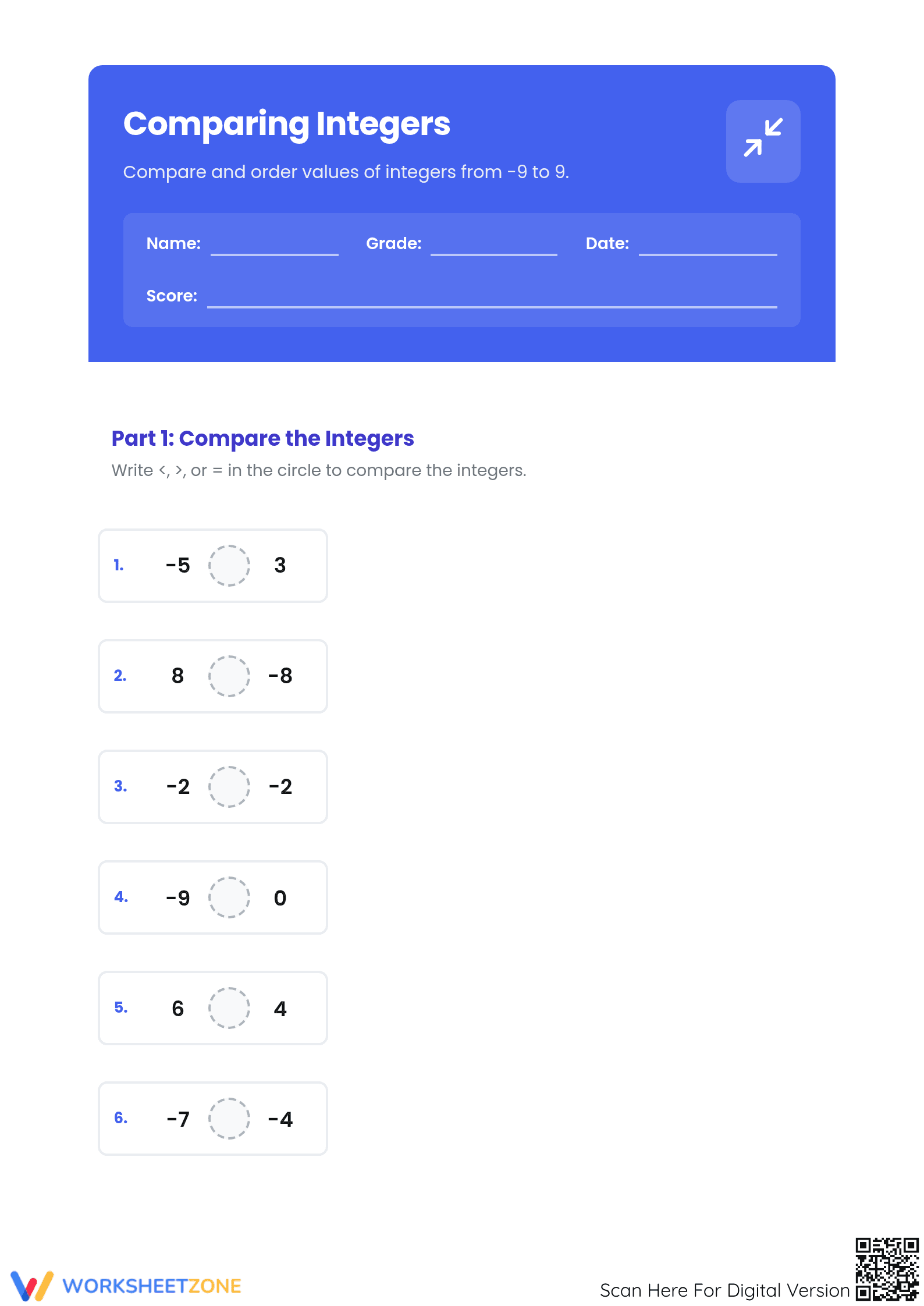
Master the fundamentals of the number system with this comprehensive integer comparison worksheet. Students practice identifying relative values of positive and negative numbers through 38 targeted exercises. This resource ensures learners transition from basic absolute value recognition to a conceptual understanding of number line positioning, preparing them for advanced algebraic operations and real-world mathematical applications.
At a Glance
- Grade: Grade 5 · Subject: Math
- Standard:
6.NS.C.7— Understand ordering and absolute value of rational numbers and position on number lines- Skill Focus: Integer comparison and ordering
- Format: 5 pages · 38 problems · Answer key included · PDF
- Best For: Independent practice and formative assessment
- Time: 30–45 minutes
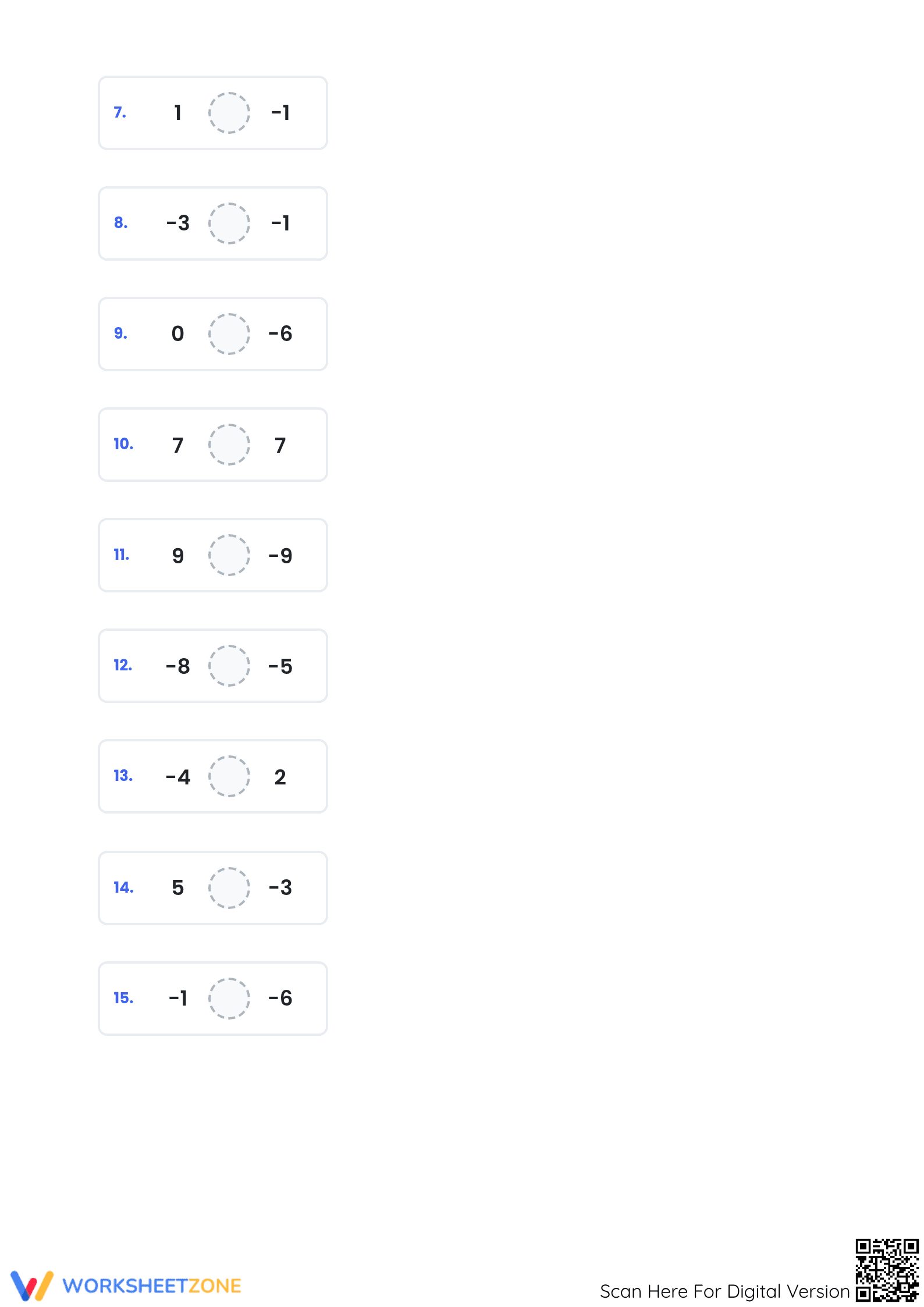
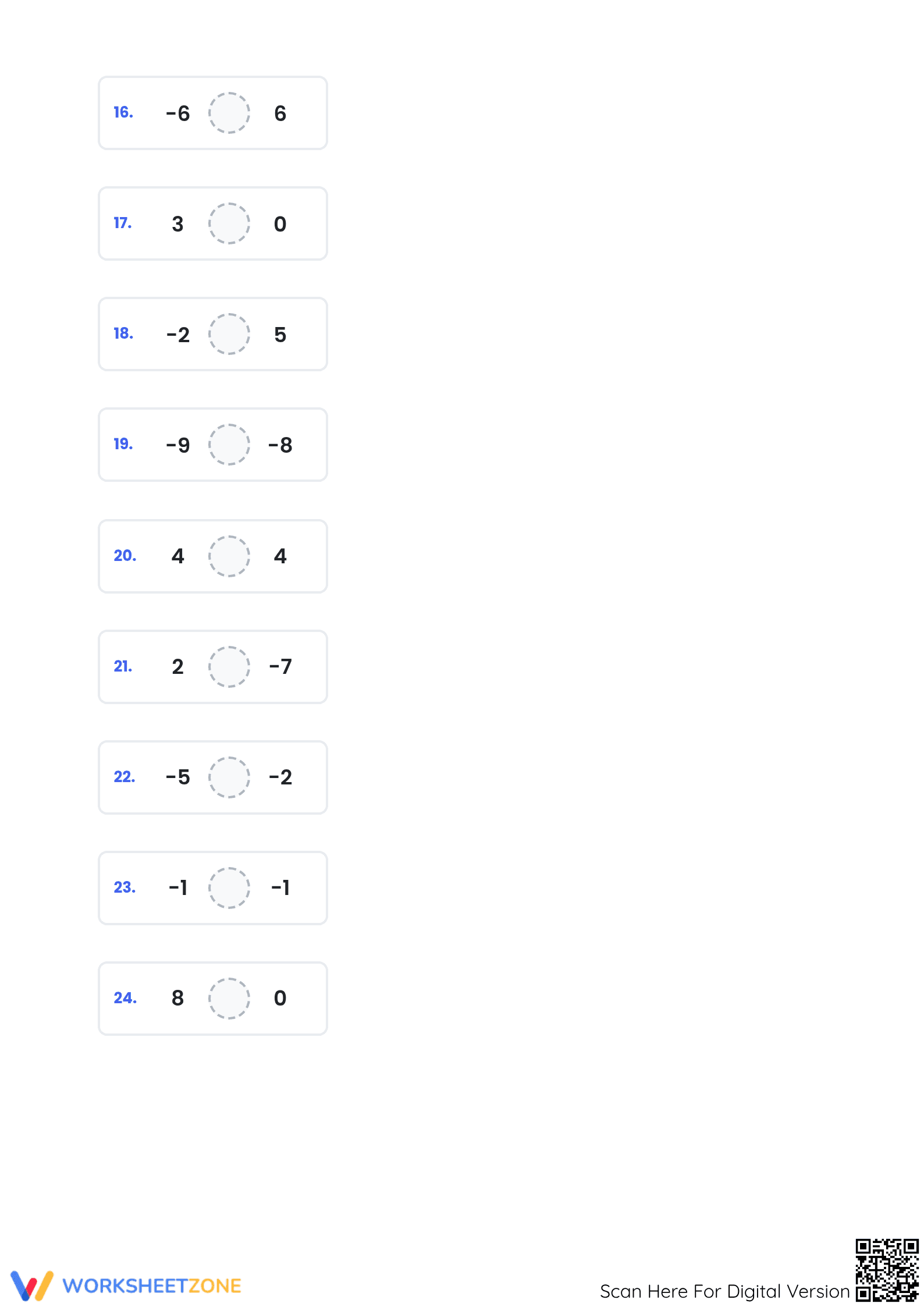
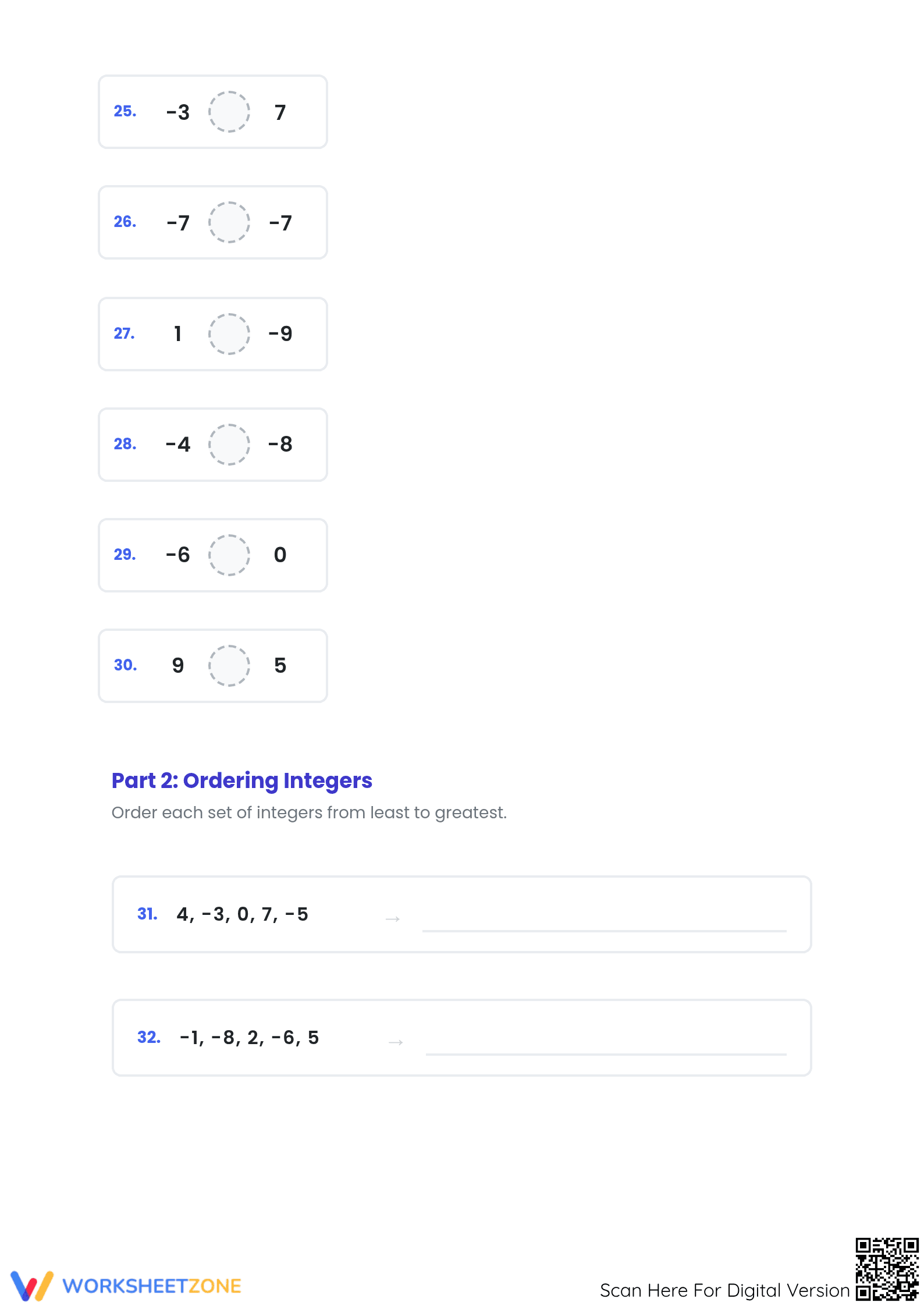
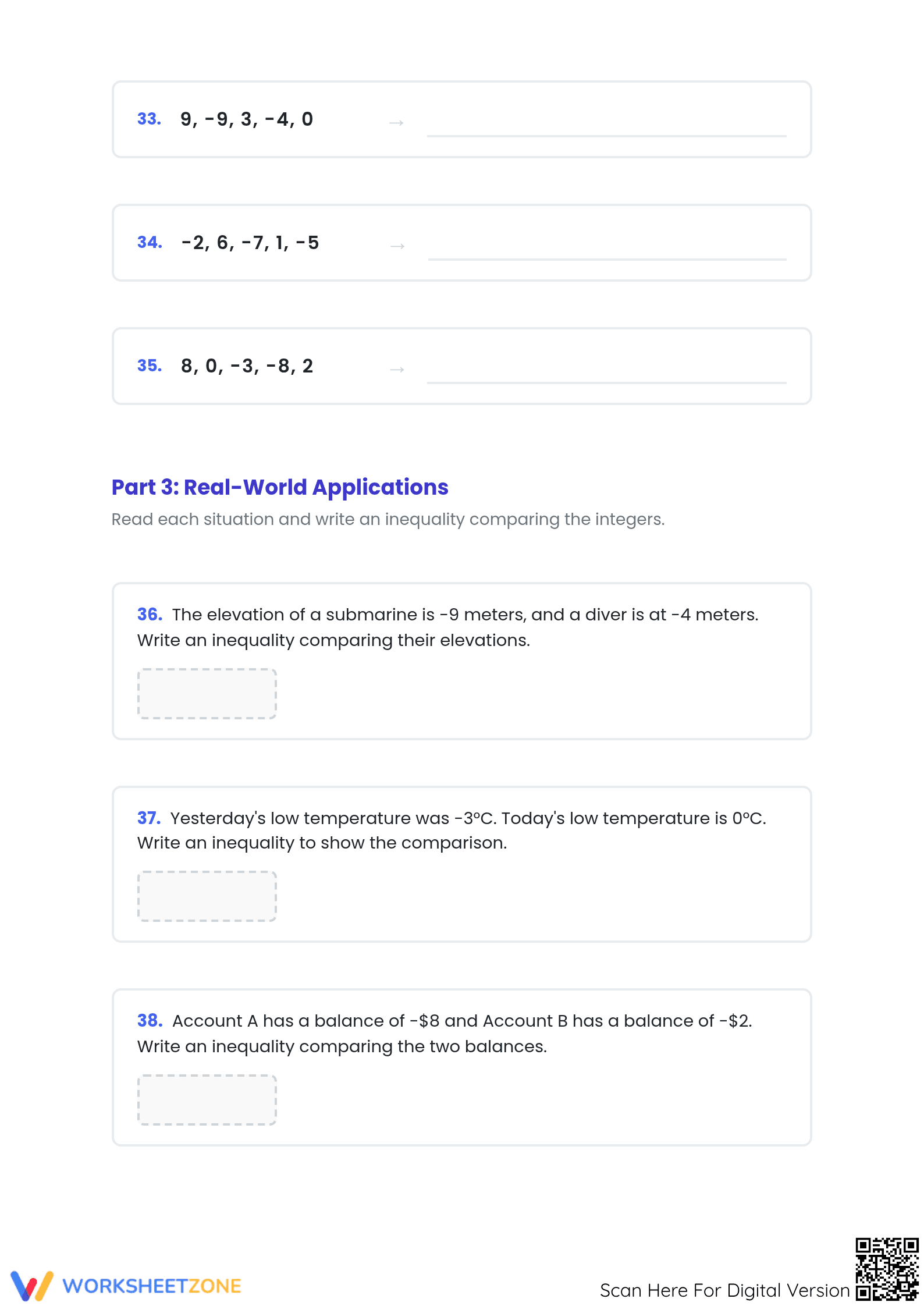
This multi-page PDF features a robust collection of 38 problems across three distinct sections. Part 1 contains 30 comparison exercises using inequality symbols, Part 2 offers 5 complex ordering sets, and Part 3 provides 3 real-world scenarios involving temperature and elevation. A complete five-page answer key is included to facilitate immediate feedback and student self-correction.
Skill Progression
- Guided Practice (Part 1): 30 direct comparison tasks using less than, greater than, and equal symbols allow students to build fluency with negative values near zero, using simple circles to record their mathematical reasoning.
- Supported Practice (Part 2): 5 multi-step ordering problems challenge students to sequence five distinct integers from least to greatest, reinforcing the relationship between positive and negative magnitudes.
- Independent Practice (Part 3): 3 contextual word problems require students to translate real-world scenarios, such as submarine depth and bank balances, into correct mathematical inequalities.
This resource utilizes a gradual-release model, moving from basic identification to complex application using an "I Do, We Do, You Do" instructional framework.
Standards Alignment
Aligned to 6.NS.C.7, students must understand ordering and absolute value of rational numbers. The tasks specifically address standard 6.NS.C.7.a by interpreting inequality as statements about the relative position of two numbers on a number line diagram. This standard code can be copied directly into lesson plans, IEP goals, or district curriculum mapping tools.
How to Use It
Assign this worksheet during the "You Do" portion of a lesson on the number system or as a comprehensive sub plan. Teachers should observe students during Part 2 to see if they mistakenly order by absolute value rather than numeric value. The 38 tasks are designed to be completed in a single 45-minute block or split across three separate warm-up sessions.
Who It's For
Designed for Grade 5 students introduced to negative numbers, this packet is also an excellent remediation tool for middle school learners. It pairs naturally with an integer number line anchor chart or a vertical thermometer visual to help students visualize the downward progression of negative values.
The conceptual shift required to understand negative integers is a critical milestone in early algebraic readiness. According to the RAND AIRS 2024 report, students who master the relative positioning of integers on a number line demonstrate significantly higher accuracy in later rational number operations. This worksheet targets the specific cognitive hurdle where learners must reconcile that a larger absolute value, like -9, represents a lesser quantity than -2. By providing 38 repetitions across symbolic and contextual formats, this resource aligns with the Fisher & Frey (2014) model of purposeful practice. The inclusion of real-world scenarios such as temperature and elevation shifts helps bridge the gap between abstract symbols and concrete understanding. This evidence-based approach ensures that Grade 5 learners build a durable mental model of the number system, fulfilling the core requirements of standard 6.NS.C.7 while establishing the prerequisite skills necessary for middle school mathematical success.


