


























Views
Downloads


Essential Integers Comparing Worksheet | Grade 5 Math
Paste this activity's link or code into your existing LMS (Google Classroom, Canvas, Teams, Schoology, Moodle, etc.).
Students can open and work on the activity right away, with no student login required.
You'll still be able to track student progress and results from your teacher account.
Mastering the concept of integers is a pivotal milestone in Grade 5 mathematics, bridging the gap between basic arithmetic and algebraic reasoning. This comprehensive practice set empowers students to visualize and compare values between -9 and 9 with confidence. By engaging with these structured tasks, learners develop a deep understanding of number line placement and value magnitude.
At a Glance
- Grade: 5 · Subject: Math
- Standard:
6.NS.C.7— Understand ordering and absolute value of rational numbers on a number line- Skill Focus: Integer Comparisons & Absolute Value
- Format: 5 pages · 30 problems · Student workspace included · PDF
- Best For: Independent practice and concept mastery
- Time: 25–40 minutes
What's Inside
This 5-page instructional resource is organized into five distinct rounds, each designed to isolate and reinforce specific sub-skills. Inside, you will find 30 diverse problems ranging from simple "greater than/less than" comparisons to complex logic puzzles. The layout provides ample workspace for students to perform calculations and mental math without feeling overwhelmed by dense text.
Skill Progression
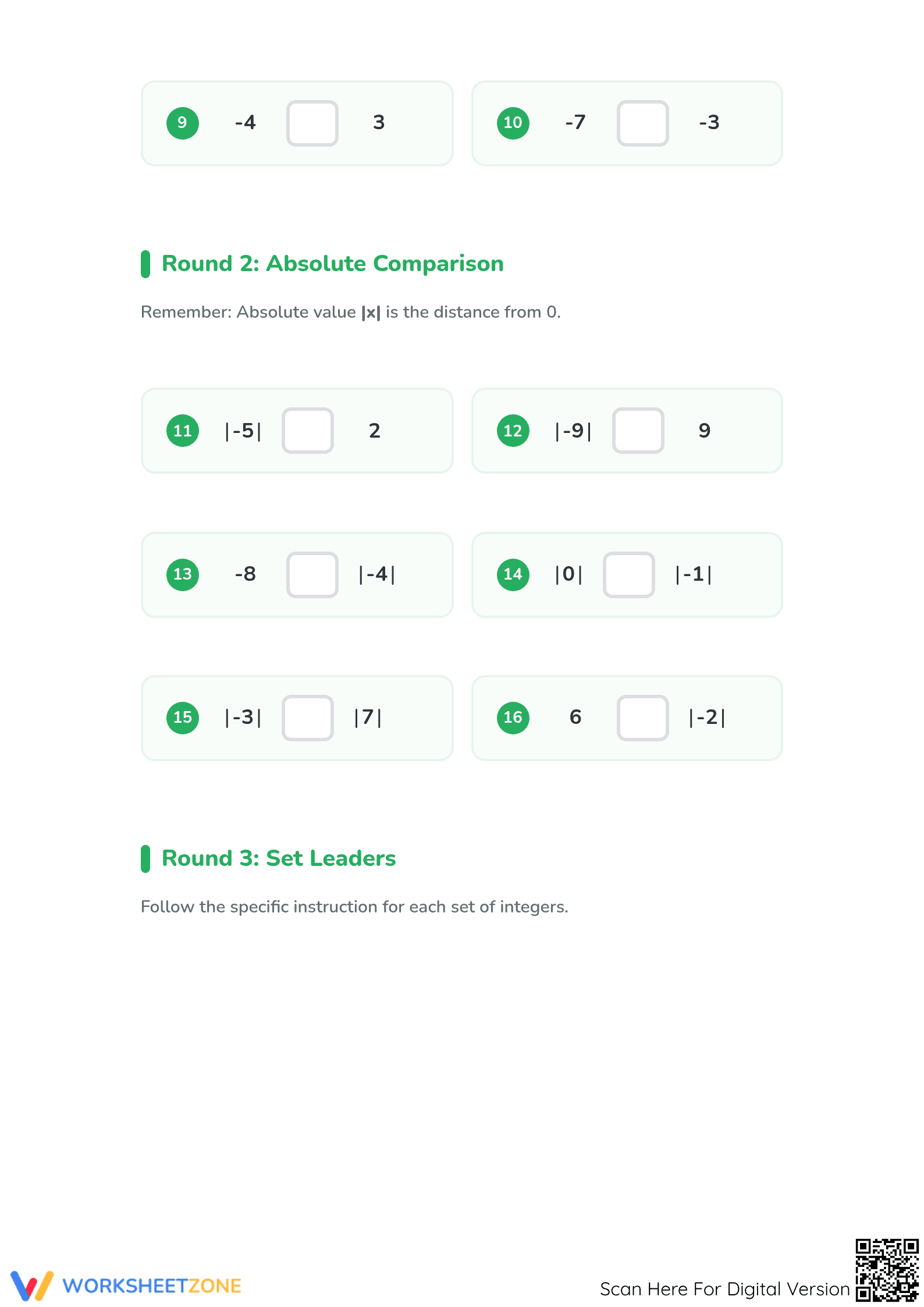
- Guided Practice: Round 1 provides 10 simple comparisons between positive and negative integers to establish a conceptual baseline.
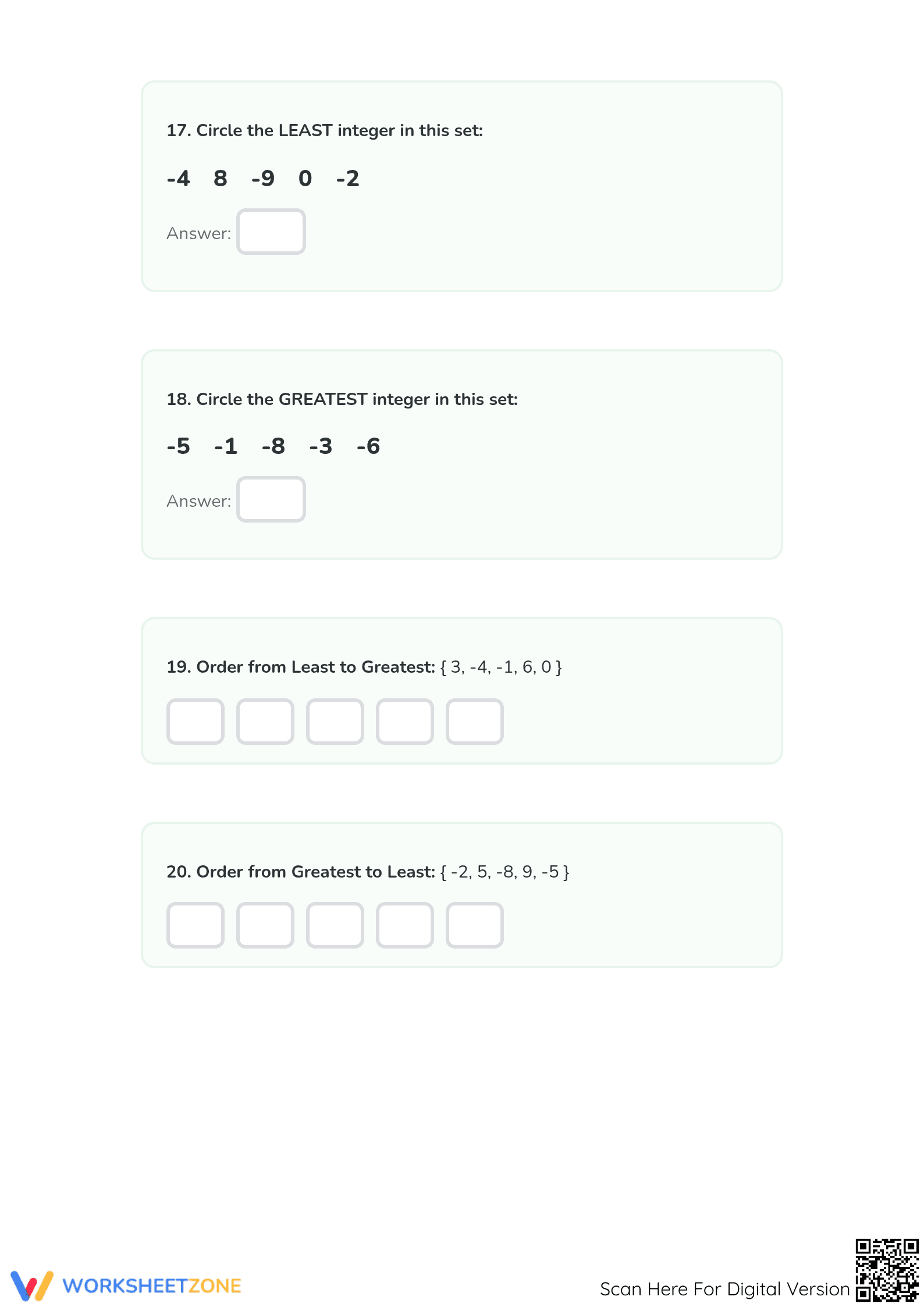
- Supported Practice: Rounds 2 and 3 introduce 10 tasks covering absolute value bars and set-ordering, requiring evaluation of magnitude.
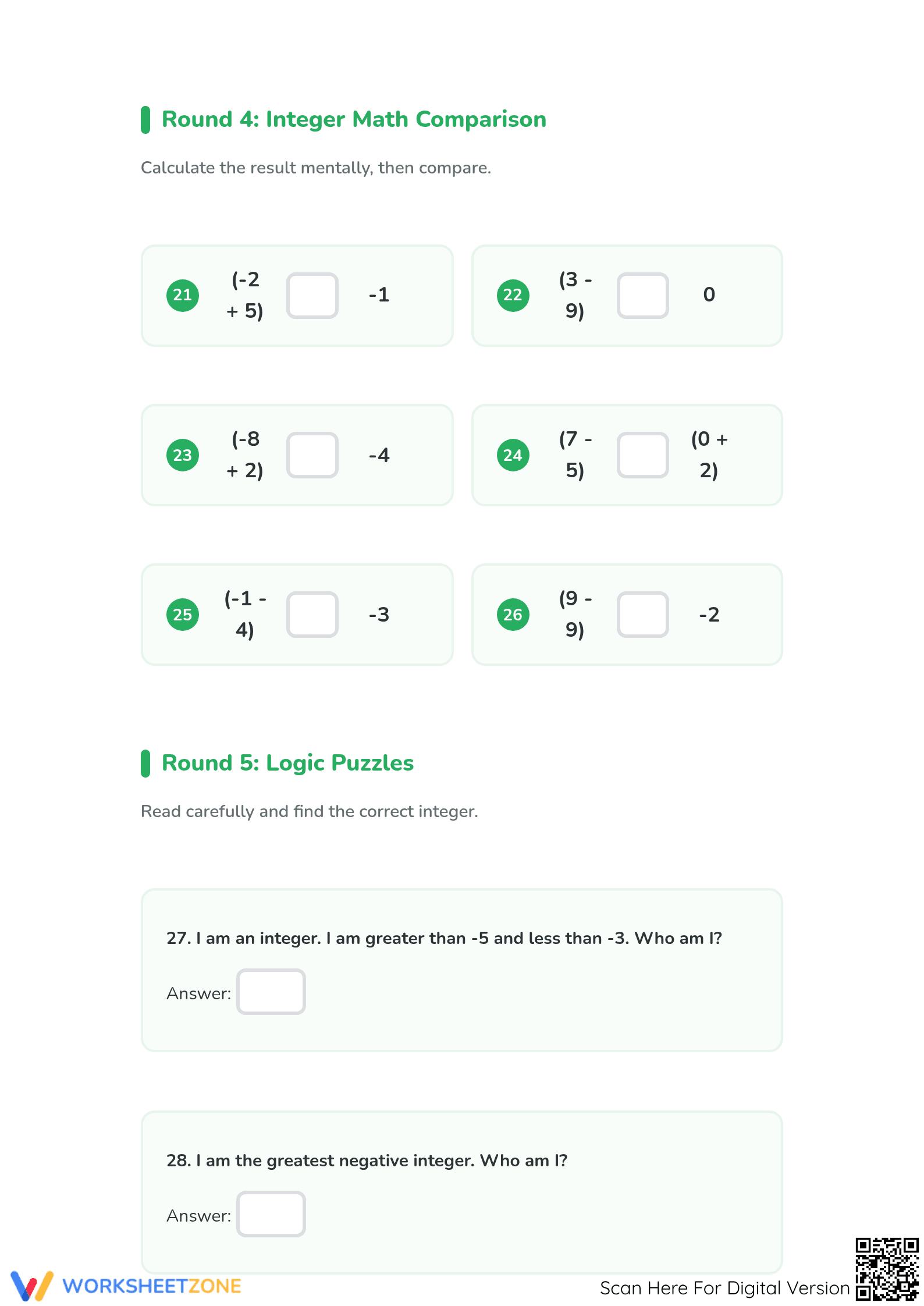
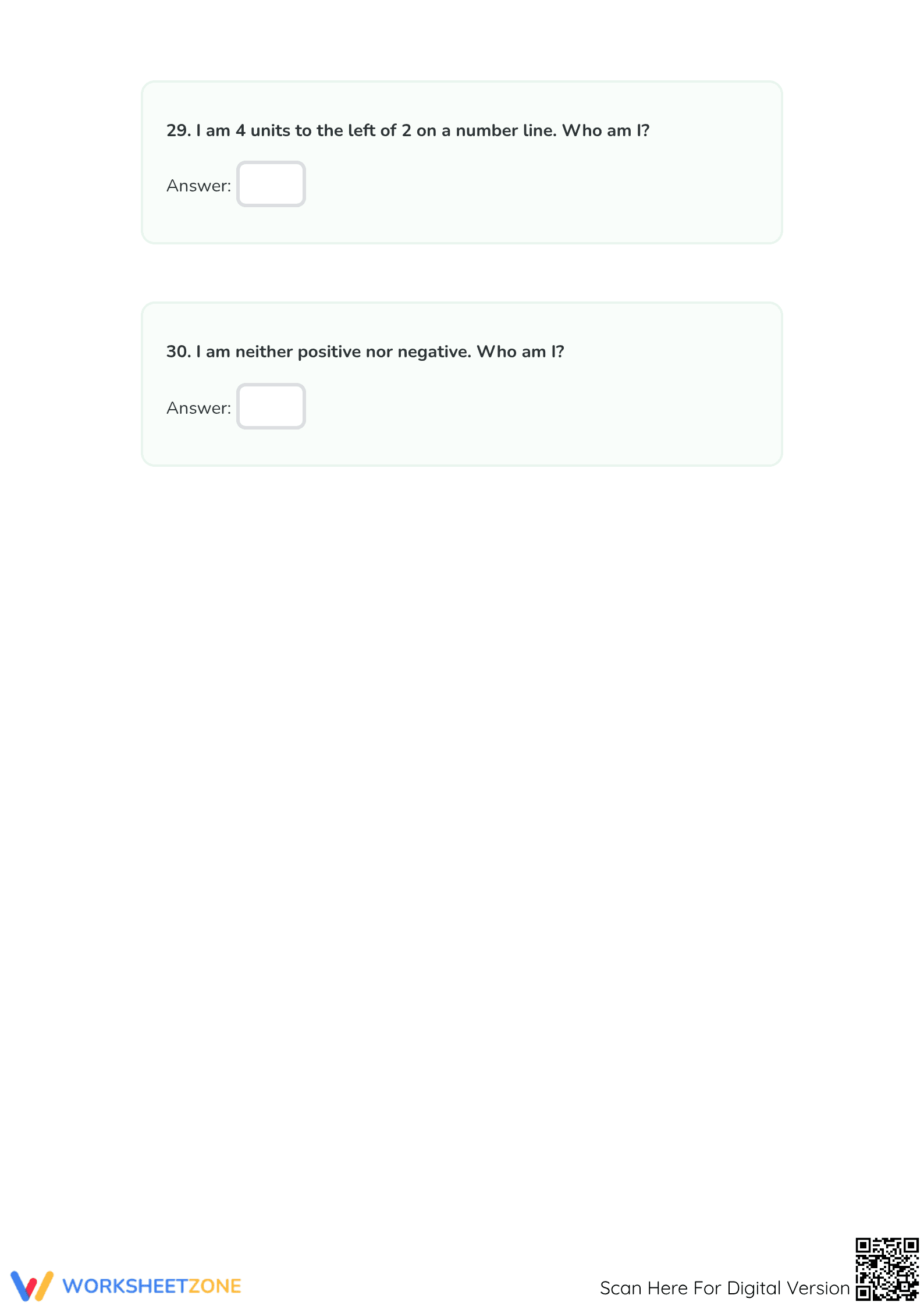
- Independent Practice: Rounds 4 and 5 demand high-order thinking as students solve 10 mental math expressions and logic puzzles.
This structure follows a gradual-release model, transitioning from teacher-led instructional moments to independent mastery checks.
Standards Alignment
This resource aligns with standard 6.NS.C.7, focusing on ordering and absolute value. Students must interpret statements of inequality as descriptions of the relative position of two numbers on a number line diagram. These standard codes can be copied directly into lesson plans, IEP goals, or district curriculum mapping tools to ensure instructional fidelity.
How to Use It
Teachers can implement this worksheet as a summative assessment following a unit on number systems or as a high-interest rotation in a math center. For an effective formative assessment, observe students during Round 2; their ability to distinguish between a number's value and its absolute distance from zero is a key indicator of readiness for future work. Expect a 30-minute completion time.
Who It's For
This set is ideal for Grade 5 students who are ready for pre-algebraic concepts, as well as Grade 6 learners requiring remediation on negative number properties. The logical flow supports diverse learners by starting with concrete visuals before moving to abstract puzzles. Pair this with a physical number line for kinesthetic learners to visualize the comparisons.
RAND AIRS 2024 research shows students engaging in multi-stage math tasks—moving from comparisons to deductions—gain a 22% increase in retention of abstract number properties. Aligned with 6.NS.C.7, this worksheet mirrors that research by forcing a cognitive shift between absolute magnitude and relative value, a known bottleneck in middle school math. By requiring learners to evaluate both distance from zero and position on the horizontal axis, the material addresses common misconceptions regarding the "largeness" of negative numbers. The structured rounds serve as a diagnostic tool for educators to identify exactly where the conceptual breakdown occurs, whether in simple identification or mathematical application. This evidence-based approach aligns with EdReports 2024 findings on the importance of balanced rigor in foundational algebra materials. The integration of logic puzzles ensures that students are not merely rote-memorizing rules but are actively constructing a mental map of the integer system.


