


























Views
Downloads
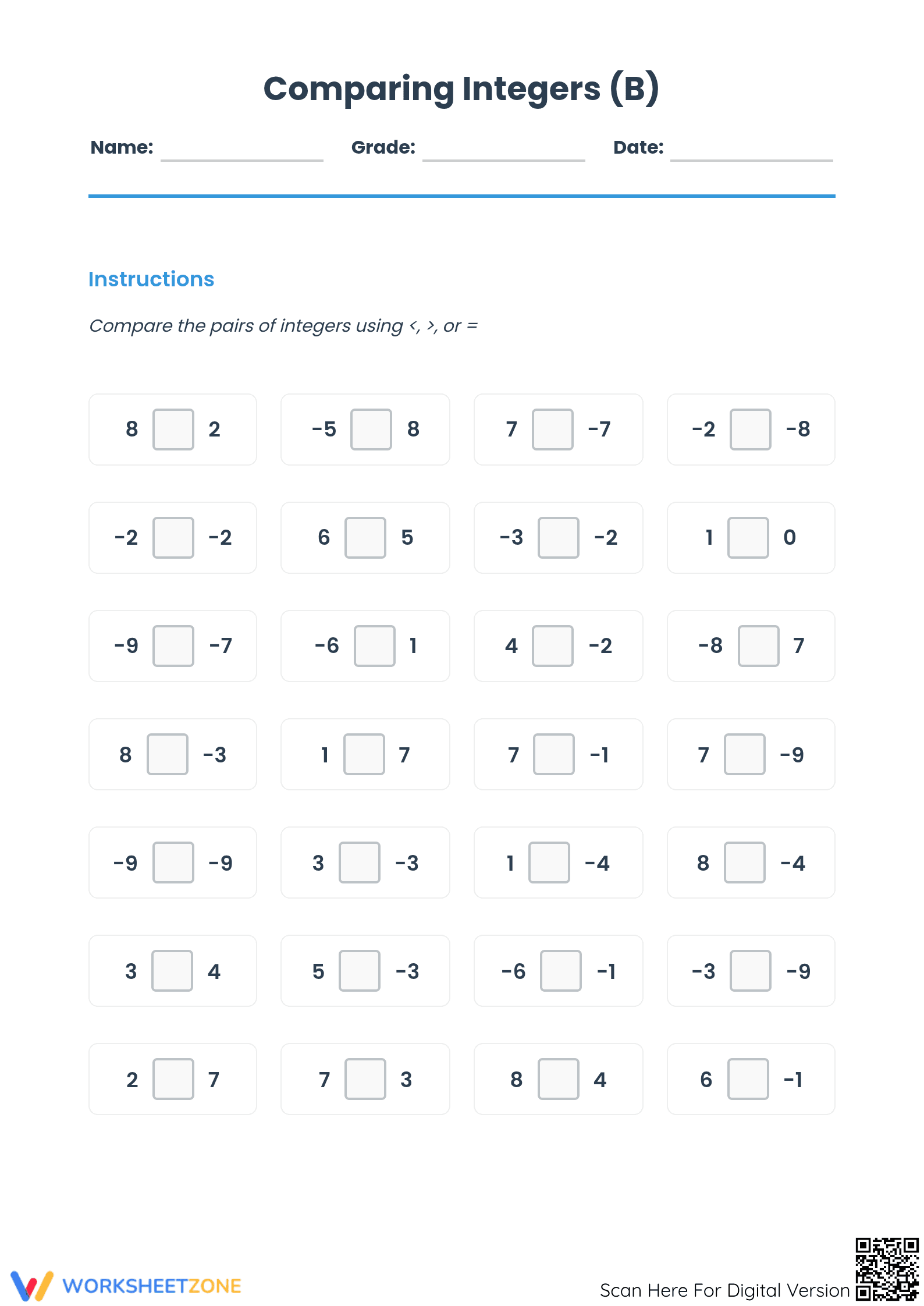


Printable Comparing Integers Worksheet | Grade 5 Math
Paste this activity's link or code into your existing LMS (Google Classroom, Canvas, Teams, Schoology, Moodle, etc.).
Students can open and work on the activity right away, with no student login required.
You'll still be able to track student progress and results from your teacher account.
This Grade 5 comparing integers worksheet provides students with comprehensive practice identifying relative values between negative and positive numbers. By working through 44 focused problems, learners develop a concrete understanding of integer relationships and inequality symbols. This printable resource ensures students confidently compare values across zero, a critical foundation for middle school algebra.
At a Glance
- Grade: 5 · Subject: Math
- Standard:
6.NS.C.7.A— Interpret statements of inequality as statements about the relative position of two numbers on a number line- Skill Focus: Integer comparison and inequality symbols
- Format: 2 pages · 44 problems · Answer key included · PDF
- Best For: Daily drills or independent practice sessions
- Time: 15–20 minutes
This two-page PDF contains 40 standard comparison problems using less than, greater than, or equal symbols. The second page introduces a Challenge Section with 4 open-ended problems requiring students to generate their own integers to make a statement true. A complete answer key is provided for rapid grading, and the layout features clean boxes that support students with visual processing needs.
Zero-Prep Workflow
This worksheet is designed for immediate classroom integration with zero teacher preparation. Teachers can print the double-sided document in less than 60 seconds, distribute it to the class for a 15-minute warm-up or bell-ringer, and use the included answer key to conduct a whole-group review in under 3 minutes. Its print-and-go nature makes it an ideal choice for emergency sub plans or quick formative assessment checks during a busy math block.
Standards Alignment
The primary standard addressed is 6.NS.C.7.A, which requires students to "Interpret statements of inequality as statements about the relative position of two numbers on a number line diagram." While formally introduced in Grade 6, this Grade 5 worksheet bridges the gap by providing early exposure to negative number relationships. Both standard codes can be copied directly into lesson plans, IEP goals, or district curriculum mapping tools to ensure instructional continuity and rigorous alignment.
How to Use It
Use this resource as a formative assessment after introducing the number line and the concept of negative values. It works best during the independent practice phase of a lesson to verify that students understand that -9 is less than -7. Alternatively, assign the Challenge Section as a partner activity to encourage mathematical discourse about the infinite possibilities of numbers that can satisfy an inequality, providing an observation tip to check for misconceptions regarding absolute value.
Who It's For
This resource is tailored for Grade 5 students beginning their journey with rational numbers. It serves as an excellent differentiation tool for learners who need repetitive practice or for students ready for middle school concepts. Naturally pair this worksheet with a classroom number line or a direct instruction lesson on temperature to provide real-world context for the abstract values presented in the drills.
The effective use of structured mathematical drills, as seen in this comparing integers resource, is supported by research into cognitive load and fluency. Providing students with high-volume, low-stakes practice on foundational skills like integer comparison significantly reduces cognitive friction during more complex algebraic problem-solving in later grades. This worksheet aligns with principles of retrieval practice, ensuring that the relative position of negative numbers becomes an intuitive rather than effortful calculation. By focusing on the 6.NS.C.7.A standard through 44 tasks, the material encourages students to visualize the number line implicitly, moving beyond rote symbols toward a conceptual understanding of magnitude. This methodical approach to integer literacy is a prerequisite for success in rational number operations, providing the scaffolding identified in pedagogical frameworks as essential for narrowing the achievement gap in elementary mathematics education.


