


























Views
Downloads

Printable Comparing Integers Worksheet | Grade 5 Math
Paste this activity's link or code into your existing LMS (Google Classroom, Canvas, Teams, Schoology, Moodle, etc.).
Students can open and work on the activity right away, with no student login required.
You'll still be able to track student progress and results from your teacher account.
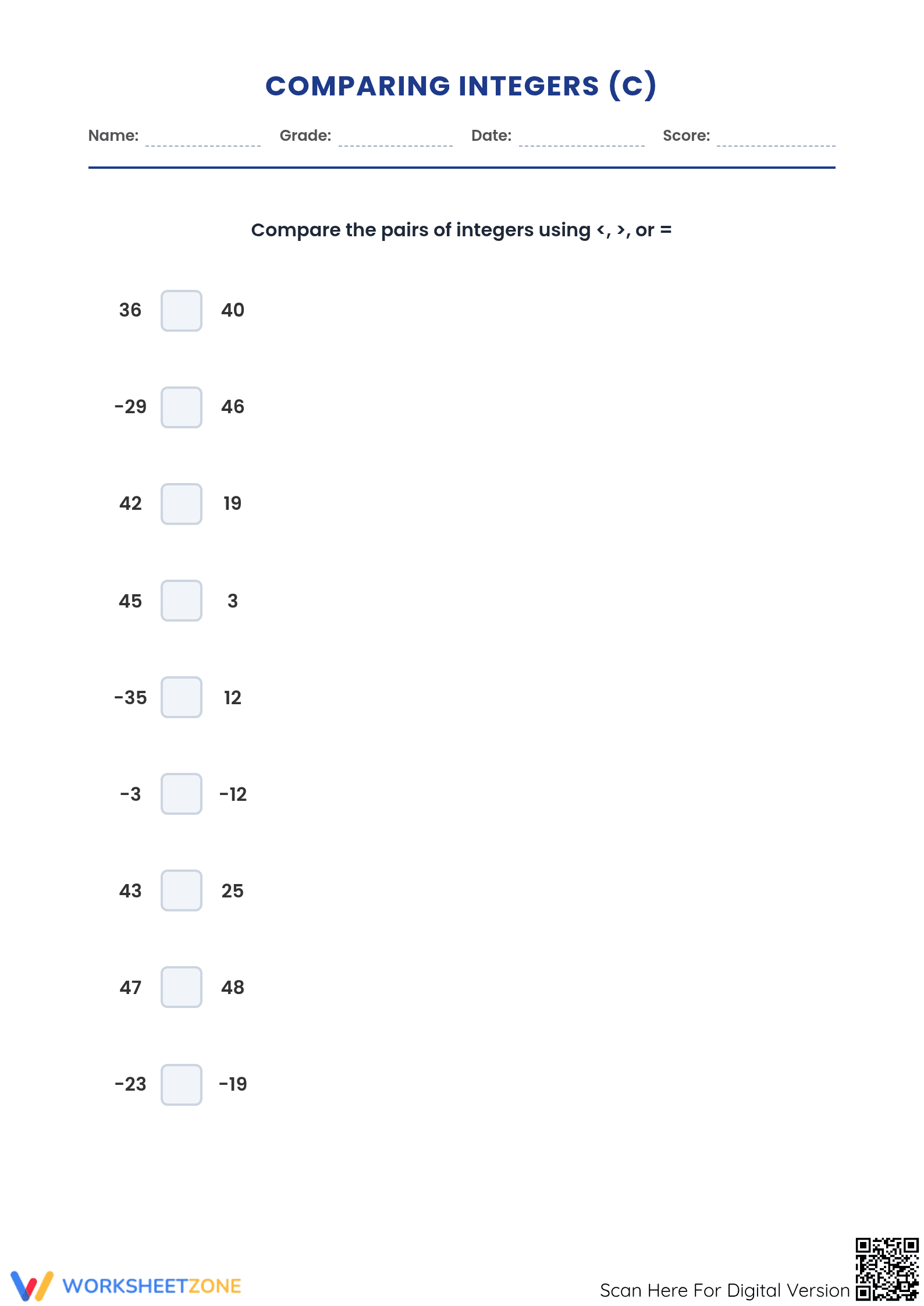
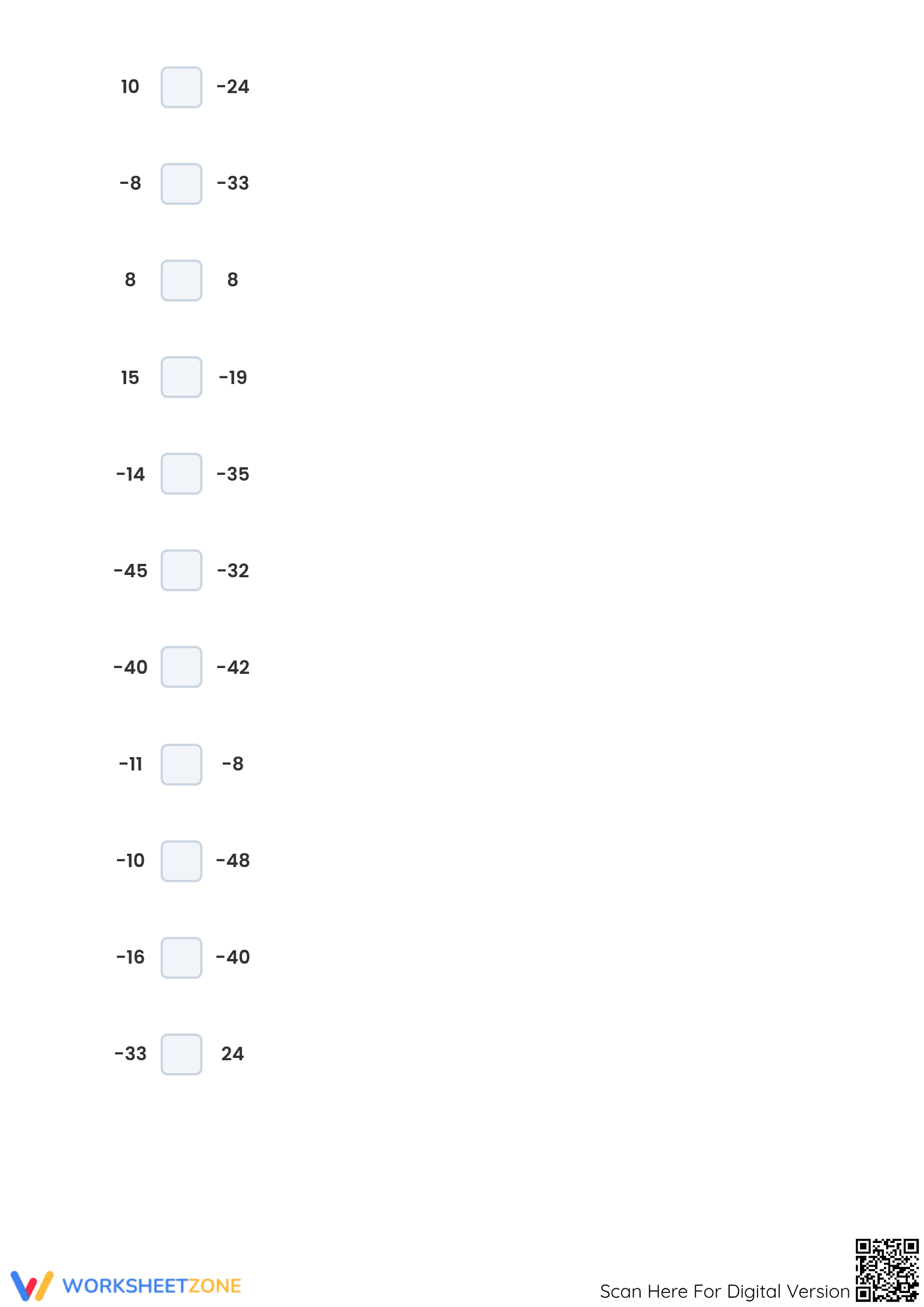
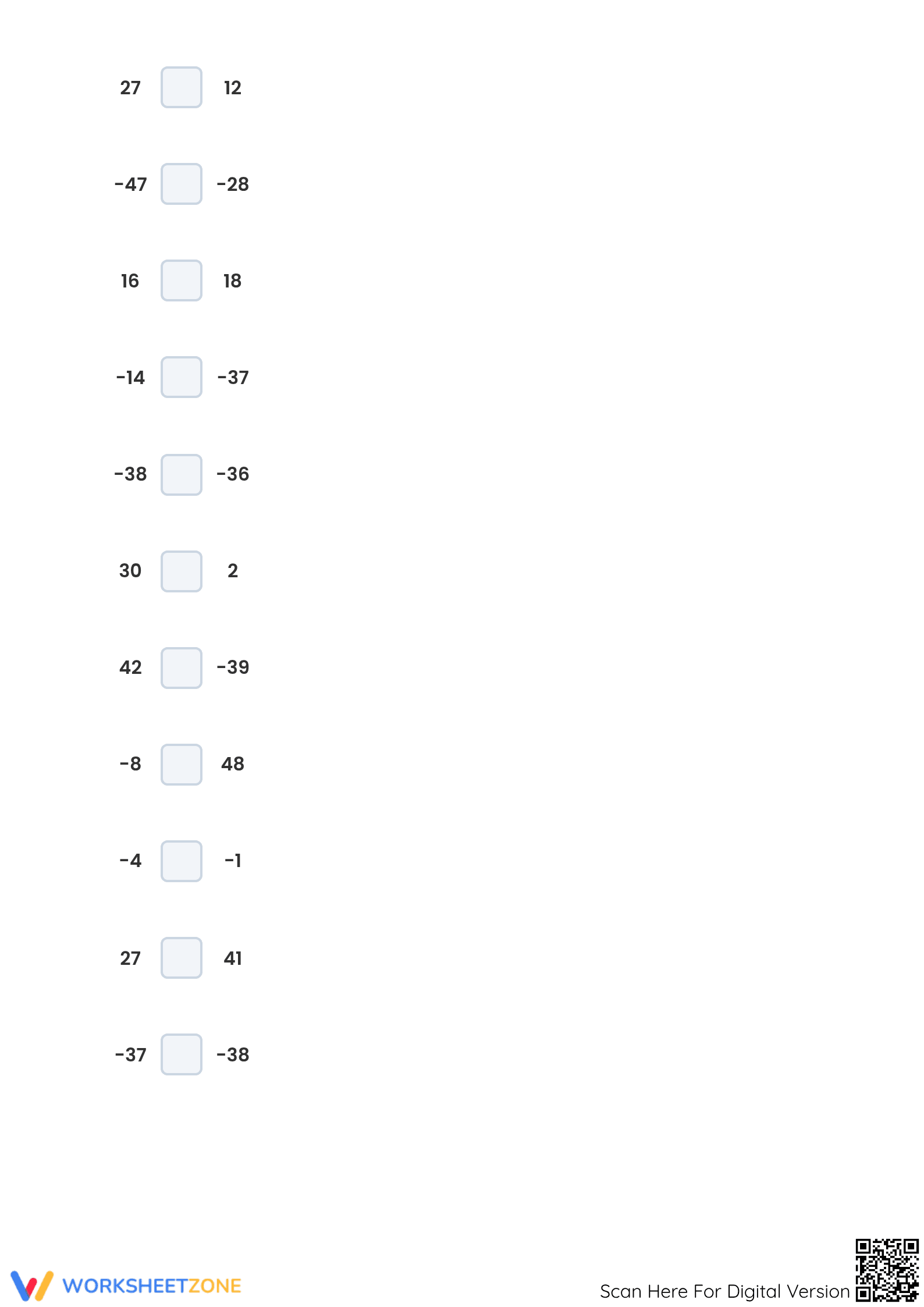
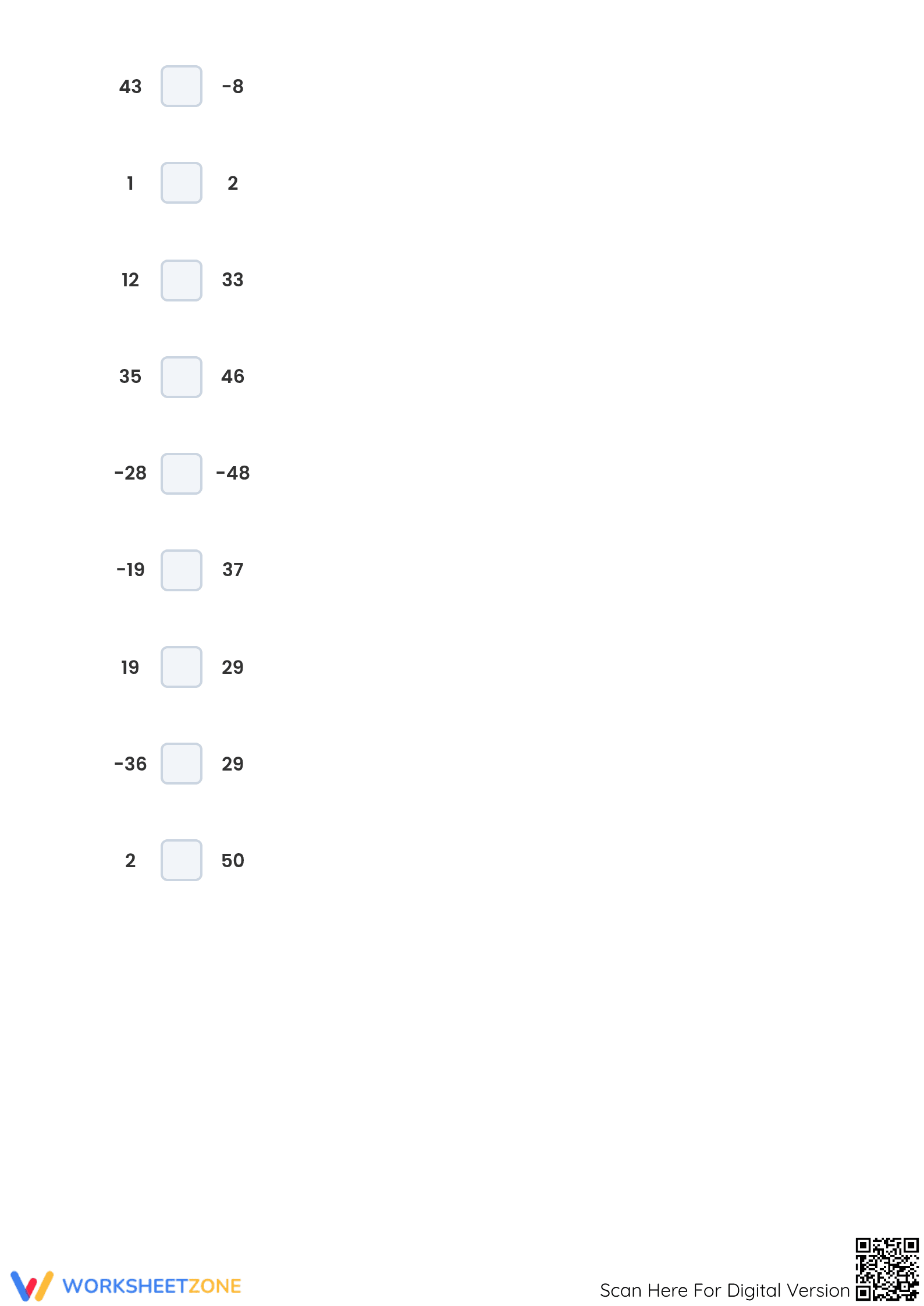
This printable math worksheet provides intensive practice for students learning to compare positive and negative integers within the range of -50 to 50. By evaluating 41 unique pairs, learners develop a concrete understanding of number line placement and relative value. This resource is designed to build the foundational fluency required for advanced algebraic operations.
At a Glance
- Grade: 5 · Subject: Math
- Standard:
CCSS.MATH.CONTENT.6.NS.C.7.A— Interpret statements of inequality as statements about the relative position of two integers- Skill Focus: Comparing Integers (-50 to 50)
- Format: 4 pages · 41 problems · Answer key included · PDF
- Best For: Homework, math centers, or quick skill assessments
- Time: 15–25 minutes
What's Inside
This comprehensive PDF pack contains four pages of focused integer comparison tasks. Students encounter a balanced variety of scenarios, including positive-to-positive, negative-to-negative, and mixed-sign comparisons. The layout features clear, high-contrast spacing with large input boxes for inequality symbols. A complete answer key is provided to facilitate rapid grading or student self-correction, ensuring immediate feedback on conceptual errors.
Skill Progression
This worksheet utilizes a gradual-release model. Guided practice begins with 9 scaffolded problems. Supported practice increases complexity with 22 problems featuring similar absolute values, demanding logical rule application. The final 10 problems offer high-volume independent practice, fostering automaticity in comparing integers and understanding their position relative to the zero-axis.
Standards Alignment
The primary focus of this worksheet is `CCSS.MATH.CONTENT.6.NS.C.7.A`, which requires students to interpret statements of inequality as statements about the relative position of two integers on a number line diagram. While listed for Grade 5, it serves as an essential bridge to Grade 6 rational number standards. Both standard codes can be copied directly into lesson plans, IEP goals, or district curriculum mapping tools.
How to Use It
Assign the first page as a "think-pair-share" activity where students must explain why -3 is greater than -12. For formative assessment, observe students as they complete the negative-to-negative pairs; if they consistently choose the larger absolute value as the greater number, intervene with a vertical number line visualization. Students should typically complete all 41 problems within 20 minutes of concentrated work.
Who It's For
This resource is ideal for Grade 5 students ready for enrichment and Grade 6 students requiring remedial support with negative numbers. It can be naturally paired with a temperature-based anchor chart or a vertical number line passage. The clear, uncluttered design supports students with executive functioning challenges by minimizing visual distractions during high-repetition practice.
The ability to compare integers is a critical milestone in the transition to algebraic thinking. According to a RAND AIRS 2024 analysis, students who achieve early fluency with negative number relationships demonstrate higher success rates in middle school math domains. This worksheet addresses the common magnitude error—where students equate higher absolute value with greater value—by providing 41 targeted comparison opportunities. By requiring inequality symbols (CCSS.MATH.CONTENT.6.NS.C.7.A), the material forces students to explicitly articulate directional relationships on the zero-centered axis. This structured repetition aligns with Fisher & Frey (2014) recommendations for developing mathematical automaticity through targeted, low-stakes practice. Educators can use these tasks to verify that students have moved beyond simple counting and mastered abstract numerical hierarchy. This 4-page PDF set ensures students are fully prepared for subsequent operations with rational numbers and variable-based equations; educators can rely on this resource as a robust formative tool.


