


























Views
Downloads

Essential Integers Comparison Worksheet | Grade 5 Math
Paste this activity's link or code into your existing LMS (Google Classroom, Canvas, Teams, Schoology, Moodle, etc.).
Students can open and work on the activity right away, with no student login required.
You'll still be able to track student progress and results from your teacher account.
Master integer relationships with this comprehensive practice set. This Grade 5 worksheet guides students through comparing positive and negative numbers between -99 and 99. By visualizing values on a number line, learners develop a concrete understanding of numerical order, ensuring they can accurately determine relative magnitude across the zero boundary in any context.
At a Glance
- Grade: 5 · Subject: Math
- Standard:
CCSS.MATH.CONTENT.6.NS.C.7— Interpret statements of inequality as statements about the relative position of two numbers- Skill Focus: Comparing Integers (-99 to 99)
- Format: 4 pages · 40 problems · Answer key included · PDF
- Best For: Independent practice and quick formative assessment
- Time: 20–30 minutes
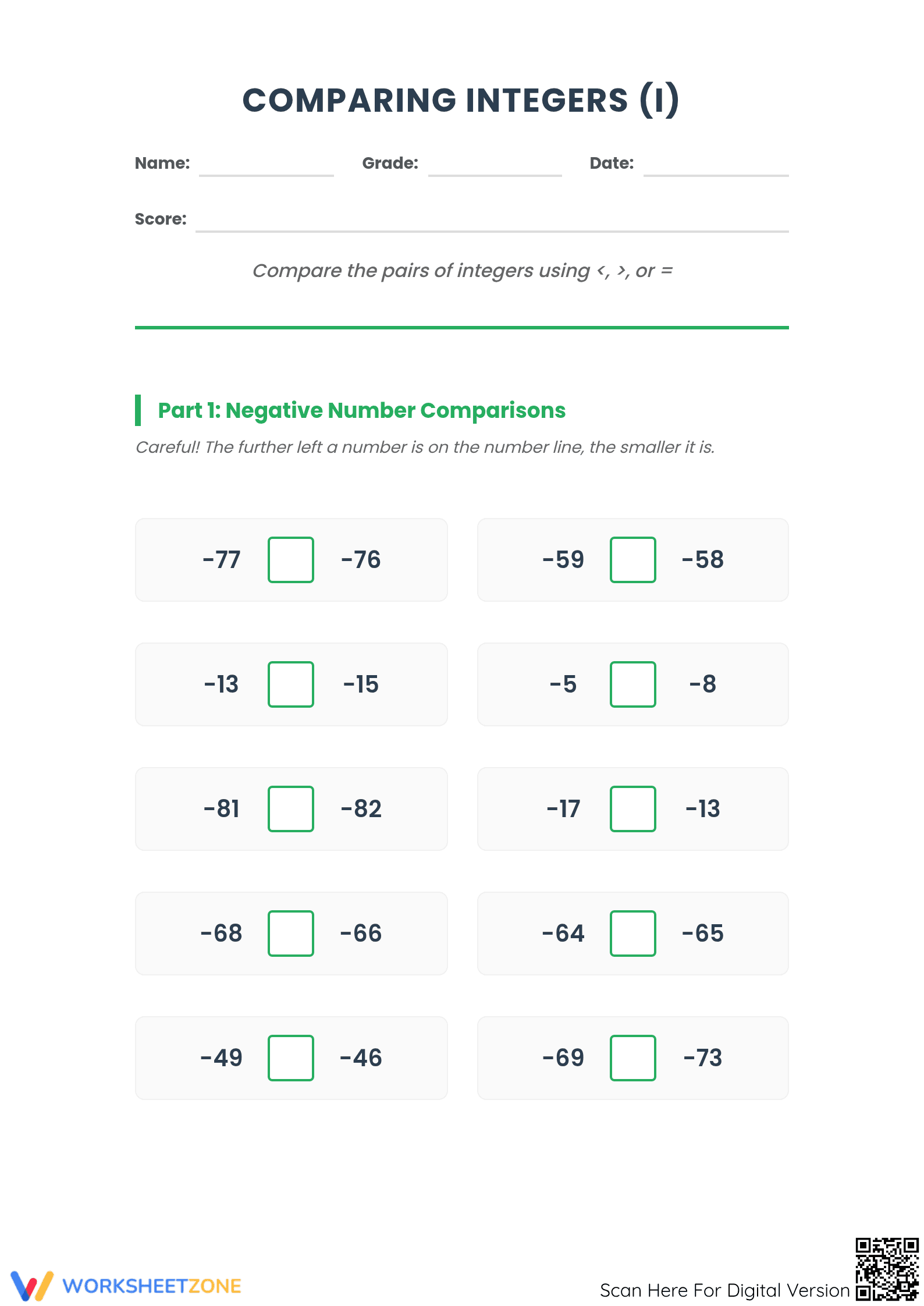
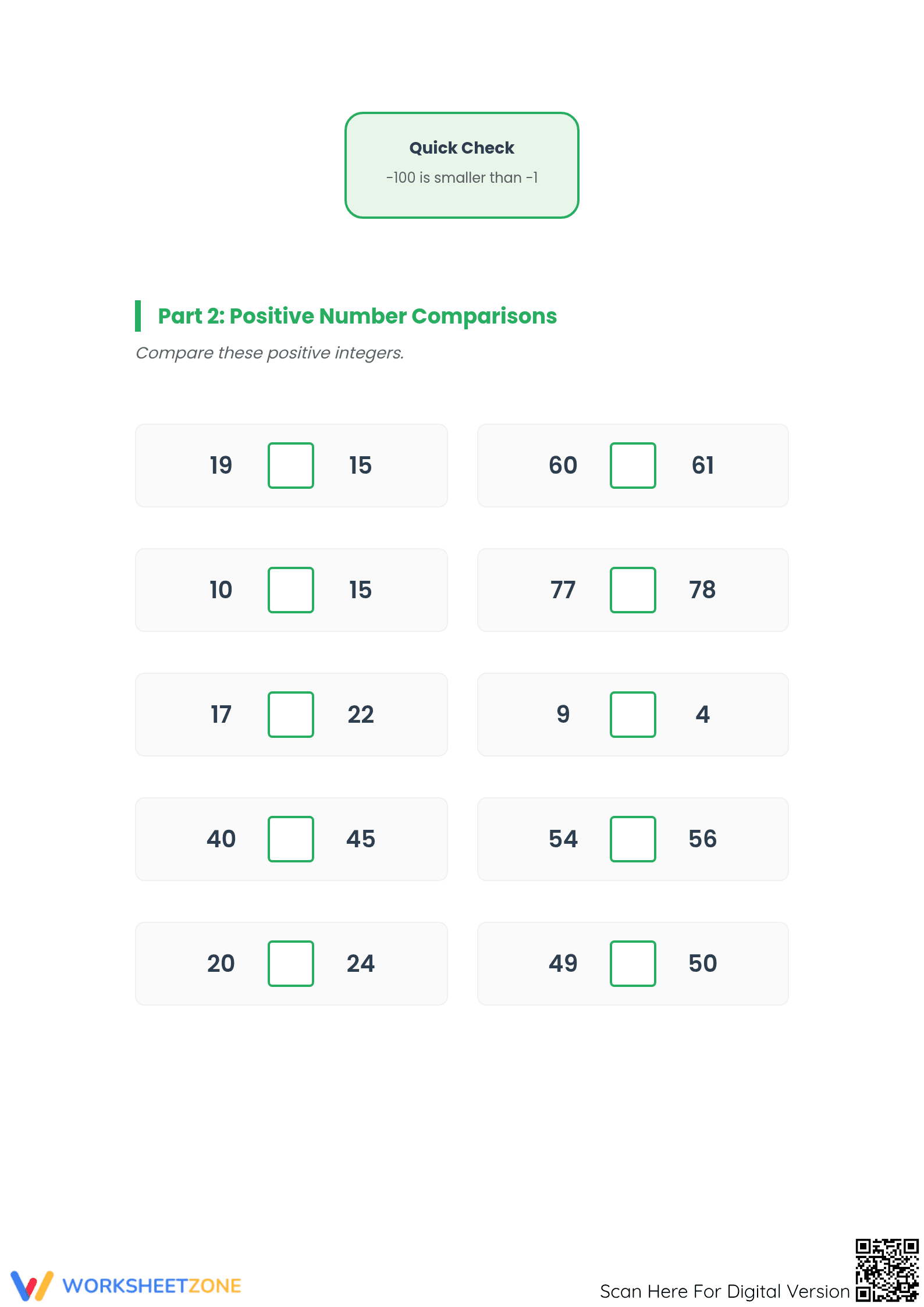
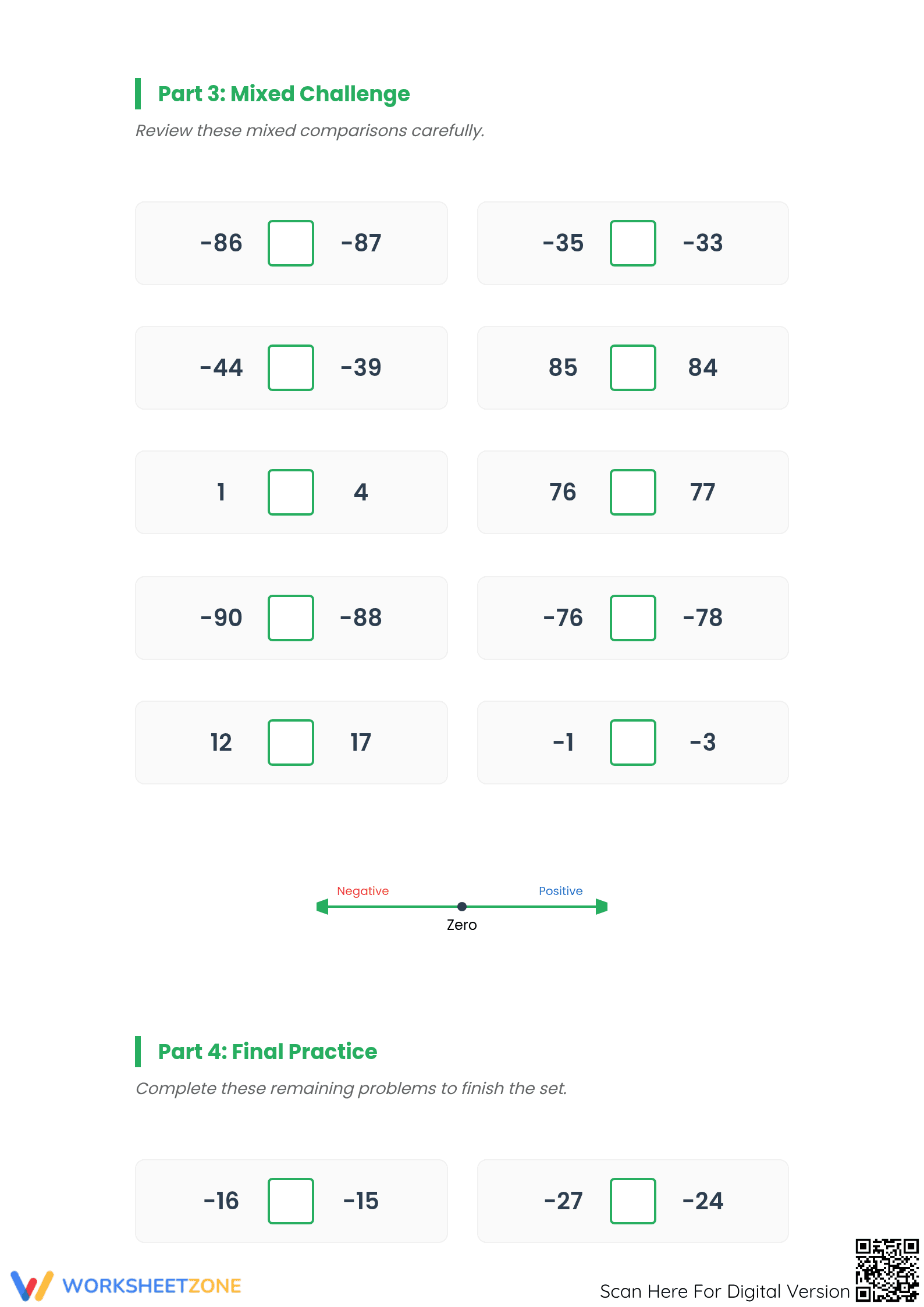
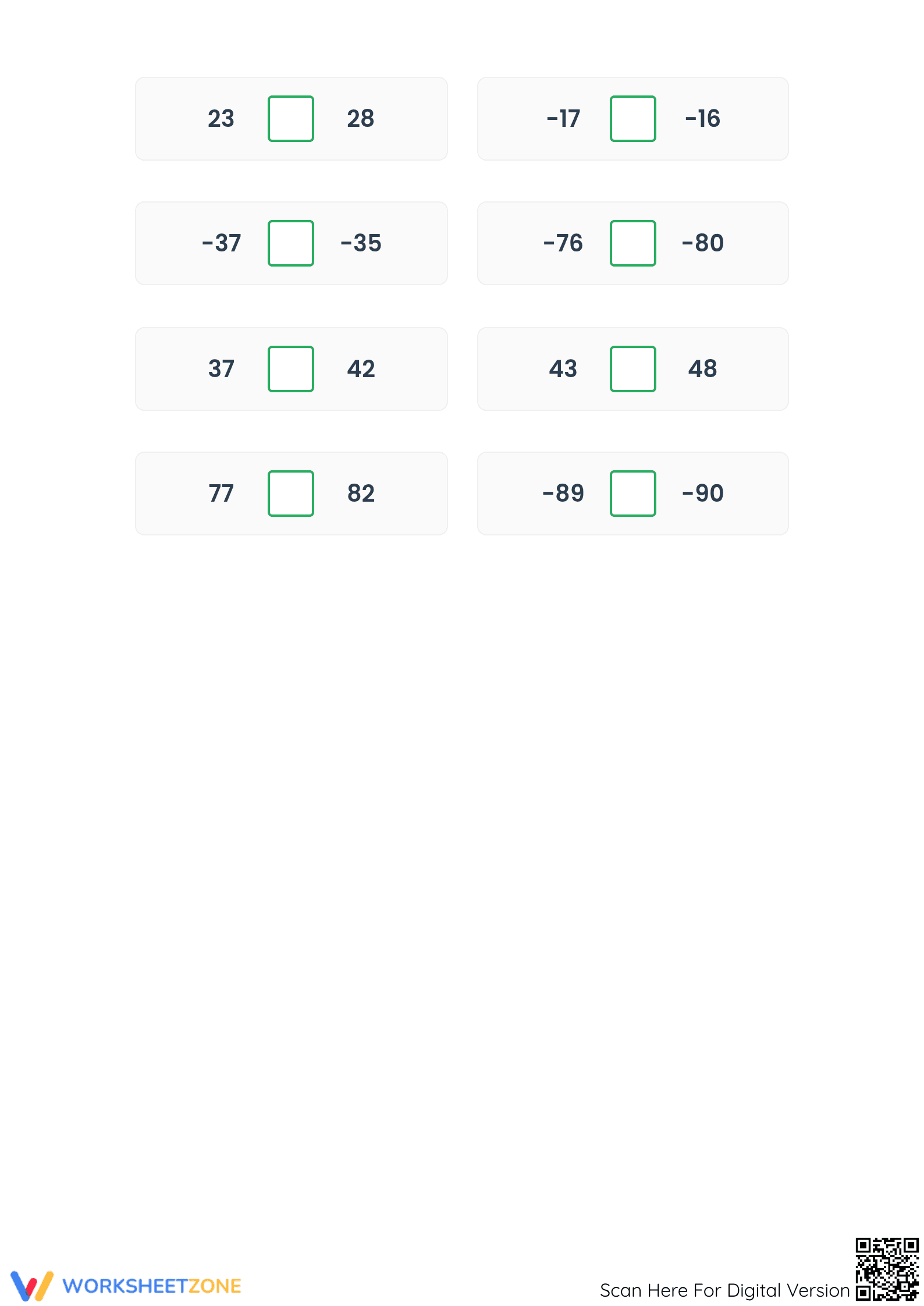
This four-page packet contains 40 targeted problems. Page one focuses on negative pairs, while page two moves to positive integers. The third page presents a mixed challenge supported by a number line visual. The final page provides a comprehensive practice set. Each section includes helpful tips to remind students that values further left are always smaller.
The zero-prep workflow is designed for efficiency. Teachers can print the set in under 30 seconds. Distribution takes one minute, with "Quick Check" boxes allowing students to begin immediately. Reviewing is streamlined by the included answer key. Total teacher preparation time is less than two minutes, making it ideal for sub plans or skill reinforcement.
Aligned to CCSS.MATH.CONTENT.6.NS.C.7, this resource helps students "interpret statements of inequality as statements about the relative position of two numbers on a number line." It provides the scaffolding for Grade 5 students transitioning into middle school number systems. This standard code can be copied directly into lesson plans or curriculum mapping tools.
Deploy this as a station activity. Students work through sections independently, using the mixed challenge as a benchmark. Alternatively, use page one as a "do-now" entry task to gauge prior knowledge. If students struggle with negative comparisons, provide a physical number line to reinforce the spatial concept. Completion time is 25 minutes.
Designed for Grade 5 students introduced to integers, this is effective for visual learners who benefit from number line diagrams. The repetitive structure supports students with executive functioning challenges. This resource pairs naturally with an interactive number line or a digital lesson, bridging the gap between symbols and physical position.
Integrating structured integer comparison tasks is supported by the RAND AIRS 2024 report, which emphasizes early exposure to non-positive numbers to prevent "whole number bias." Research indicates that students mastering the spatial relationship of integers—specifically that value decreases as one moves left—demonstrate higher proficiency in algebra. This worksheet facilitates this shift by isolating negative-to-negative comparisons, identified by Fisher & Frey (2014) as a primary hurdle in mathematical literacy. By providing 40 opportunities for application of CCSS.MATH.CONTENT.6.NS.C.7, this resource ensures the "further left is smaller" rule is internalized through repetitive practice. Educators can cite this as a verified tool for building mental models required for rational number reasoning. This systematic approach allows Grade 5 learners to build the prerequisite skills for coordinate geometry and advanced number system operations found in middle school curricula.


