


























Views
Downloads
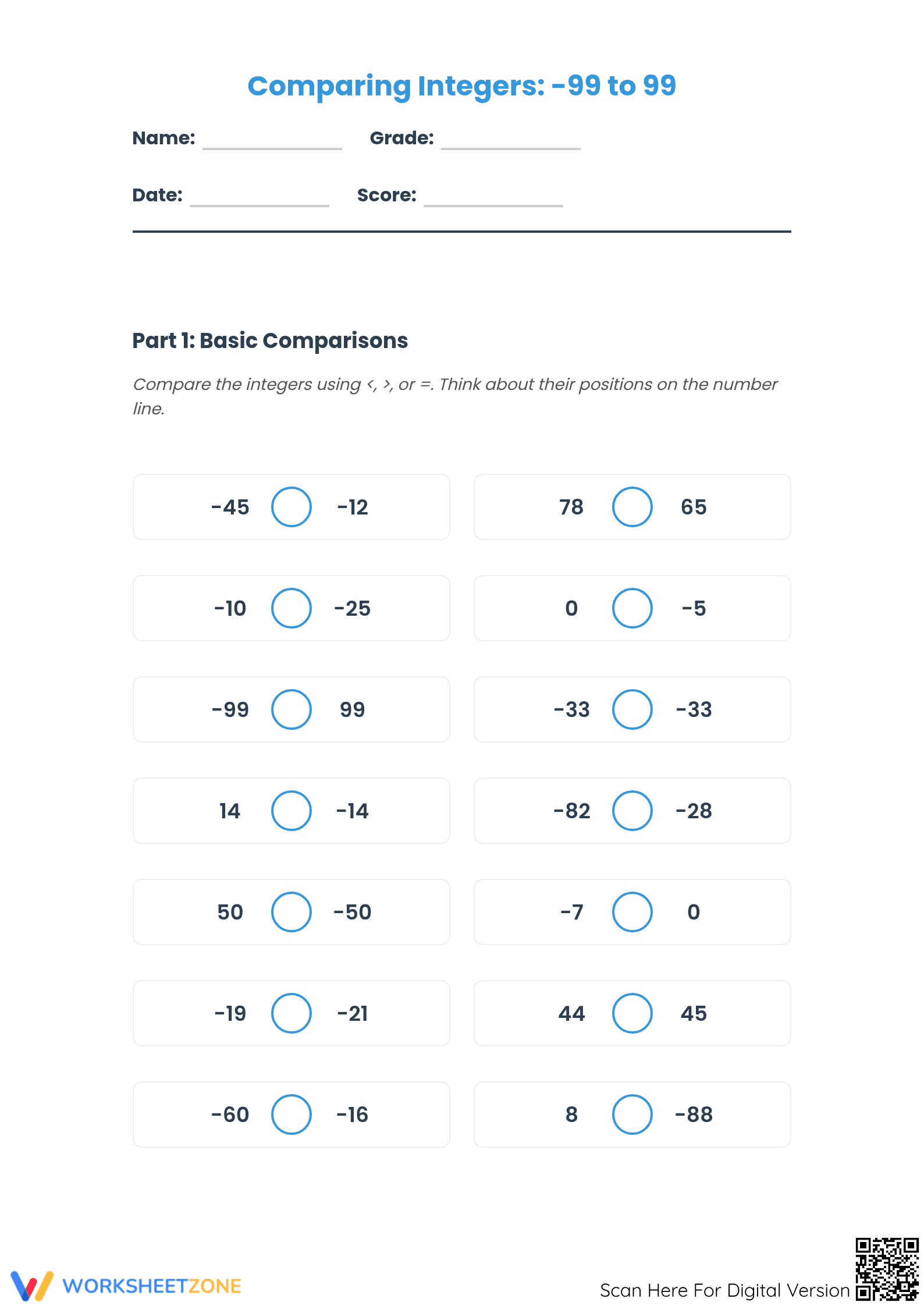
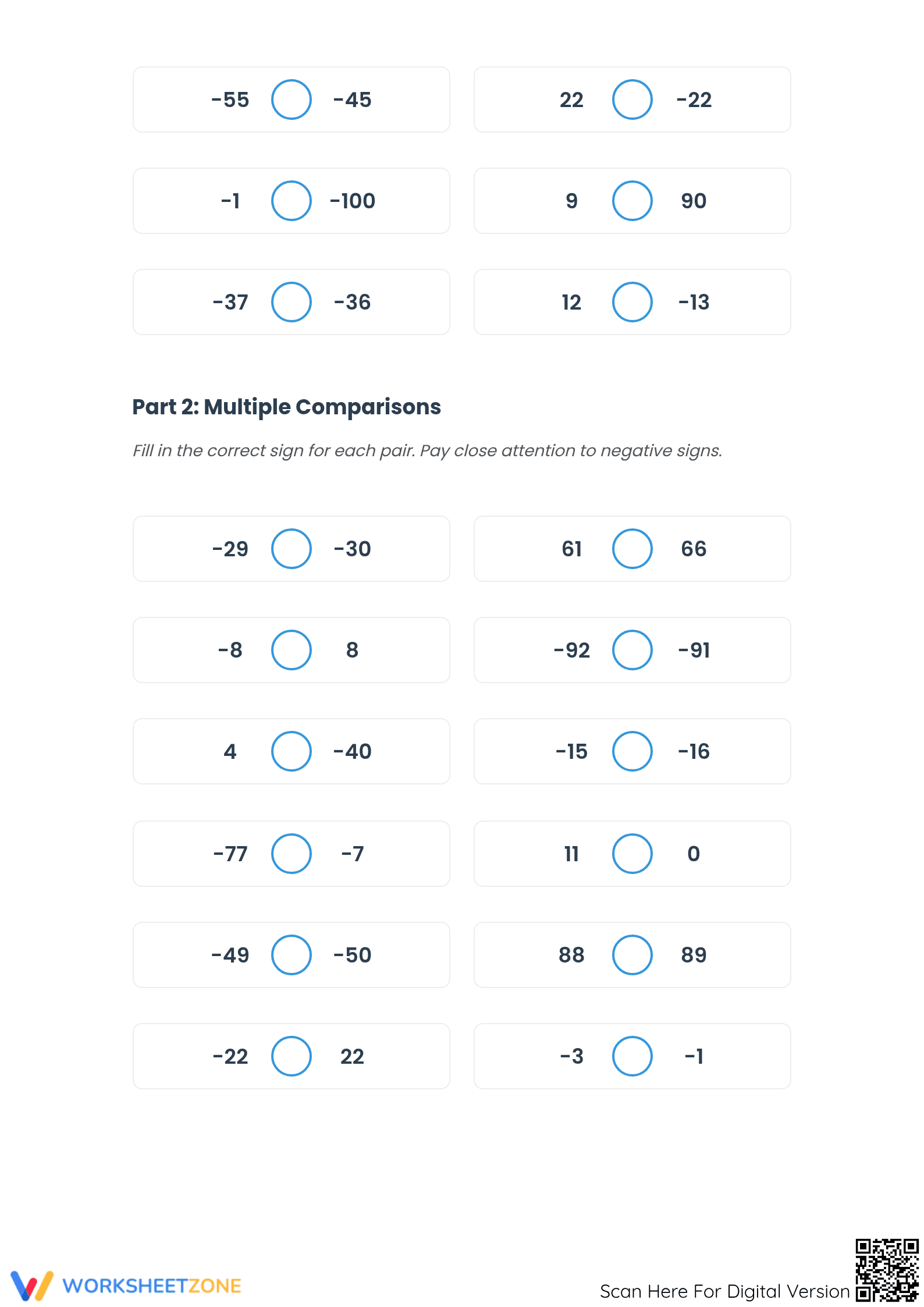
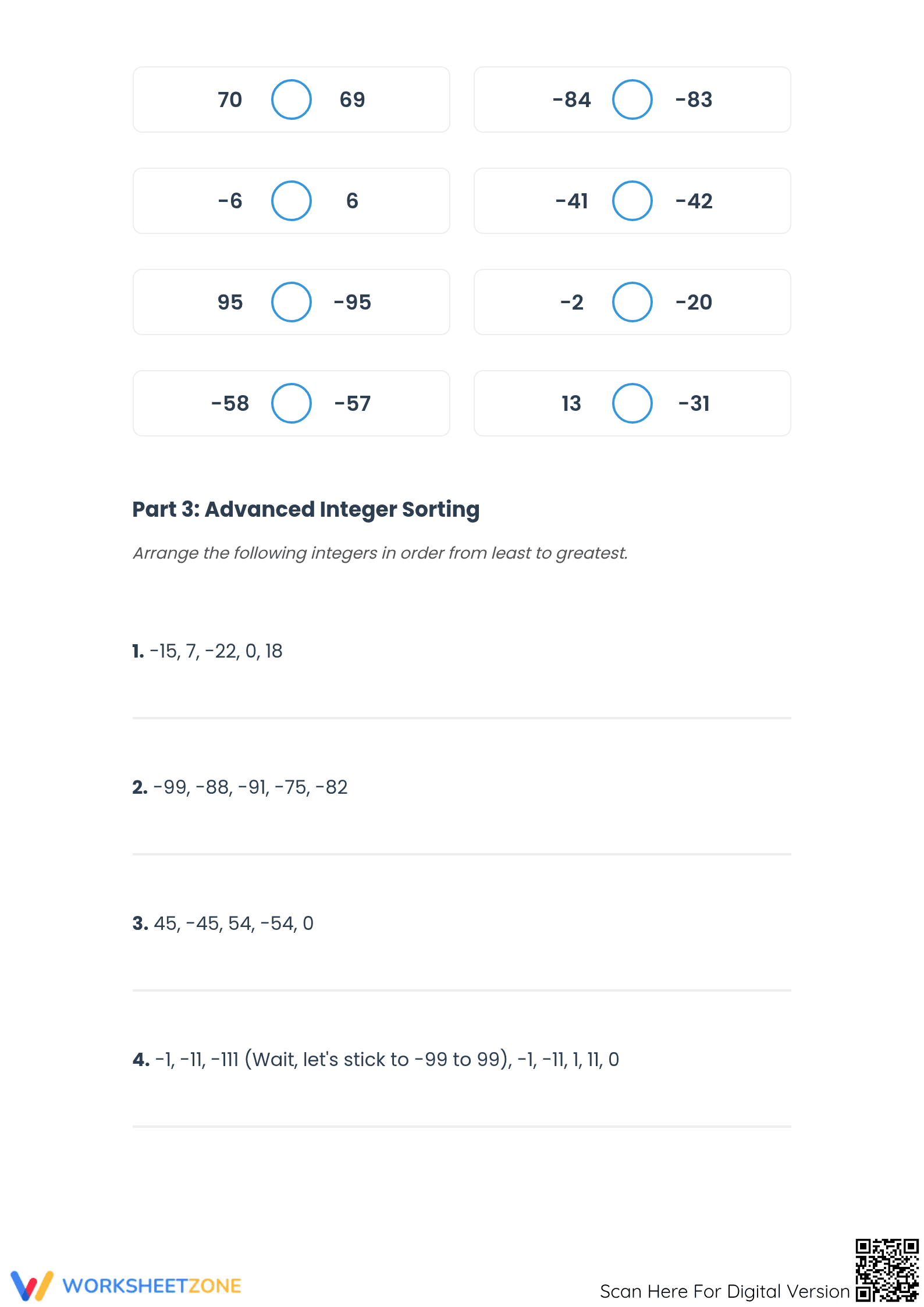
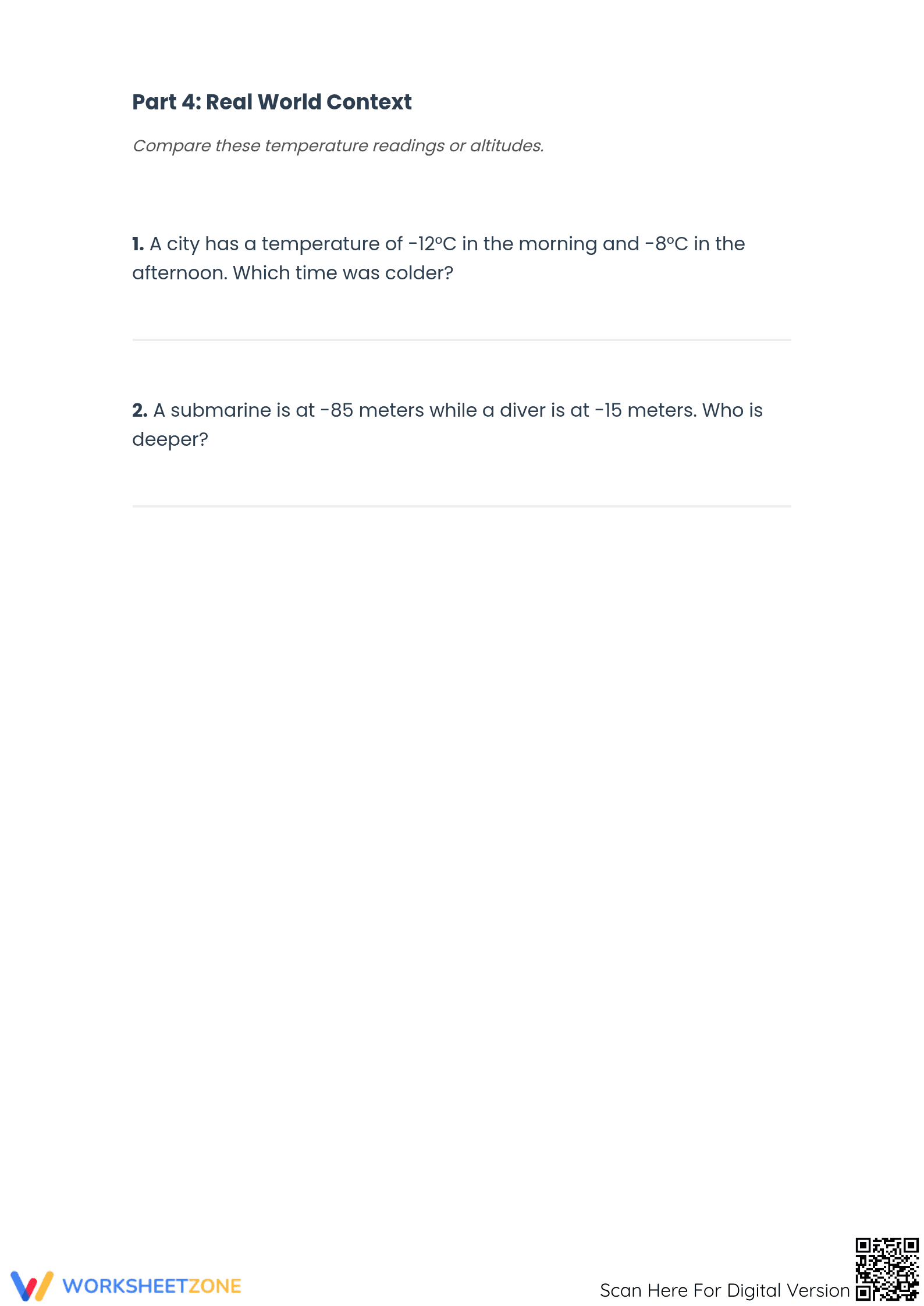

Grade 5 Comparing Integers — Printable No-Prep Worksheet
Paste this activity's link or code into your existing LMS (Google Classroom, Canvas, Teams, Schoology, Moodle, etc.).
Students can open and work on the activity right away, with no student login required.
You'll still be able to track student progress and results from your teacher account.
This Grade 5 integers worksheet provides comprehensive practice for students to master the comparison and ordering of positive and negative numbers between -99 and 99. Students develop a deep understanding of number line placement and relative values through 46 structured problems, ensuring they can confidently identify which integer is greater in both abstract and real-world contexts.
At a Glance
- Grade: 5 · Subject: Math
- Standard:
CCSS.MATH.CONTENT.6.NS.C.7— Compare and order integers from -99 to 99 and solve real-world problems- Skill Focus: Comparing and ordering integers (-99 to 99)
- Format: 4 pages · 46 problems · Answer key included · PDF
- Best For: Independent practice and real-world math application
- Time: 25–35 minutes
This four-page PDF includes four distinct sections: basic comparisons, multiple sign checks, advanced integer sorting from least to greatest, and real-world application word problems. The resource features clear, legible boxes for students to write comparison symbols and includes a complete answer key for rapid grading or student self-correction.
Zero-Prep Workflow
- Step 1: Print — Select the four-page PDF and print enough copies for your class in approximately 30 seconds.
- Step 2: Distribute — Hand out the worksheets as a transition activity or a focused math station requiring only 1 minute of setup.
- Step 3: Review — Use the provided answer key to grade the 46 tasks or have students peer-review their sorting and word problem logic.
Total teacher prep time is under 2 minutes. This comprehensive set is a perfect sub-plan solution or a ready-made formative assessment for the introduction of negative numbers.
Standards Alignment
Aligned to CCSS.MATH.CONTENT.6.NS.C.7. This standard requires students to "Understand ordering and absolute value of rational numbers." While typically a Grade 6 anchor, this Grade 5 resource scaffolds the concept using integers from -99 to 99 to prepare students for higher-level algebraic thinking and coordinate plane navigation. Both standard codes can be copied directly into lesson plans, IEP goals, or district curriculum mapping tools.
How to Use It
Use this worksheet during the independent practice phase of a lesson on the number line to solidify the concept that larger absolute values in negative numbers represent smaller total values. Alternatively, assign the real-world context section as a quick formative assessment exit ticket to observe if students can translate abstract integer comparison to practical scenarios like temperature changes or altitude depths. Completion typically takes 30 minutes.
Who It's For
This resource is designed for fifth-grade students beginning their journey with negative numbers, but it also serves as an excellent intervention tool for sixth-grade students needing remediation. It pairs naturally with a vertical number line anchor chart or a digital thermometer simulation to provide visual support for struggling learners who benefit from concrete representations of value.
Research from EdReports 2024 highlights that high-quality instructional materials must explicitly bridge the gap between abstract mathematical operations and situational problem-solving to ensure long-term mastery. This worksheet aligns with those findings by progressing from simple comparison tasks to complex sorting and finally to real-world applications involving temperature and depth. By engaging with 46 varied problems, students move beyond rote memorization of rules and begin to internalize the spatial logic of the number line. The inclusion of the CCSS.MATH.CONTENT.6.NS.C.7 standard ensures that the practice remains rigorous and relevant for middle-school readiness. This structured approach mirrors the Fisher & Frey (2014) model of gradual release, providing enough repetition to build fluency while challenging students to apply their knowledge in unfamiliar contexts, ultimately fostering a more robust numerical intuition that supports future algebra success.


