


























Views
Downloads

Printable Comparing Integers Worksheet | Grade 5 Math
Paste this activity's link or code into your existing LMS (Google Classroom, Canvas, Teams, Schoology, Moodle, etc.).
Students can open and work on the activity right away, with no student login required.
You'll still be able to track student progress and results from your teacher account.
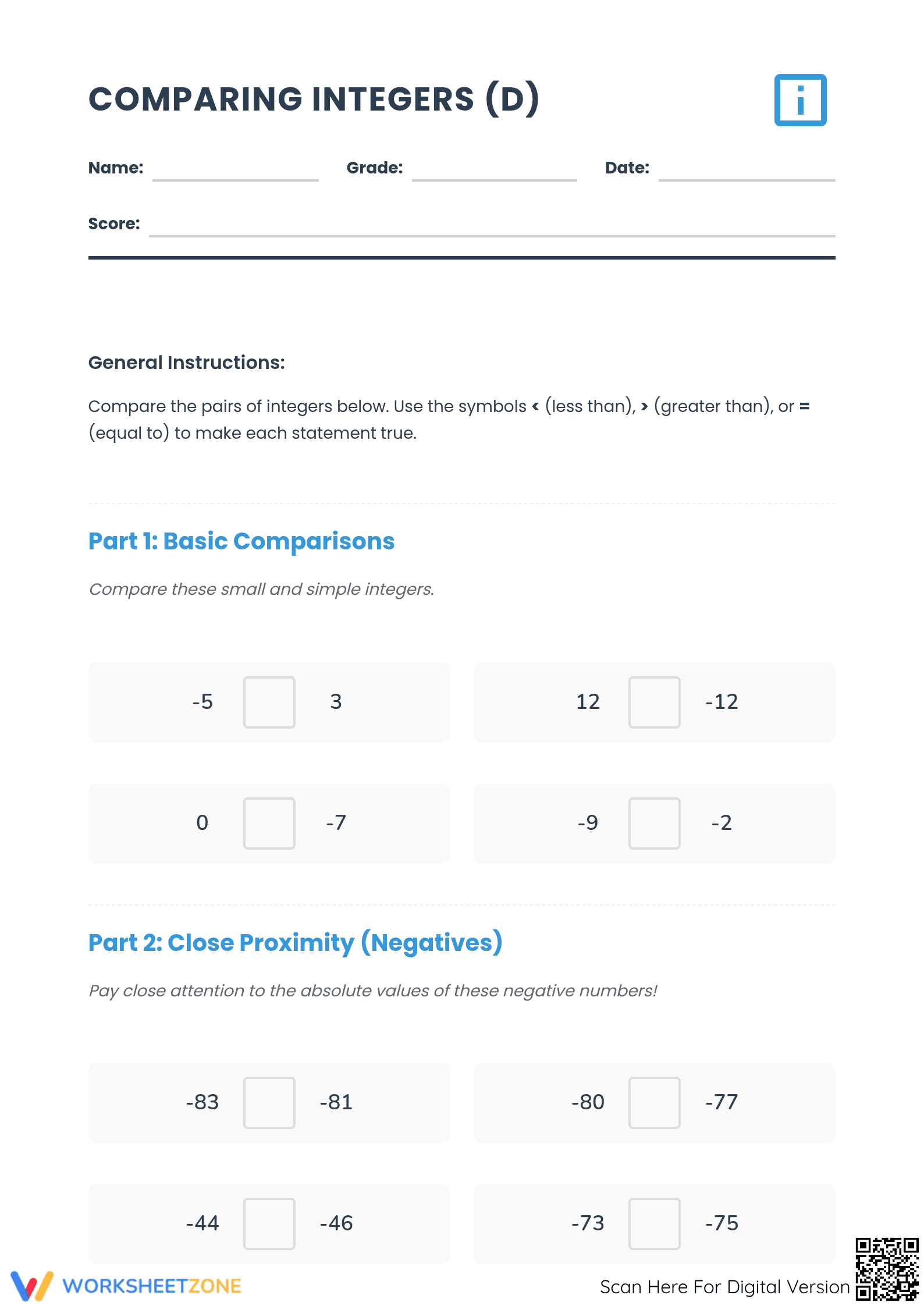
This Grade 5 Math worksheet provides a robust framework for mastering the comparison of integers from -99 to 99. With 50 targeted problems, students develop a conceptual understanding of numerical relationships. The exercises ensure learners can accurately evaluate values, focusing on the relationship between absolute value and magnitude in negative numbers.
At a Glance
- Grade: 5 · Subject: Math
- Standard:
CCSS.MATH.CONTENT.6.NS.C.7— Understand ordering and absolute value of rational numbers in real-world contexts.- Skill Focus: Comparing Integers (-99 to 99)
- Format: 4 pages · 50 problems · Answer key included · PDF
- Best For: Independent practice and number sense reinforcement
- Time: 25–35 minutes
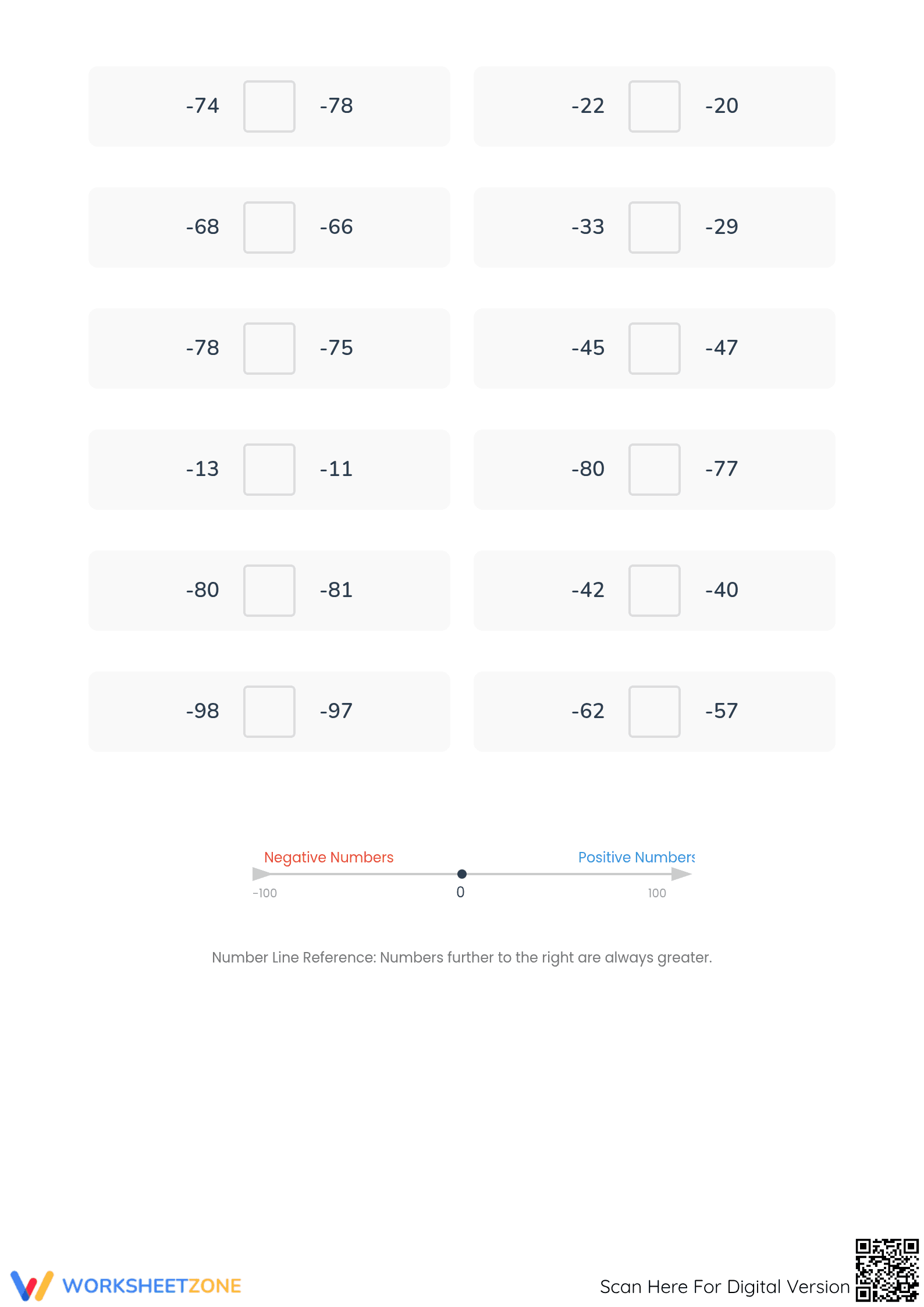
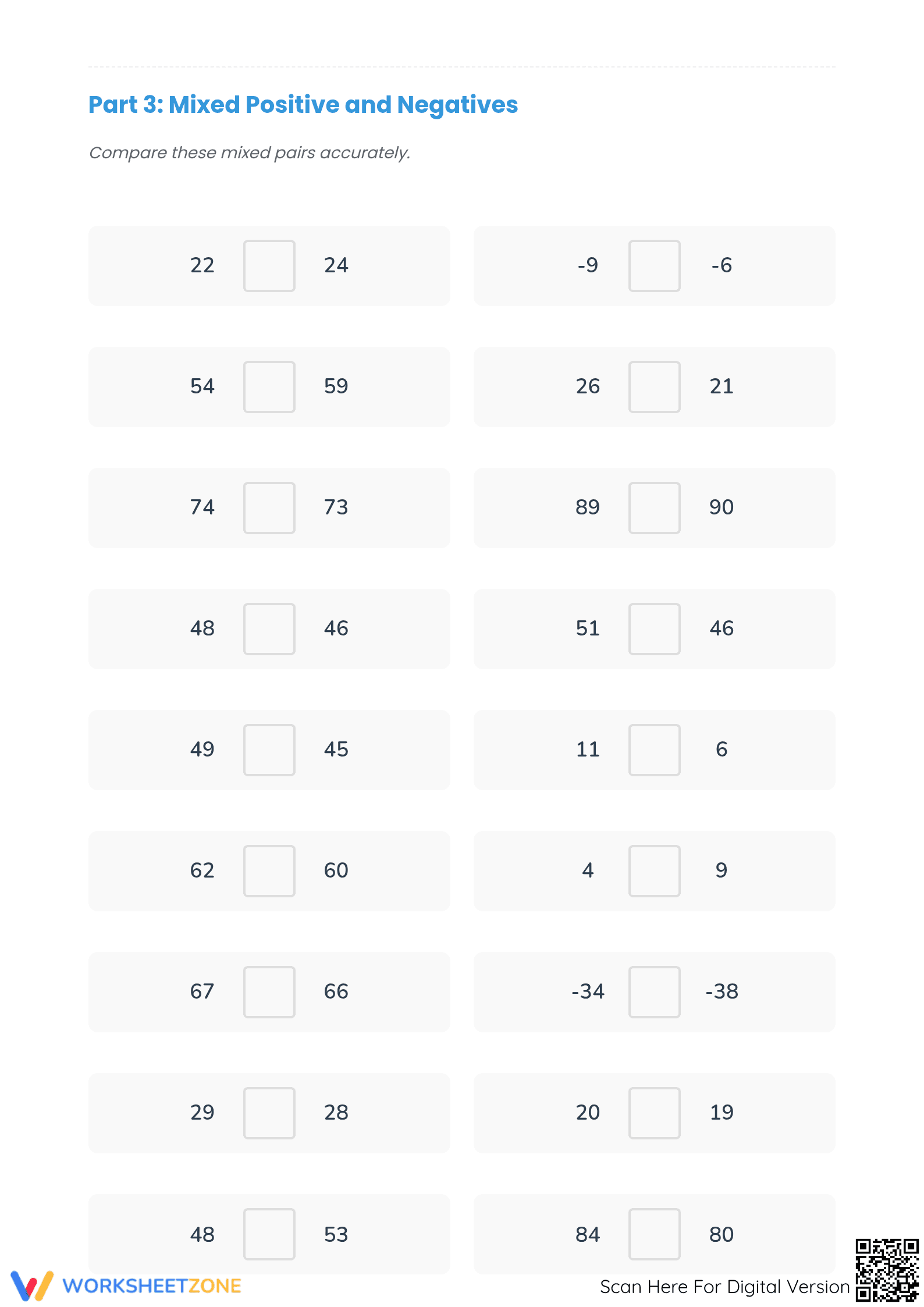
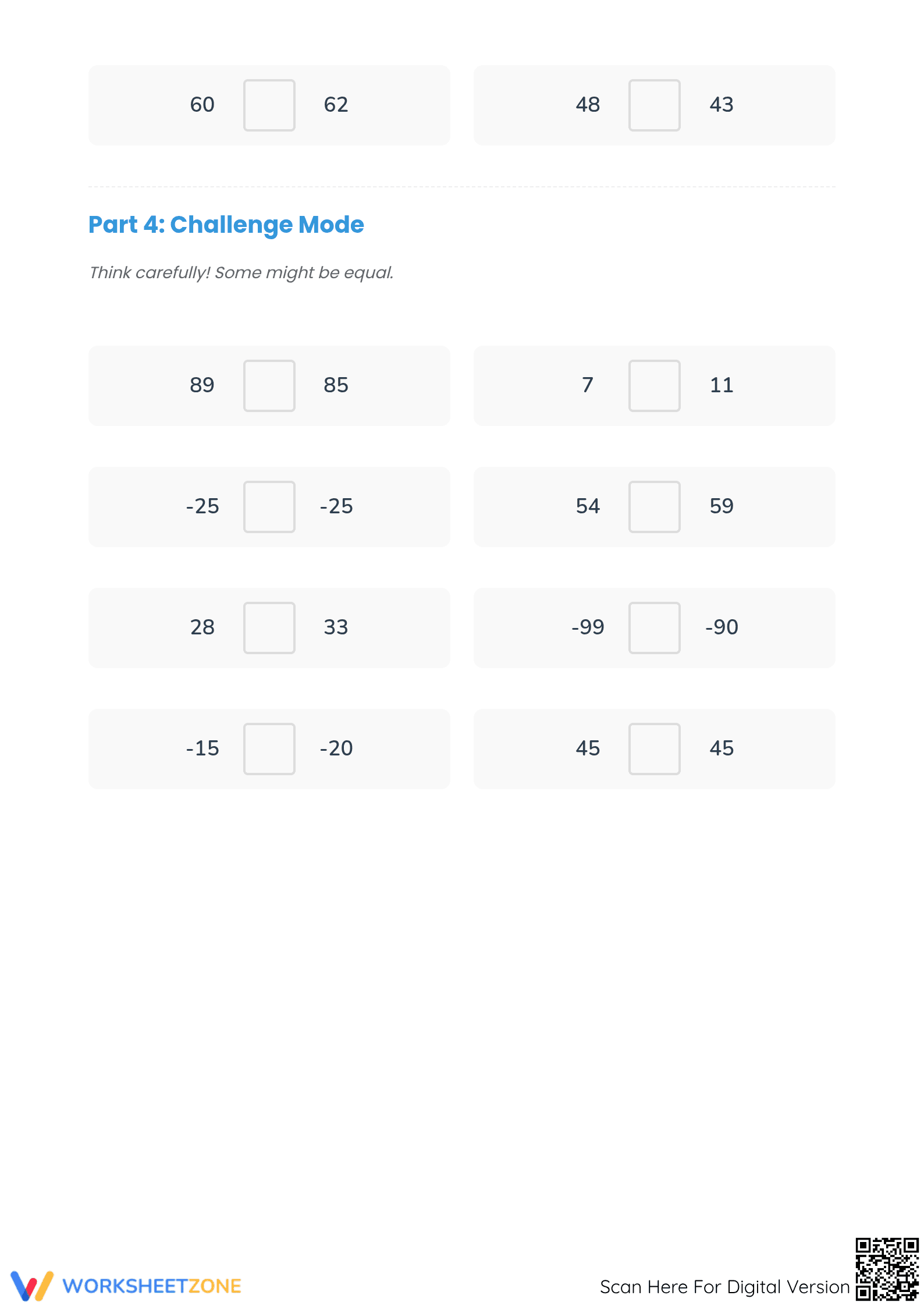
This four-page packet includes basic comparisons, close-proximity negatives, mixed pairs, and a challenge mode. A number line reference provides visual support, helping students visualize magnitude. The included answer key ensures quick grading and immediate feedback for both students and teachers during classroom practice sessions.
Skill Progression
- Guided Practice: 8 foundational problems establish the basic comparison workflow and introduce symbols.
- Supported Practice: 12 specialized problems focus on negative numbers in close proximity to challenge misconceptions.
- Independent Practice: 30 final problems challenge students with mixed sets and complex pairs in challenge mode.
This sequence follows a gradual-release model to build student mastery and ensure confidence before tackling complex operations with rational numbers.
Aligned with standard `CCSS.MATH.CONTENT.6.NS.C.7`, students interpret statements of inequality as relative positions on a number line. This standard code can be copied directly into lesson plans or district curriculum mapping tools to document progress toward rational number proficiency and bridge gaps between elementary and middle school mathematics.
Assign this as independent practice or a bell ringer. It works well as a formative assessment to identify misconceptions about negative numbers. For a quick check, review student performance on Part 2. Expected completion time is 25 to 35 minutes.
This resource is designed for Grade 5 students needing enrichment or Grade 6 students requiring remediation. It serves as an excellent sub plan or intervention tool. Pair this with a physical number line activity to help kinesthetic learners grasp the concept more effectively.
The development of integer comprehension in middle childhood represents a critical shift from whole-number bias to a bidirectional understanding of the number line. This worksheet, aligned with standard `CCSS.MATH.CONTENT.6.NS.C.7`, addresses the common misconception that a larger absolute value corresponds to a larger quantity in the negative realm. By providing 50 scaffolded problems that range from basic comparisons to close-proximity negative pairs, the resource mirrors the high-quality instructional materials advocated by the RAND AIRS 2024 report on mathematical fluency. Effective instruction in integers requires students to move beyond rote memorization of rules toward a conceptual model where numbers further to the right are always greater. Research by Fisher & Frey (2014) emphasizes that such structured practice is essential for stabilizing these abstract concepts before progressing to operations. This comprehensive packet ensures that learners develop the necessary precision to evaluate numeric relationships across the zero-point boundary with confidence.


