


























Views
Downloads

Essential Comparing Integers Worksheet | Grade 5 Math
Paste this activity's link or code into your existing LMS (Google Classroom, Canvas, Teams, Schoology, Moodle, etc.).
Students can open and work on the activity right away, with no student login required.
You'll still be able to track student progress and results from your teacher account.
Mastering the relationship between positive and negative numbers is a critical milestone in middle-grade mathematics. This comprehensive worksheet guides Grade 5 students through the intricacies of integer comparison, moving from basic symbolic inequalities to complex real-world applications like temperature and elevation. Students build a robust mental number line, ensuring long-term success in algebraic thinking and rational number operations.
At a Glance
- Grade: 5 · Subject: Math
- Standard:
CCSS.MATH.CONTENT.6.NS.C.7.A— Interpret statements of inequality as relative positions on a number line diagram- Skill Focus: Integer Comparison and Ordering
- Format: 3 pages · 53 problems · Answer key included · PDF
- Best For: Independent practice or substitute teacher plans
- Time: 25–35 minutes
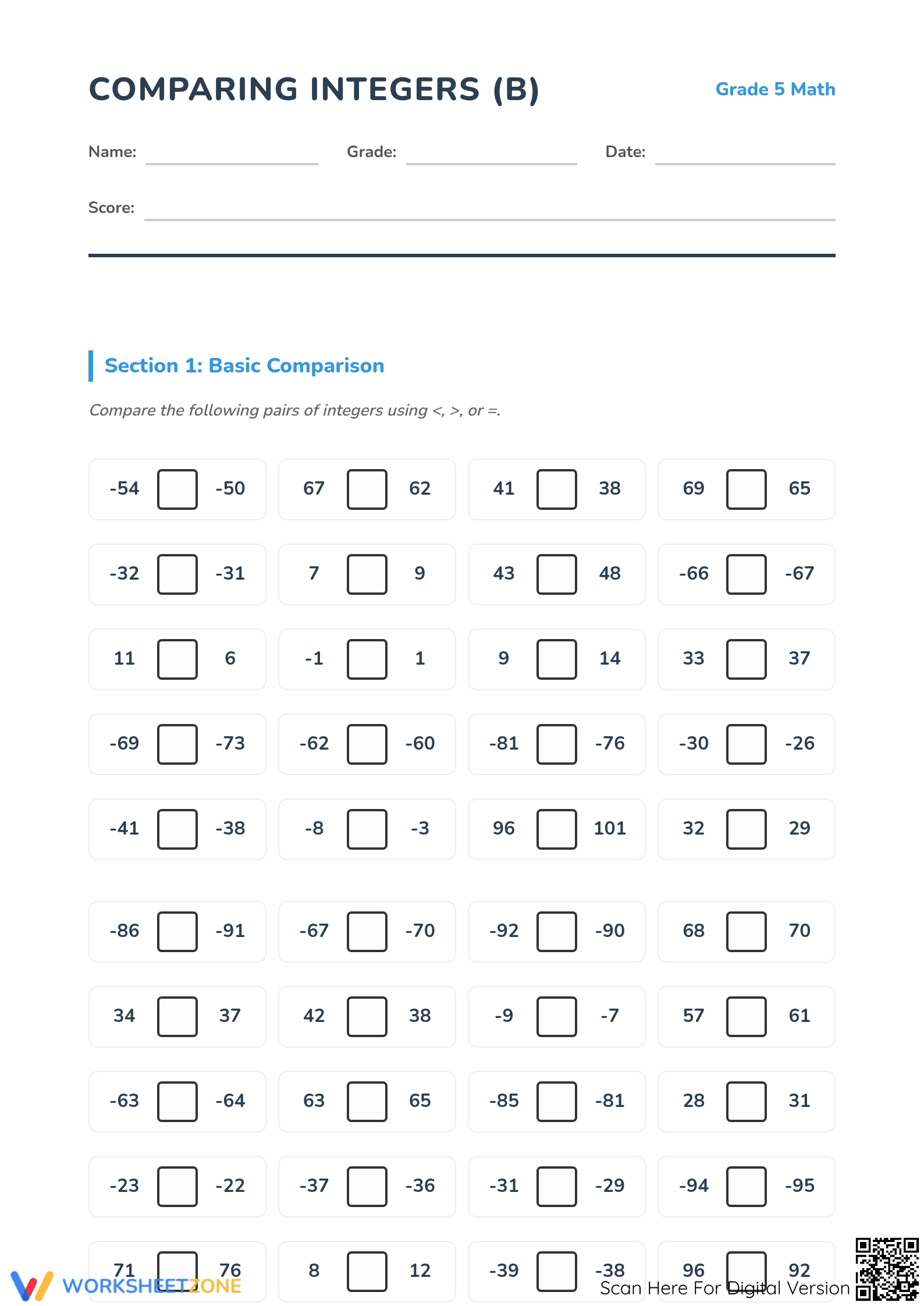
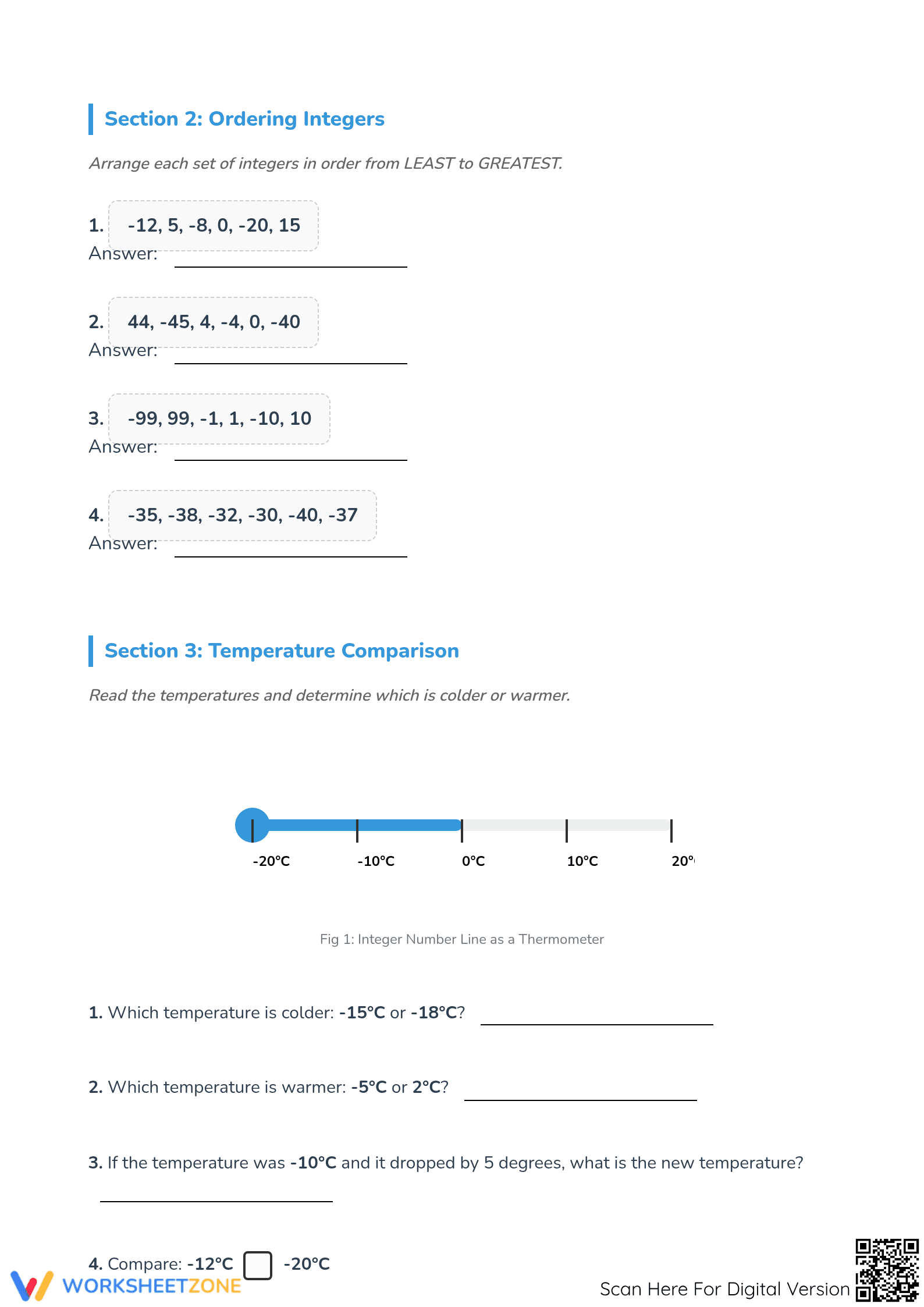
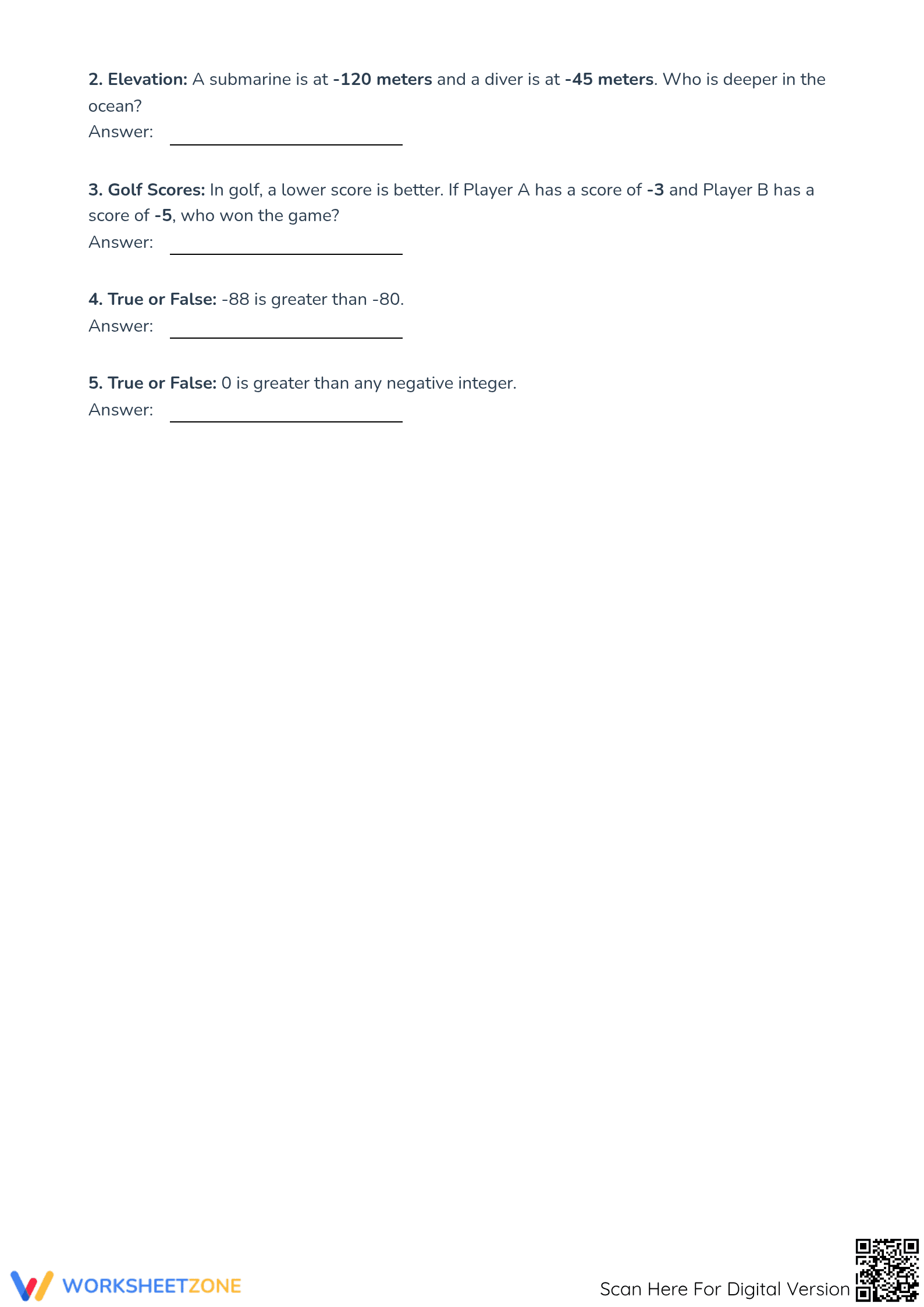
The resource consists of three structured pages totaling 53 unique tasks. The first page features 40 rapid-fire comparison problems using inequalities. The second page introduces ordering sets from least to greatest and a visual thermometer number line for temperature context. Finally, the third page challenges students with real-world word problems involving elevation and golf scores, alongside conceptual true-or-false questions. A full answer key is included for rapid grading.
Zero-Prep Workflow
- Print: Generate the three-page PDF in seconds for immediate use.
- Distribute: Hand out to students for a complete 30-minute instructional block.
- Review: Utilize the integrated answer key or the digital scan code for rapid student feedback.
This "print-and-go" design ensures high-quality instruction remains consistent even during emergency sub days or busy morning transitions, requiring less than two minutes of total teacher setup.
Standards Alignment
The primary focus is CCSS.MATH.CONTENT.6.NS.C.7.A, requiring students to "Interpret statements of inequality as statements about the relative position of two numbers on a number line diagram." While for Grade 5, it bridges to Grade 6 standards by incorporating ordering 6.NS.C.7.B and context-driven signs. These standard codes can be copied directly into lesson plans or curriculum mapping tools.
How to Use It
Use this worksheet as a summative assessment after a unit on the number system to gauge mastery of integer relationships. It also serves as an excellent formative tool during small-group instruction; teachers should observe if students mistakenly equate a larger absolute value with a larger integer (e.g., thinking -10 is greater than -2). Expect students to complete the entire set in 25 to 35 minutes depending on their familiarity with negative numbers.
Who It's For
This resource is designed for Grade 5 or 6 students beginning their journey with rational numbers. It provides essential scaffolding for English Language Learners through visual aids like the thermometer number line. It pairs naturally with a physical classroom number line or a direct instruction lesson on the "greater than" symbol pointing toward the right on a horizontal axis.
According to the ScienceDirect TpT Analysis, math worksheets integrating symbolic practice with real-world contexts—like temperature and elevation—improve conceptual retention in middle-grade learners. This resource aligns with these findings, providing 53 structured tasks moving students from calculation to applied problem-solving. By utilizing the CCSS.MATH.CONTENT.6.NS.C.7.A framework, students develop a dual understanding of integers: as abstract symbols and representations of physical reality. Diverse task types, from ordering sets to interpreting golf scores, ensure learners engage across cognitive levels. This multi-modal approach reduces the cognitive load of introducing negative values. Educators can confidently implement this standards-aligned tool to bridge achievement gaps in rational number operations, providing a proven foundation for future algebraic success. The inclusion of word problems reinforces the practical utility of integers in everyday life, fostering deeper mathematical fluency and quantitative reasoning skills essential for secondary education.


