


























Views
Downloads
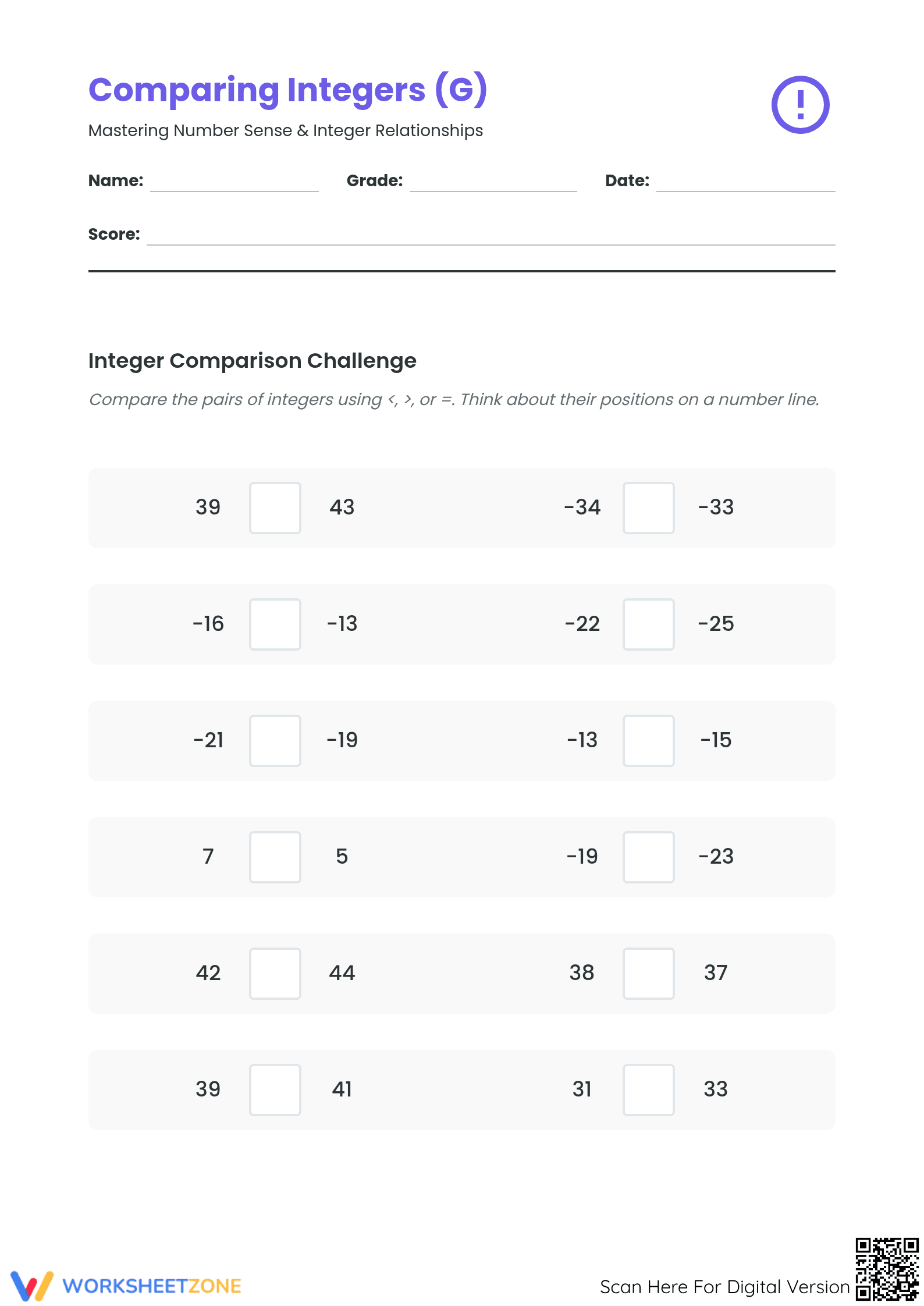

Printable Comparing Integers Worksheet | Grade 5 Math
Paste this activity's link or code into your existing LMS (Google Classroom, Canvas, Teams, Schoology, Moodle, etc.).
Students can open and work on the activity right away, with no student login required.
You'll still be able to track student progress and results from your teacher account.
Strengthen student understanding of number systems with this comprehensive comparing integers worksheet. This resource provides structured practice for Grade 5 students to master the relationships between positive and negative numbers. By working through these problems, learners develop the essential mental models required for higher-level algebra and real-world mathematical applications.
At a Glance
- Grade: 5 · Subject: Math
- Standard:
CCSS.MATH.CONTENT.6.NS.C.7— Understand ordering and absolute value of rational numbers on a number line- Skill Focus: Integer Comparison (<, >, =)
- Format: 3 pages · 42 problems · Answer key included · PDF
- Best For: Independent practice and homework assignments
- Time: 20–30 minutes
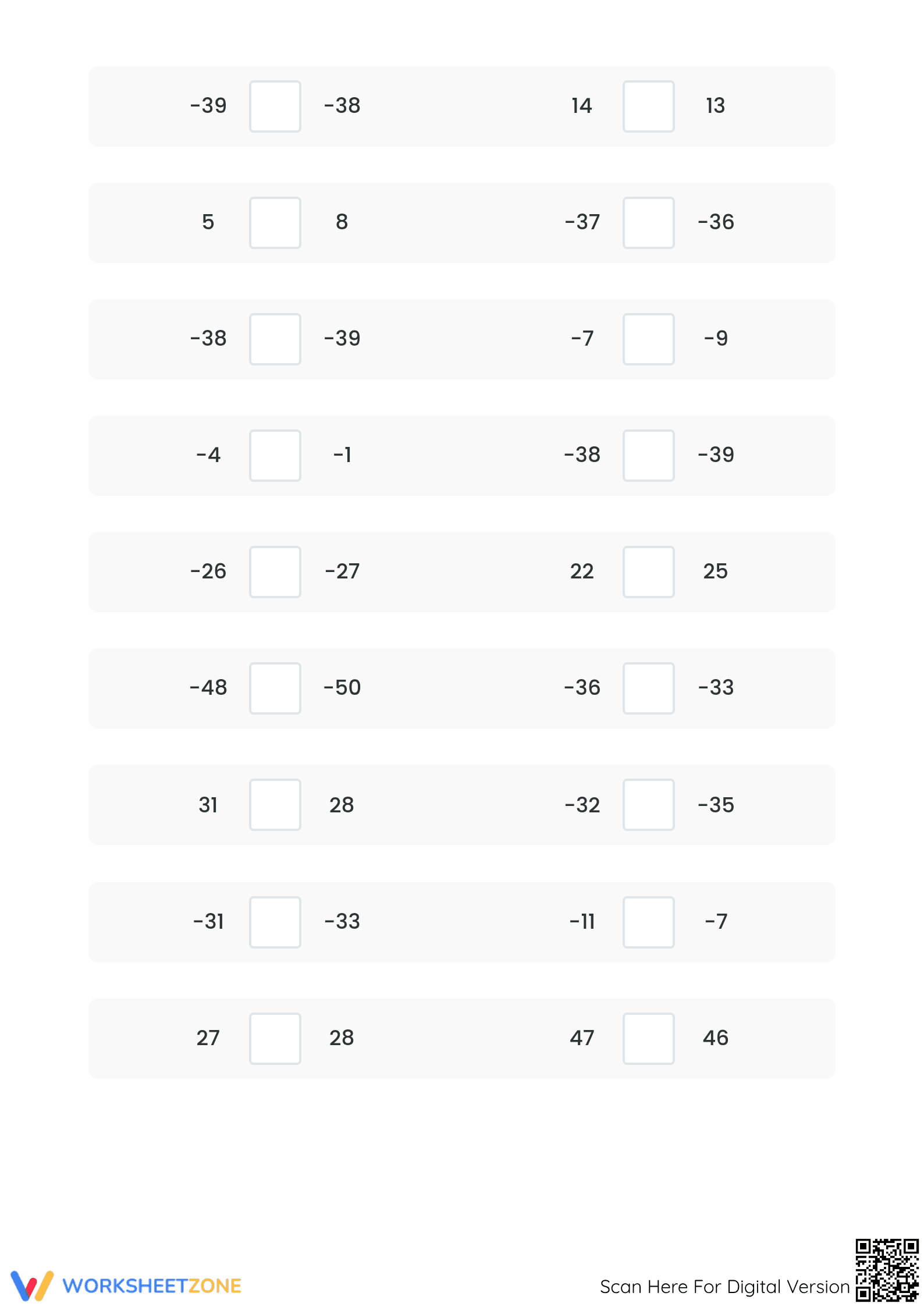
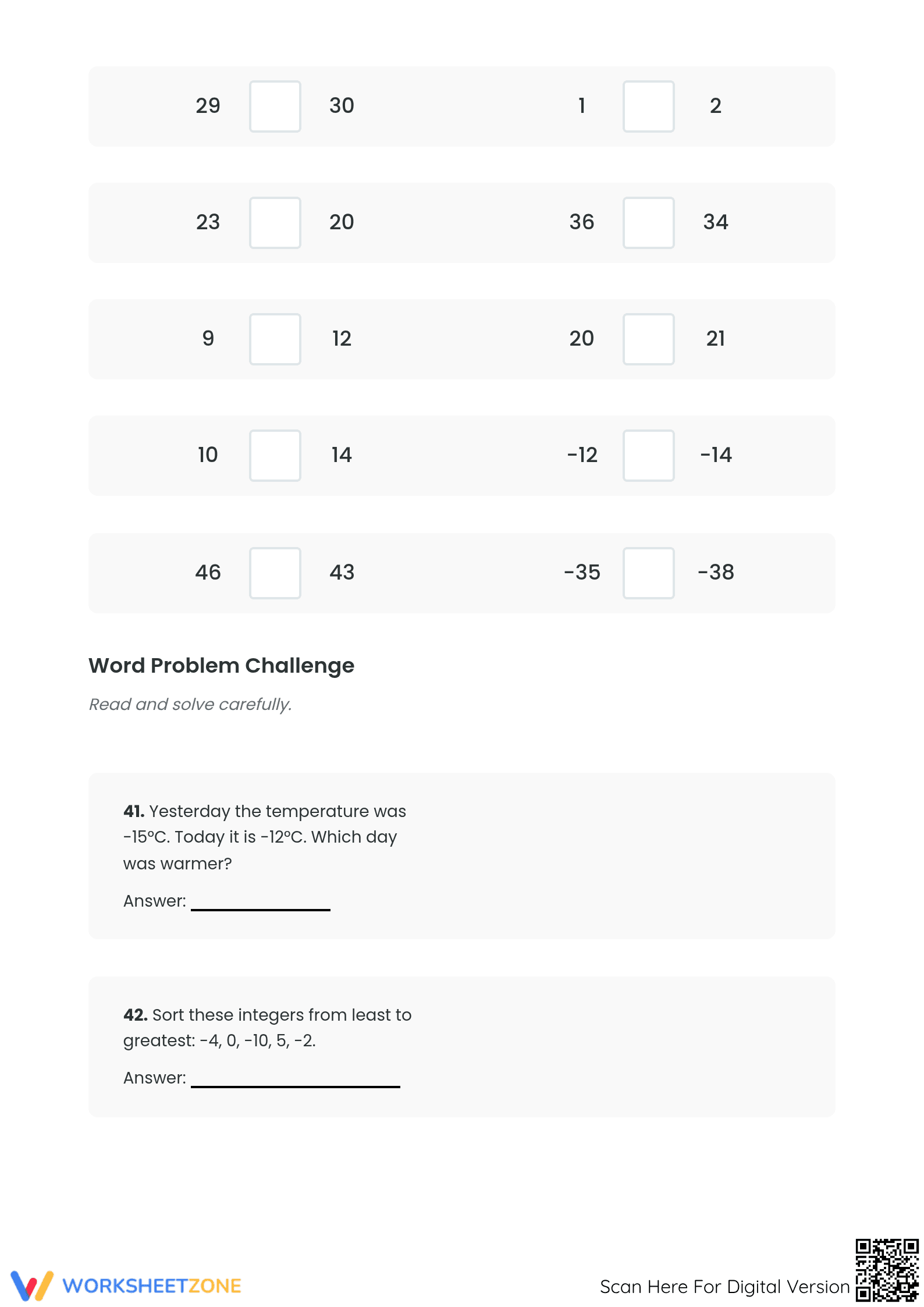
This three-page PDF offers a robust set of 42 tasks designed to move students from basic recognition to conceptual mastery. The layout features clear, high-contrast text and dedicated response boxes, ensuring that the focus remains entirely on numerical logic. A full answer key is provided to facilitate quick grading or student self-correction during independent work time.
- Guided Practice: The initial 12 problems introduce simple comparisons between positive and negative values, allowing students to build confidence using the greater-than and less-than symbols.
- Supported Practice: The middle section contains 28 problems focusing on close-proximity integers (e.g., -34 vs -33), forcing students to visualize the number line accurately rather than relying on absolute value alone.
- Independent Practice: The final page includes two critical thinking tasks: a temperature-based word problem and a multi-integer sorting challenge to ensure students can apply their skills in context.
This resource is aligned to CCSS.MATH.CONTENT.6.NS.C.7. While primarily used for Grade 5 enrichment or Grade 6 core instruction, it perfectly addresses the standard requirement for students to understand that a negative number's position to the left indicates a lesser value. Both standard codes can be copied directly into lesson plans, IEP goals, or district curriculum mapping tools.
For best results, use this worksheet as a formative assessment after an introductory lesson on the horizontal number line. Teachers should observe students as they work through the negative-to-negative comparisons on page two, as this is where the most common misconceptions regarding absolute value occur. Most students will complete the full set in 25 minutes.
This worksheet is ideal for general education classrooms, small group interventions, or as a targeted exercise for students struggling with the directionality of negative numbers. It pairs naturally with a physical number line or a temperature-based anchor chart. The inclusion of word problems makes it suitable for verifying that students have moved beyond rote calculation into conceptual understanding.
According to the ScienceDirect TpT Analysis, high-quality math worksheets that integrate both symbolic comparison and contextual word problems significantly improve retention of number sense concepts in upper elementary students. This resource focuses on the plain-English skill of accurately ordering rational numbers on a number line, specifically addressing the hurdle where students mistakenly assume a larger absolute value signifies a larger integer. By providing 42 distinct opportunities for practice, the worksheet aligns with the Fisher & Frey (2014) gradual release of responsibility framework. The inclusion of close-proximity integers ensures that students cannot simply guess based on the sign of the number, but must instead engage in active retrieval of the number line's structure. This rigorous approach to CCSS.MATH.CONTENT.6.NS.C.7 ensures that learners are prepared for the more complex coordinate geometry and algebraic operations they will face in middle school and beyond.


