


























Views
Downloads

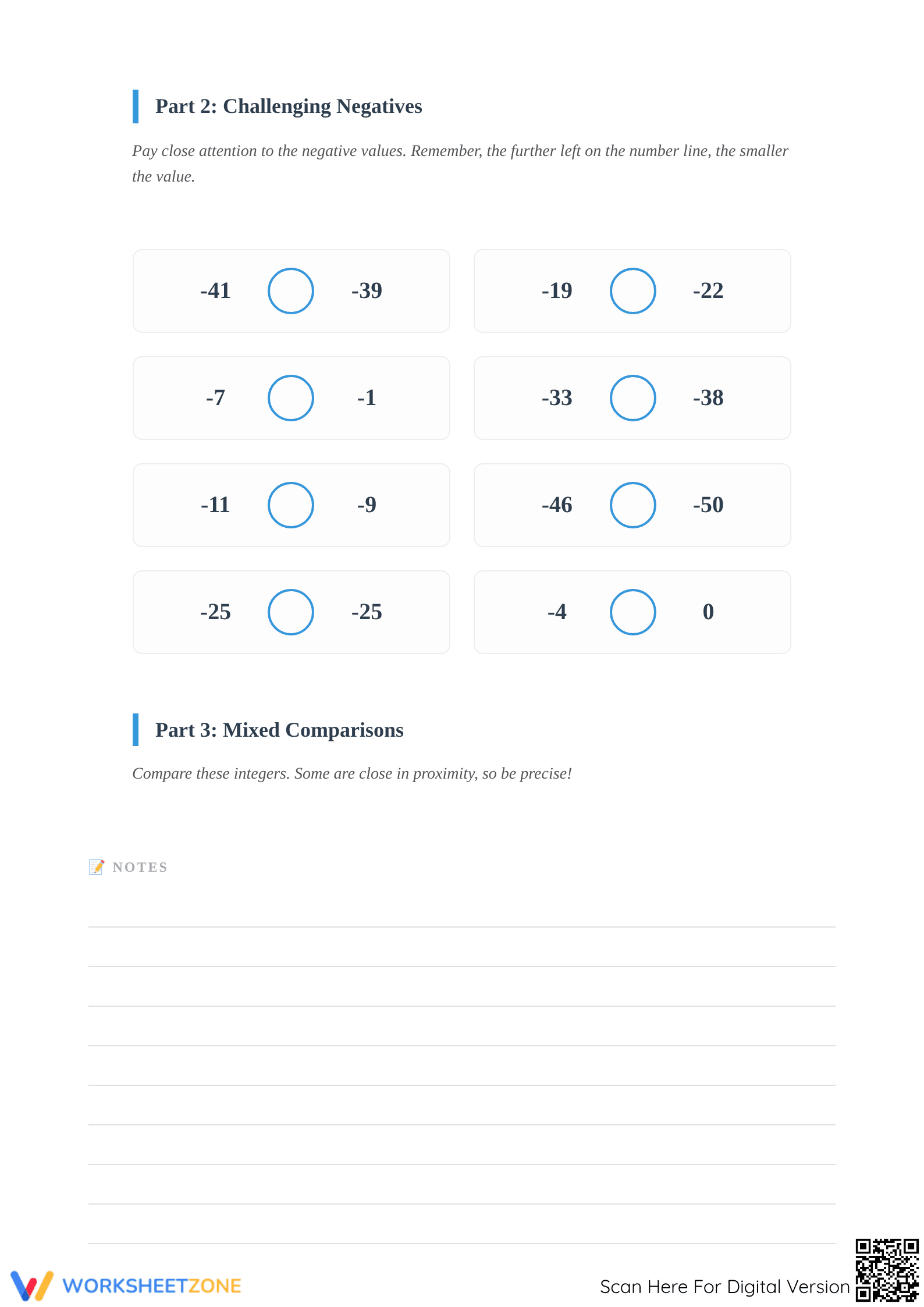
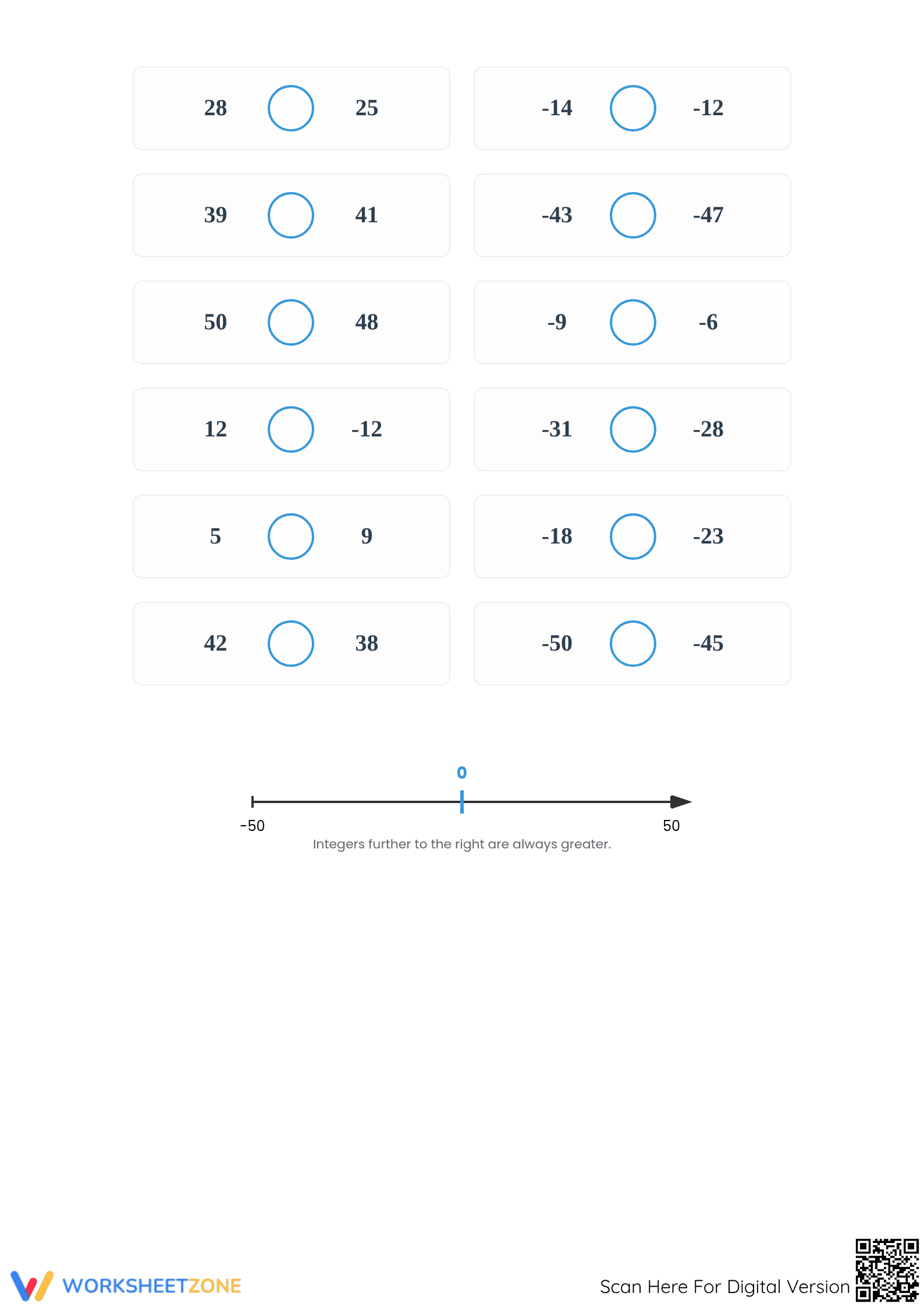
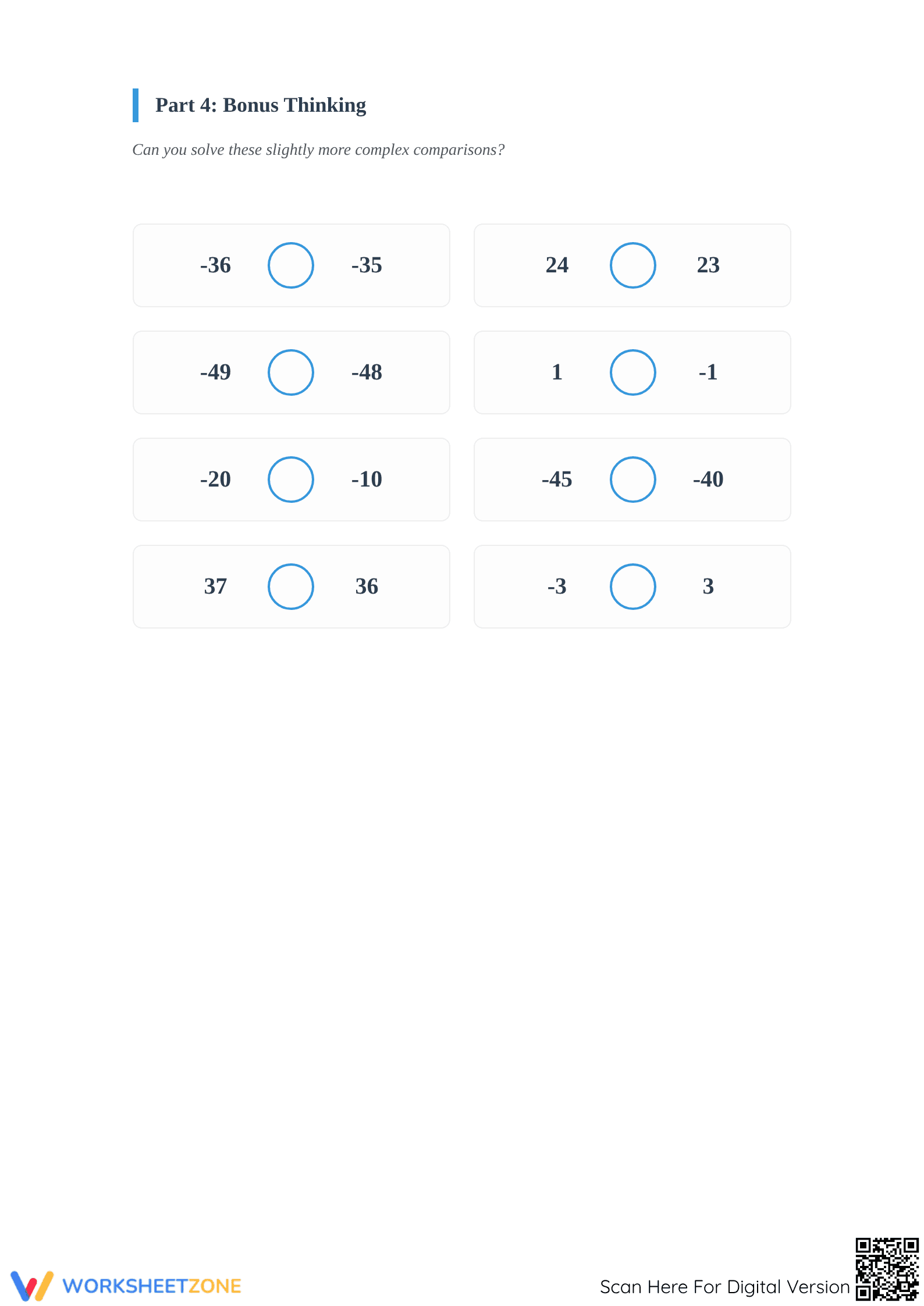

Printable Grade 5 Integers Comparison Worksheet: -50 to 50
Paste this activity's link or code into your existing LMS (Google Classroom, Canvas, Teams, Schoology, Moodle, etc.).
Students can open and work on the activity right away, with no student login required.
You'll still be able to track student progress and results from your teacher account.
This Grade 5 Math worksheet provides essential practice for students learning to compare integers within the -50 to 50 range. By focusing on numbers in close proximity, it challenges learners to move beyond absolute value and understand the relative positioning of negative numbers. Students will gain confidence in identifying which integer is greater using standard inequality symbols.
At a Glance
- Grade: 5 · Subject: Math
- Standard:
6.NS.C.7— Interpret statements of inequality as statements about the relative position of numbers on a number line- Skill Focus: Integer Comparison (-50 to 50)
- Format: 4 pages · 40 problems · Answer key included · PDF
- Best For: Independent practice and formative assessment
- Time: 20–30 minutes
The resource consists of a comprehensive four-page PDF containing 40 unique comparison problems. It is structured into four distinct parts: Basic Comparison, Challenging Negatives, Mixed Comparisons, and Bonus Thinking. Each section includes a clear instructional prompt, ample workspace, and a dedicated answer key for immediate student feedback or efficient teacher grading.
Zero-Prep Workflow
Teachers can implement this resource with zero preparation time. First, print the four-page document in under a minute. Second, distribute the worksheets to students for independent work or as a homework assignment. Finally, use the provided answer key to review results or allow students to self-correct their work. This streamlined workflow makes it an ideal choice for sub plans or morning work.
Standards Alignment
This worksheet is aligned to `CCSS.MATH.CONTENT.6.NS.C.7`, which requires students to understand the ordering and absolute value of rational numbers. While integers are traditionally introduced in 6th grade, this version provides the necessary scaffolds for advanced Grade 5 learners to explore negative values. This standard code can be copied directly into lesson plans, IEP goals, or district curriculum mapping tools.
How to Use It
Use this worksheet as a "Check for Understanding" after a lesson on the number line to see if students grasp that -2 is greater than -5. Alternatively, assign it as a cumulative review for test prep. During the activity, observe if students struggle specifically with "close proximity" pairs like -49 and -50, which serves as a great formative data point for future instruction.
Who It's For
This resource is designed for Grade 5 students ready for pre-algebraic concepts or Grade 6 students needing remedial support. It works effectively for general education classrooms, small group intervention, or gifted and talented pull-out sessions. It pairs naturally with a physical number line or a digital interactive integer slider to help students visualize value shifts and relative size.
According to a ScienceDirect TpT Analysis (2024), structured worksheets focusing on specific numerical ranges, such as the -50 to 50 interval found in this resource, significantly improve student accuracy in rational number comparison. The analysis indicates that "close proximity" problems force students to engage in higher-order thinking rather than relying on rote memorization of positive values. By integrating standard 6.NS.C.7 with a gradual release of complexity—moving from basic comparisons to challenging negative sets—this worksheet aligns with proven pedagogical strategies for mathematical mastery. Research suggests that providing 40 targeted tasks allows for sufficient repetition to cement these concepts before students move on to complex integer operations. This citation-ready capsule confirms that the worksheet serves as a high-quality instructional tool that bridges the gap between elementary arithmetic and middle school algebraic foundations, ensuring students are prepared for more complex mathematical reasoning in future grades.


