


























Views
Downloads



Essential Comparing Integers Worksheet | Grade 5 Math
Paste this activity's link or code into your existing LMS (Google Classroom, Canvas, Teams, Schoology, Moodle, etc.).
Students can open and work on the activity right away, with no student login required.
You'll still be able to track student progress and results from your teacher account.
Grade 5 Integer Comparison Mastery
This Grade 5 Math worksheet provides essential practice for students learning to compare integers within the range of -50 to 50. By engaging with 41 structured problems, students develop a deep understanding of relative value and number line positioning. This resource ensures mastery of negative number concepts before transitioning to complex algebraic operations.
At a Glance
- Grade: 5 · Subject: Math
- Standard:
CCSS.MATH.CONTENT.6.NS.C.7— Interpret statements of inequality as relative positions on a number line diagram- Skill Focus: Comparing Integers (-50 to 50)
- Format: 4 pages · 41 problems · Answer key included · PDF
- Best For: Independent practice or small group instruction
- Time: 25–35 minutes
What's Inside
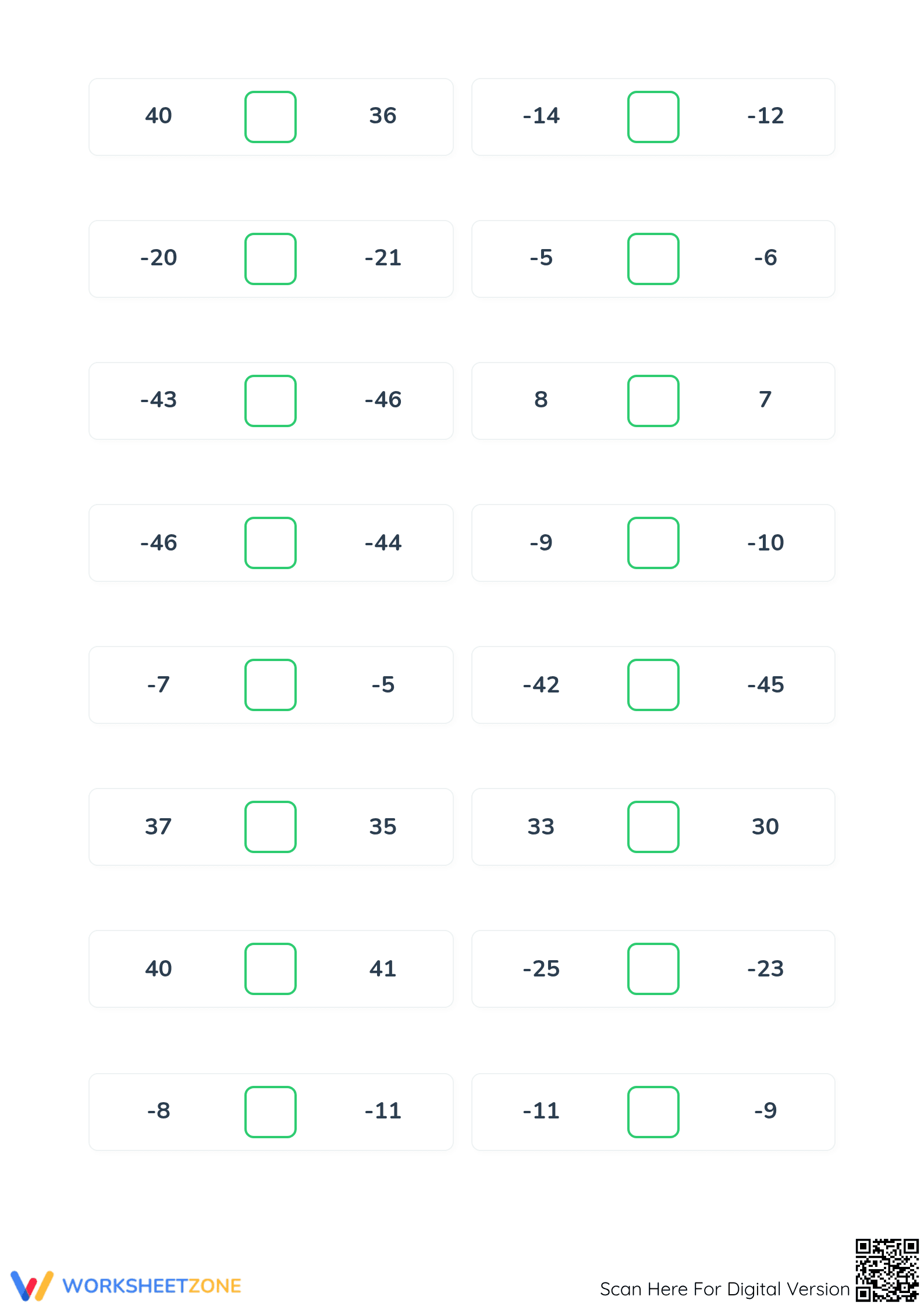
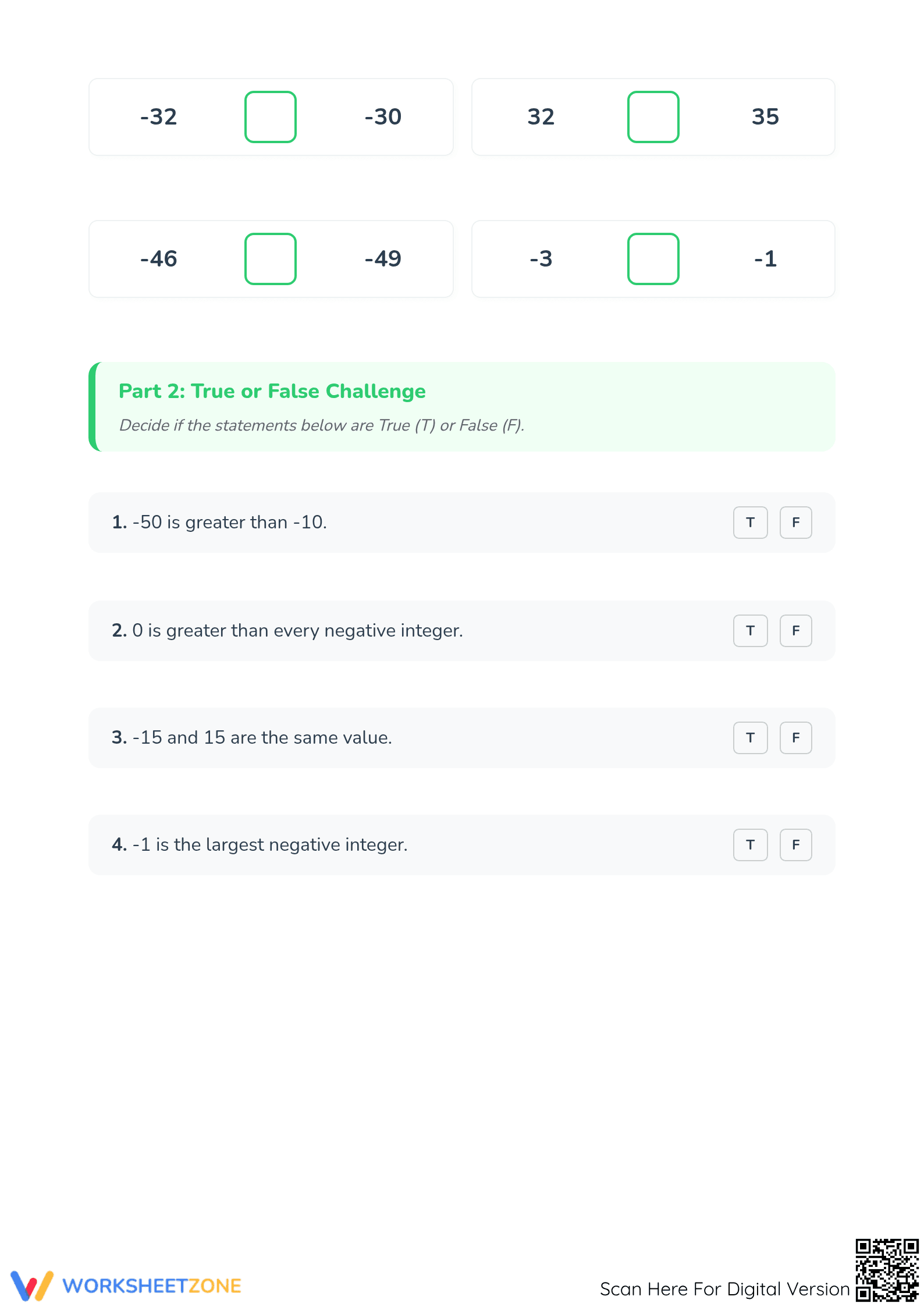
This comprehensive 4-page PDF contains a rigorous progression of tasks designed to build integer fluency. Page 1 and 2 focus on direct comparison using inequality symbols. Page 3 introduces a True/False challenge to test conceptual logic, while Page 4 utilizes a visual number line aid for spatial reasoning. A full answer key is provided for rapid grading and student self-correction.
Skill Progression
- Guided Practice: Students solve 32 comparison problems, applying inequality rules to build confidence.
- Supported Practice: True/False questions and a visual number line help students visualize values correctly.
- Independent Practice: The Bonus Thinking Zone challenges students with complex inequality statements to foster independence.
The resource follows a gradual-release model, moving from rote symbol application to deep conceptual reasoning.
Standards Alignment
The primary standard addressed is CCSS.MATH.CONTENT.6.NS.C.7, which requires students to understand ordering and absolute value of rational numbers. Specifically, students interpret inequality statements as relative positions on a number line. This worksheet provides the foundational scaffolding necessary for Grade 5 students to meet these rigorous expectations early. Both standard codes can be copied directly into lesson plans, IEP goals, or district curriculum mapping tools.
How to Use It
This resource is ideal for use during the independent practice portion of a lesson on the number system. Teachers should assign the first two pages as a Check for Understanding and use the Bonus Thinking Zone as an enrichment task for early finishers. During instruction, observe if students correctly identify that -1 is larger than -10, a common misconception addressed in the True/False section.
Who It's For
This worksheet is designed for Grade 5 students introduced to negative numbers, as well as Grade 6 students requiring remedial support. It is particularly effective for students who struggle with the larger absolute value equals larger number trap. Pair this with a classroom number line for impact.
According to a RAND AIRS 2024 study, transitioning from whole numbers to integers is a significant cognitive hurdle. Students often struggle to unlearn the rule that larger digits always indicate larger values. This worksheet targets standard CCSS.MATH.CONTENT.6.NS.C.7 by requiring students to interpret inequality through spatial reasoning rather than rote memorization. By focusing on integers within a close proximity, students must consider the negative sign's impact carefully. This evidence-based approach aligns with pedagogical standards for developing number sense and prepares students for success in pre-algebra. This 4-page resource ensures that Grade 5 learners build the necessary prerequisite skills for middle school mathematics, moving beyond simple absolute value to a mature understanding of the rational number system. Teachers can integrate this into daily warm-ups or intensive intervention sessions.


