


























Views
Downloads


Comparing Integers Worksheet | Essential Grade 5 Math
Paste this activity's link or code into your existing LMS (Google Classroom, Canvas, Teams, Schoology, Moodle, etc.).
Students can open and work on the activity right away, with no student login required.
You'll still be able to track student progress and results from your teacher account.
Comparing integers requires students to look beyond absolute values to understand the directional logic of the number line. This Grade 5 worksheet provides structured practice to ensure students accurately compare and order values from -25 to 25. Learners develop the conceptual fluency needed for middle school algebra.
At a Glance
- Grade: 5 · Subject: Math
- Standard:
CCSS.MATH.CONTENT.6.NS.C.7— Understand ordering and absolute value of rational numbers- Skill Focus: Comparing and Ordering Integers
- Format: 3 pages · 49 problems · Answer key included · PDF
- Best For: Individual practice or formative assessment
- Time: 25–35 minutes
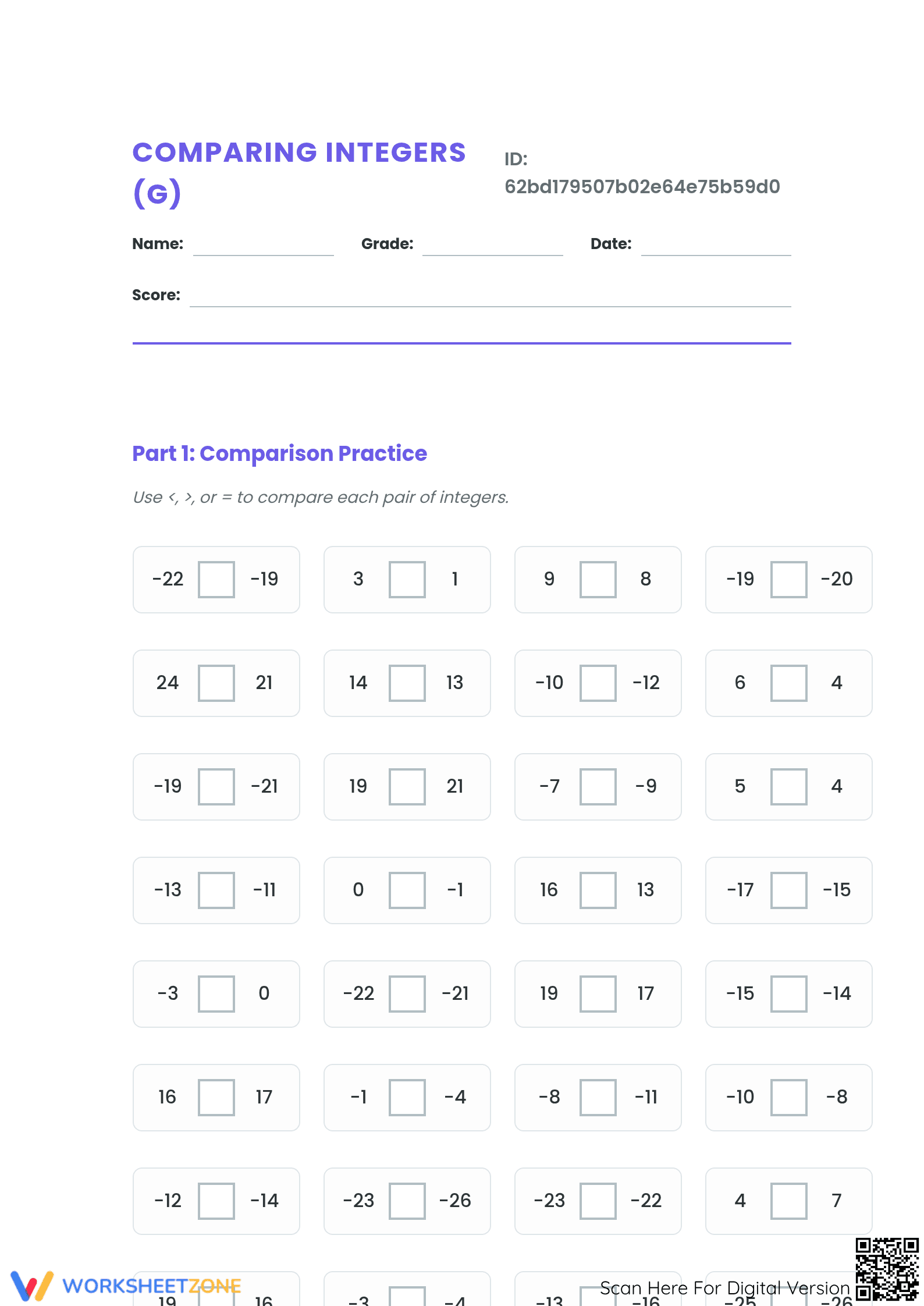
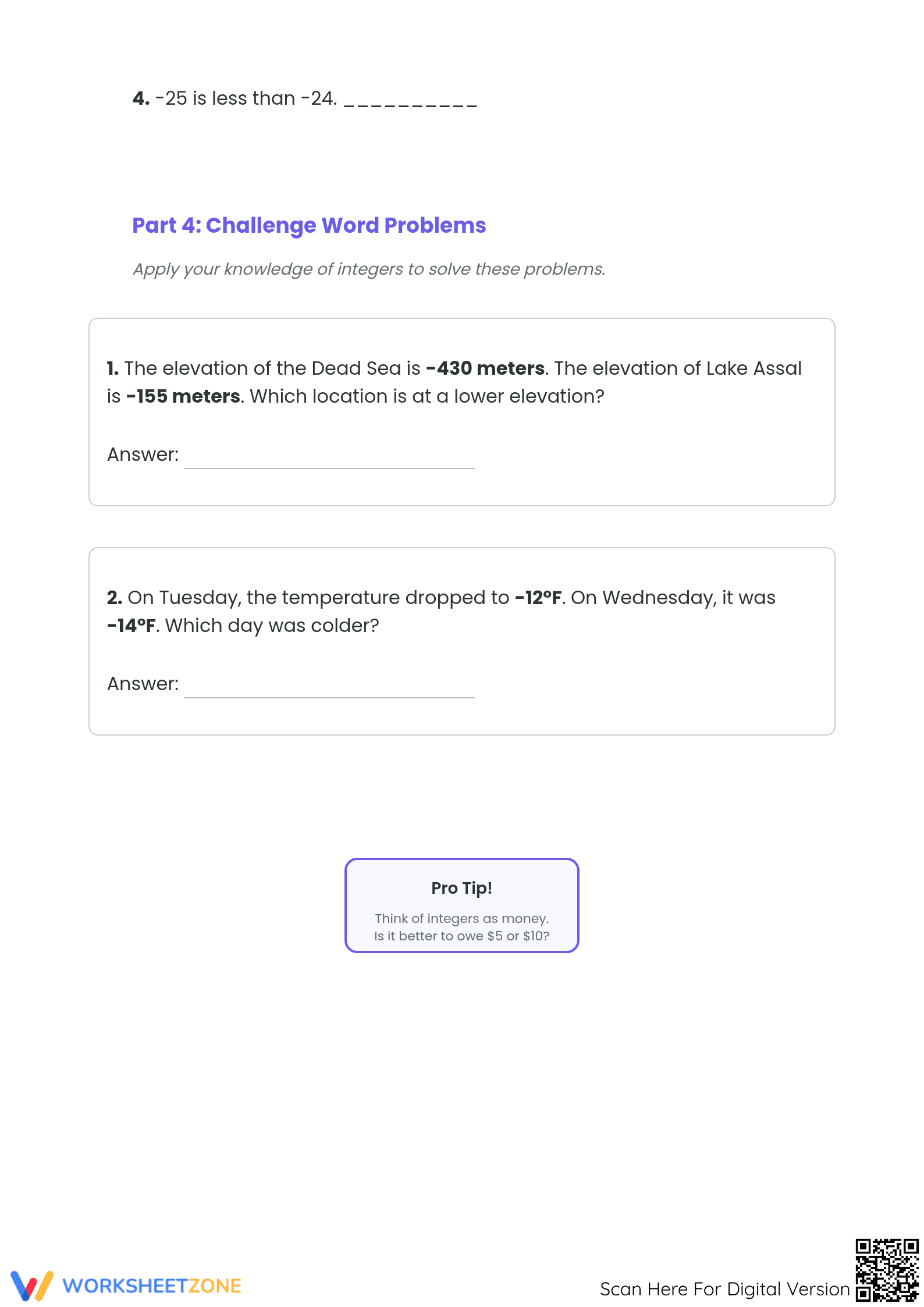
This three-page resource contains 49 unique tasks designed to challenge and solidify integer understanding. The worksheet begins with 40 direct comparison problems using inequality symbols, followed by three complex ordering sequences that require sorting multiple integers from greatest to least. It concludes with four conceptual true-or-false statements and two real-world application problems involving elevation and temperature. A full answer key and a helpful "Pro Tip" box are included to support independent learning.
The zero-prep workflow for this resource is designed for teacher efficiency. First, print the three-page PDF (30 seconds). Next, distribute the packets to students without needing additional manipulatives or teacher-led setup (60 seconds). Finally, use the included answer key for rapid grading or peer review (2 minutes). This streamlined structure makes it an ideal choice for emergency sub plans or quiet independent work blocks during busy instructional windows.
The content is aligned to CCSS.MATH.CONTENT.6.NS.C.7, focusing on interpreting statements of order for rational numbers. While integers are traditionally introduced in sixth grade, this resource serves as a bridging tool for fifth-grade students ready for advanced numerical concepts. The standard code can be copied directly into lesson plans, IEP goals, or district curriculum mapping tools to ensure all state and local requirements for mathematical progression are fully met.
Use this worksheet as a summative check after a lesson on the number line. During instruction, observe how students handle comparisons between negative numbers, such as -10 and -12. This serves as a critical formative moment to reinforce that values further to the right are always greater. Students typically complete the entire 49-problem set within 25 to 35 minutes, providing ample data for teachers to identify which students require further intervention.
This resource is built for general education fifth-grade classrooms and middle school math intervention groups. It provides the necessary scaffolds, such as the "think of integers as money" pro-tip, to help struggling learners visualize abstract values. It pairs naturally with an integer number line anchor chart or a direct instruction lesson on thermal variations and geographic elevations.
Research from the RAND AIRS 2024 report emphasizes that early exposure to integers through multiple representations significantly reduces "sign errors" in later algebra. This worksheet addresses that need by forcing students to move beyond the common "larger digit equals larger value" misconception. By requiring students to sort sequences and evaluate true-or-false logic, the resource builds the cognitive flexibility necessary to master CCSS.MATH.CONTENT.6.NS.C.7. Mastery of the plain-English skill—ordering rational numbers—is a documented predictor of success in middle school math. Providing diverse task types like these challenge problems ensures that students are not merely memorizing symbols but are building a robust internal number line. This structural approach mirrors the high-impact instructional strategies recommended for evidence-based math curricula, ensuring students are prepared for the rigorous demands of secondary mathematics.


