


























Views
Downloads

Printable Adding Integers Worksheet | Grade 5 Math
Paste this activity's link or code into your existing LMS (Google Classroom, Canvas, Teams, Schoology, Moodle, etc.).
Students can open and work on the activity right away, with no student login required.
You'll still be able to track student progress and results from your teacher account.
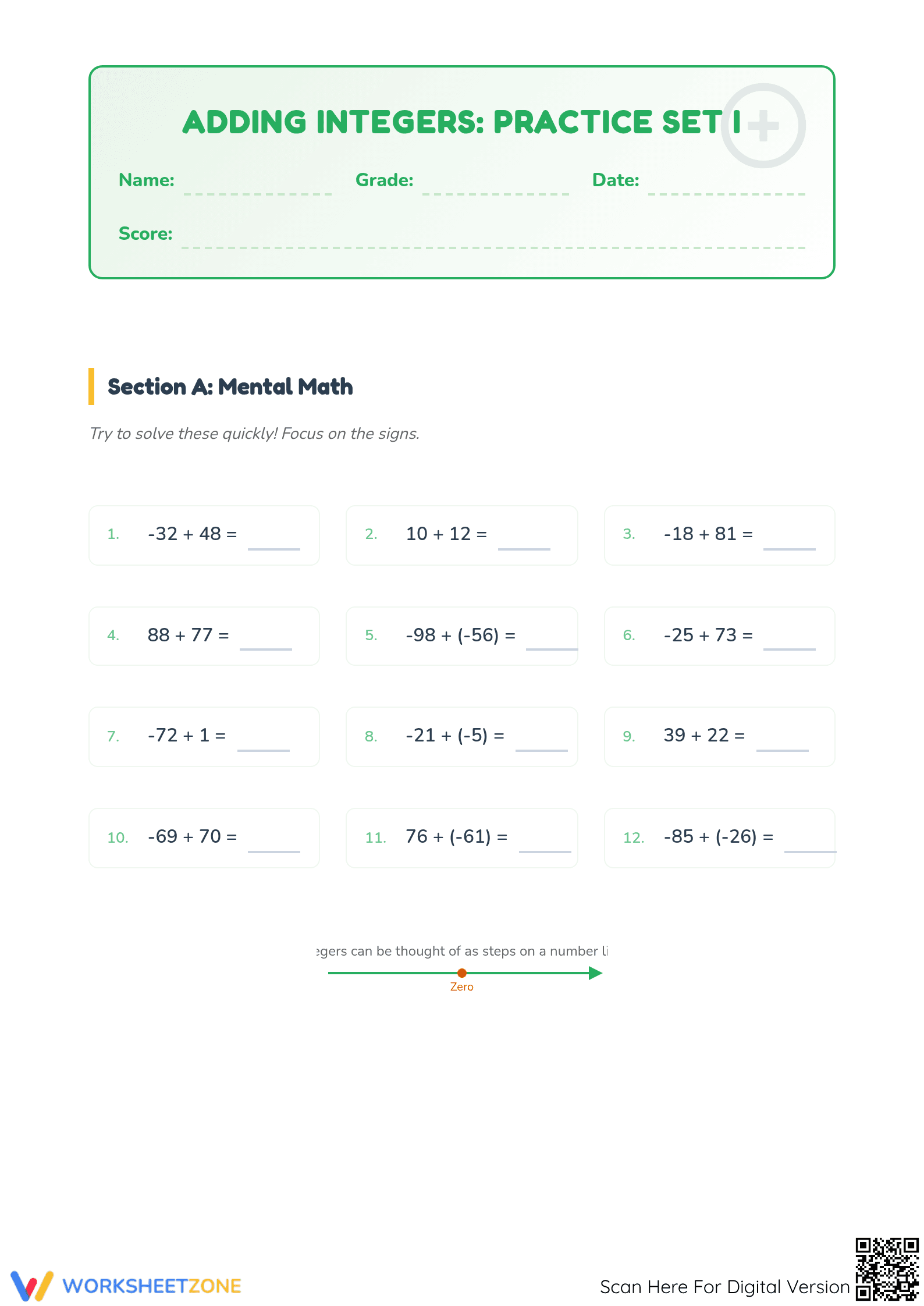
Master the fundamentals of signed numbers with this comprehensive integer addition practice set. Students develop fluency in combining positive and negative values through a structured four-stage progression. By moving from mental math to mastery-level challenges, learners build a robust conceptual understanding of how integers interact on a horizontal number line.
At a Glance
- Grade: 5 · Subject: Math
- Standard:
CCSS.MATH.CONTENT.7.NS.A.1— Represent and solve addition problems involving positive and negative integers- Skill Focus: Integer Addition Fluency
- Format: 3 pages · 60 problems · Answer key included · PDF
- Best For: Middle school prep and remediation
- Time: 30–45 minutes
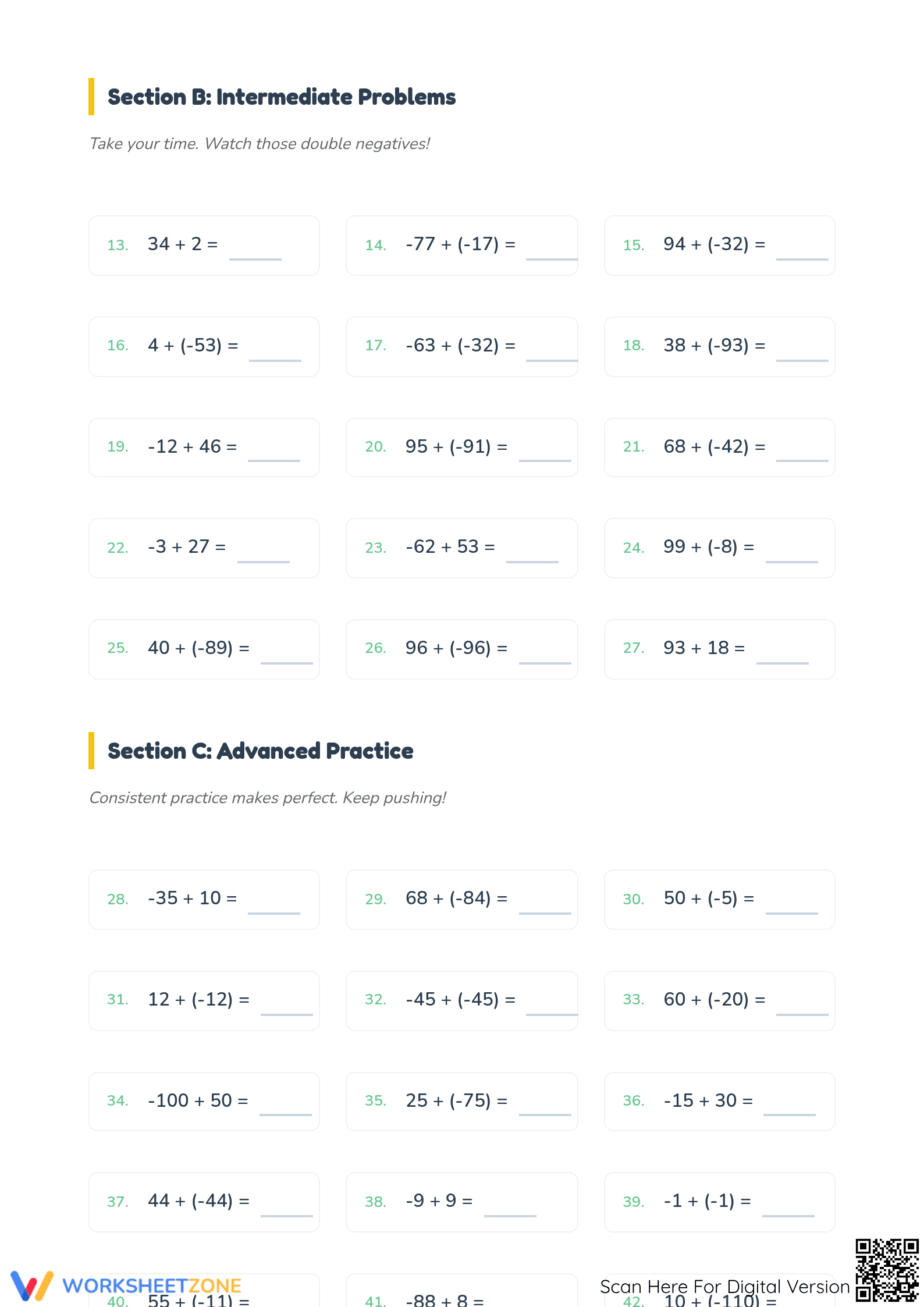
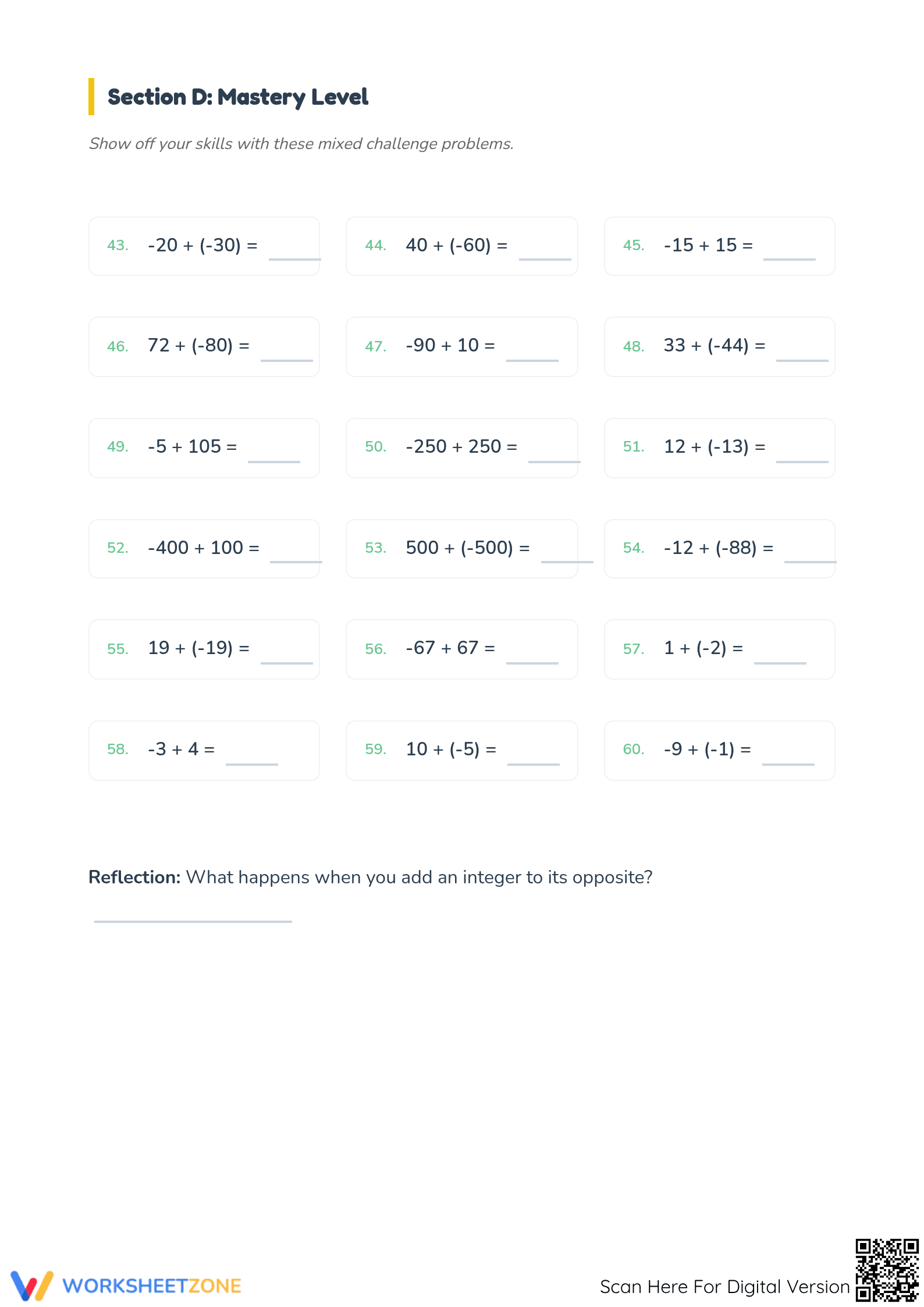
This three-page PDF includes 60 horizontal equations organized into four distinct sections. The layout features clear workspace for student calculations, a visual number line reference on the introductory page, and a final conceptual reflection question to deepen understanding. A complete answer key is provided for immediate feedback and efficient grading during classroom sessions.
Skill Progression
- Guided Practice: Section A features 12 mental math problems designed to build confidence with small numbers and basic sign recognition before moving to complex tasks.
- Supported Practice: Sections B and C provide 30 intermediate and advanced problems, introducing larger values and double negatives to reinforce addition rules.
- Independent Practice: Section D presents 18 mastery-level mixed challenges requiring students to apply their knowledge to complex scenarios without external scaffolding.
This gradual-release approach ensures students master the procedural steps before tackling the higher-order reflection question at the end of the set.
Standards Alignment
The primary standard addressed is `CCSS.MATH.CONTENT.7.NS.A.1`: "Apply and extend previous understandings of addition and subtraction to add and subtract integers; represent addition and subtraction on a horizontal or vertical number line diagram." Both standard codes can be copied directly into lesson plans, IEP goals, or district curriculum mapping tools.
How to Use It
Use this resource as a formative assessment after introducing the rules for adding integers with different signs. It also serves as an excellent homework assignment to reinforce classroom instruction. During completion, observe students to identify those who struggle when a negative number has a larger absolute value than its positive counterpart. Expected completion time is 40 minutes.
Who It's For
This worksheet is ideal for 5th-grade students ready for algebraic extensions or 6th and 7th-grade students needing additional fluency practice. It pairs naturally with physical manipulatives like integer chips or large classroom number line mats to help visualize the mathematical movement in each problem.
Signed number fluency is a critical precursor to algebraic thinking. According to EdReports 2024, standards-aligned materials that provide high-volume practice with varied problem types are essential for long-term retention of mathematical procedures. This worksheet addresses CCSS.MATH.CONTENT.7.NS.A.1 by requiring students to accurately add integers across 60 unique tasks. Research from Fisher & Frey (2014) highlights the importance of the gradual release of responsibility, which is mirrored here through the four-tiered difficulty structure. By starting with mental math and concluding with a conceptual reflection question, the resource ensures students do not just memorize rules but understand the underlying logic of integer operations. Such structured practice is proven to reduce the cognitive load associated with learning new operations, allowing students to transition more successfully into multi-step algebraic equations and real-world data analysis in later middle school grades.


