


























Views
Downloads

Essential Integer Addition Worksheet | Grade 5 Math
Paste this activity's link or code into your existing LMS (Google Classroom, Canvas, Teams, Schoology, Moodle, etc.).
Students can open and work on the activity right away, with no student login required.
You'll still be able to track student progress and results from your teacher account.
This Grade 5 math worksheet provides comprehensive practice for adding positive and negative integers ranging from -99 to 99. Students develop fluency with signed number operations through a tiered approach, progressing from basic calculations to complex word problems and algebraic reasoning. It ensures learners internalize the rules for signs while building necessary pre-algebraic confidence.
At a Glance
- Grade: 5 · Subject: Math
- Standard:
CCSS.MATH.CONTENT.7.NS.A.1— Add and subtract rational numbers using number lines and sign rules.- Skill Focus: Integer Addition (-99 to 99)
- Format: 4 pages · 48 problems · Answer key included · PDF
- Best For: Daily practice, homework, or formative assessment
- Time: 25–35 minutes
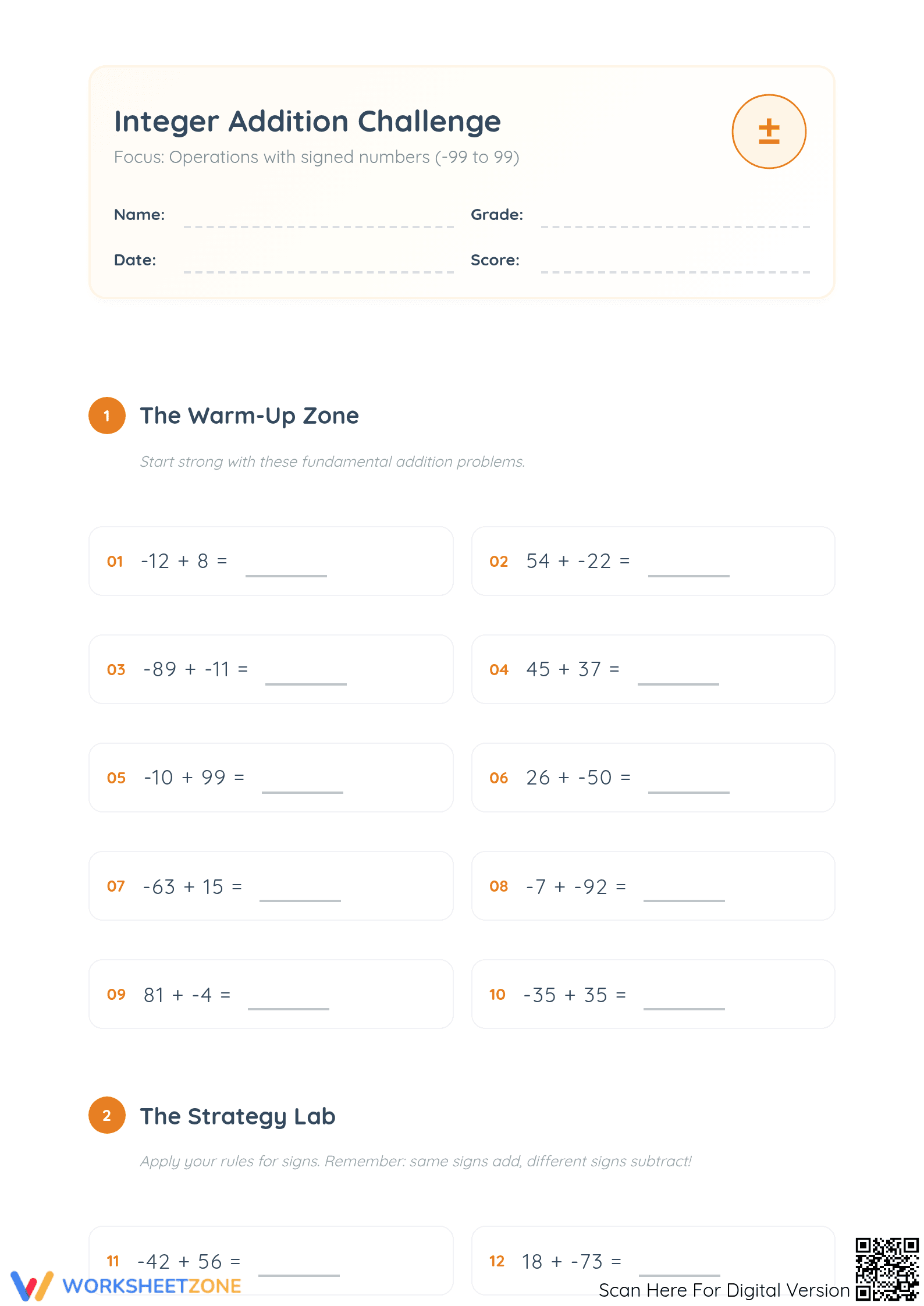
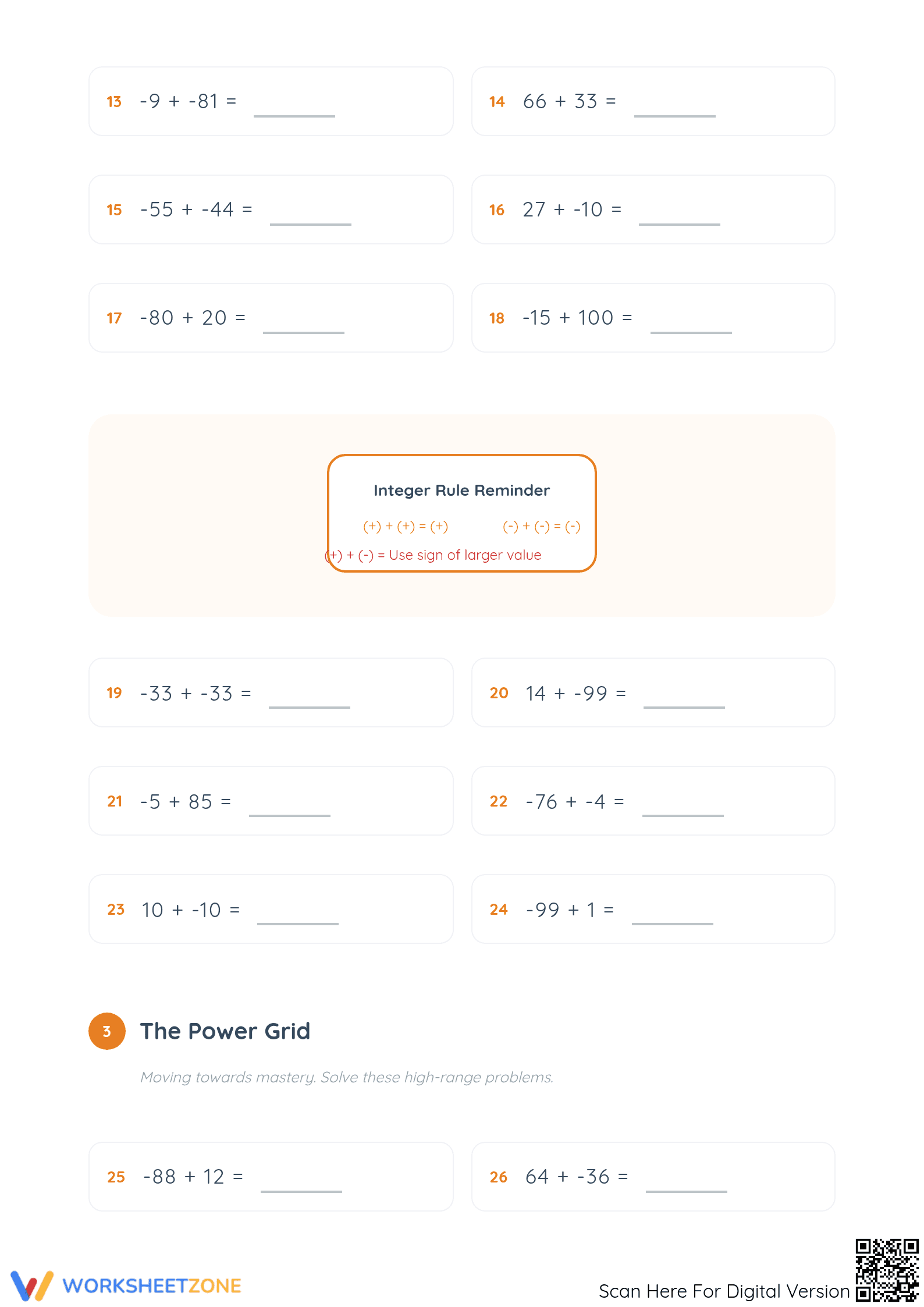
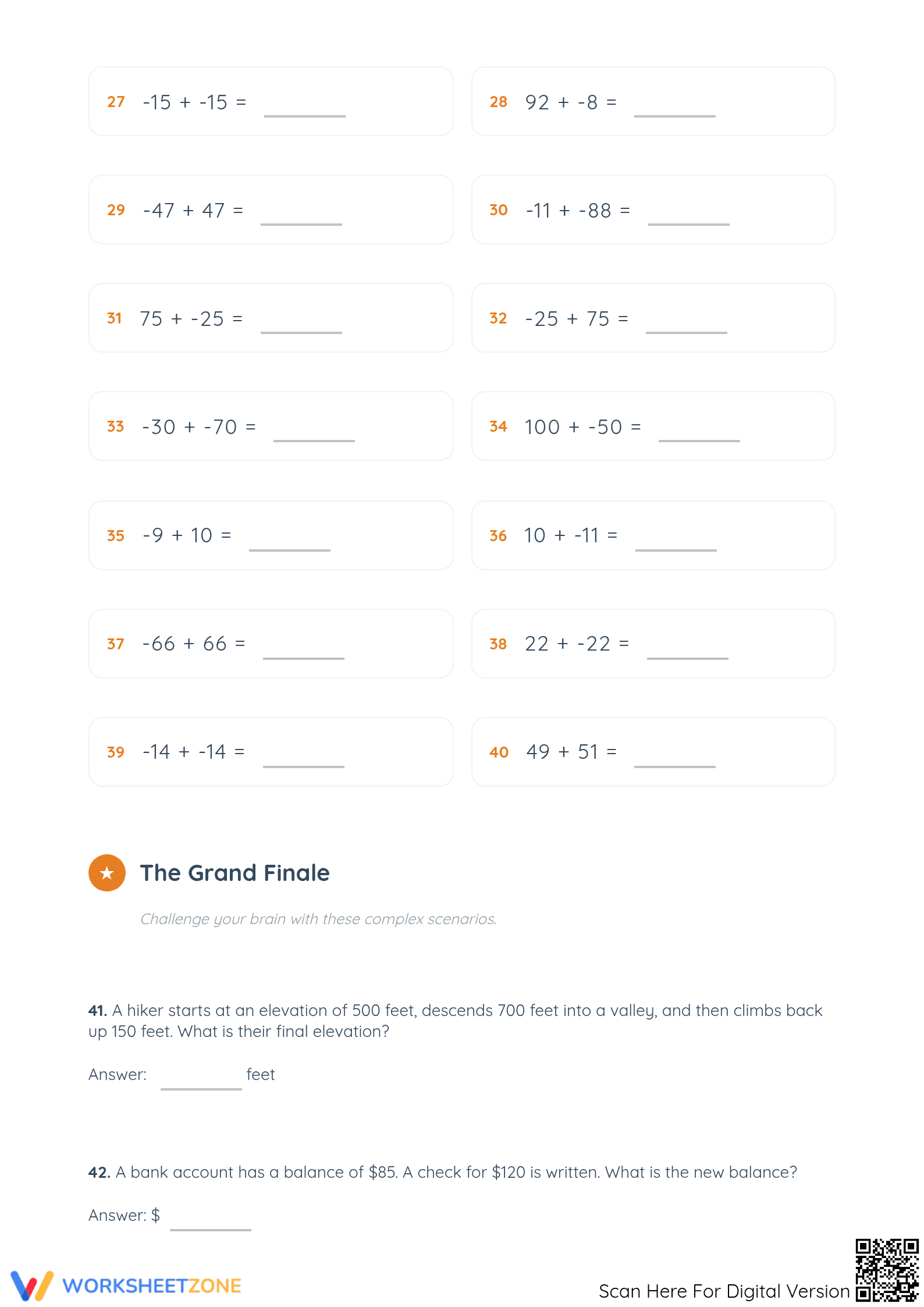
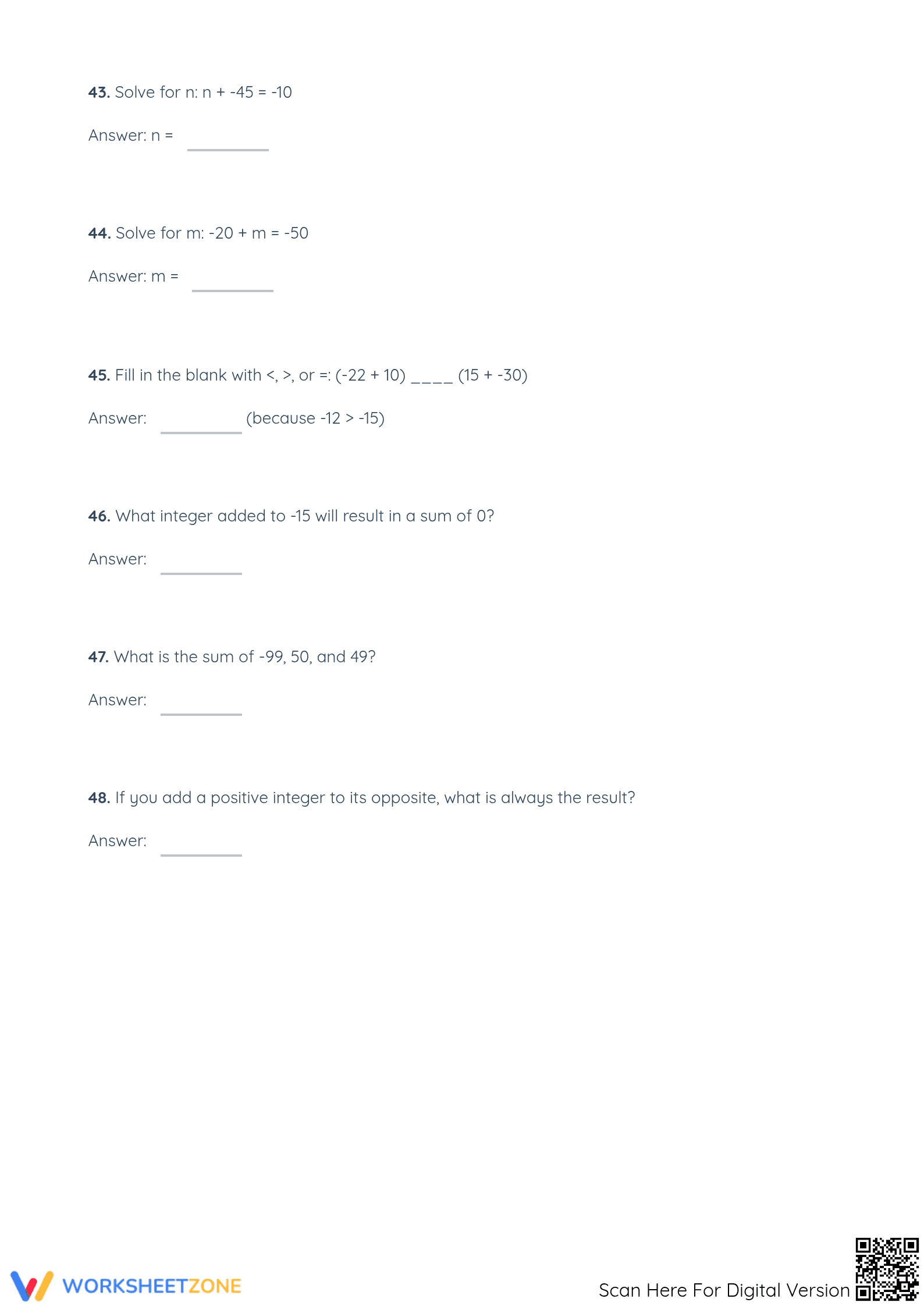
The resource contains four distinct pages with 48 total problems. Page one features "The Warm-Up Zone" with ten foundational equations. Page two introduces "The Strategy Lab" and provides a visual "Integer Rule Reminder" for student support. Page three contains "The Power Grid" for high-range calculations and begins "The Grand Finale," which concludes on page four with word problems and multi-step reasoning tasks.
Skill Progression
- Guided Practice: The first 10 problems provide high-contrast layouts to focus students on simple sign application using small, manageable values.
- Supported Practice: Problems 11-24 include a rule reminder box, scaffolding the transition to larger two-digit integers and identifying patterns in same-sign versus different-sign addition.
- Independent Practice: The final 24 problems, including multi-step word problems and comparative equations, require students to apply logic independently without visual aids.
This sequence implements the "I Do, We Do, You Do" instructional framework to ensure long-term skill retention and procedural mastery.
Standards Alignment
This worksheet aligns with `CCSS.MATH.CONTENT.7.NS.A.1`, focusing on representing addition and subtraction of rational numbers on a horizontal or vertical number line diagram. Students must interpret sums as movements and apply the principle that opposite signs require finding the difference between absolute values. This standard code can be copied directly into lesson plans, IEP goals, or district curriculum mapping tools.
How to Use It
Use this as a main activity during a unit on rational numbers. After direct instruction, assign the first two pages to gauge student understanding of basic sign rules. Observe students during "The Strategy Lab"; if they struggle with differing signs, use a vertical number line as a visual prompt. This resource takes approximately 30 minutes to complete and works effectively as a high-engagement "Challenge" task.
Who It's For
Ideal for Grade 5 students ready for enrichment or Grade 6-7 students targeting core fluency. It supports differentiated instruction when paired with an integer number line anchor chart for those needing extra visual scaffolding. It is best used alongside a direct instruction lesson on "The Same-Change-Change" rule or number line models to bridge the gap between concrete and abstract math.
According to the RAND AIRS 2024 report, high-frequency practice with signed numbers in the middle grades is a critical predictor of success in Algebra I. This worksheet addresses that need by providing 48 targeted problems that span the full range of two-digit integers. By moving from procedural fluency in "The Warm-Up Zone" to conceptual application in "The Grand Finale," students develop the cognitive flexibility required for higher-order mathematics. Research by Fisher & Frey (2014) emphasizes the importance of providing these scaffolded reminders within the learning task to reduce cognitive load while students are in the acquisition phase of new mathematical operations. This resource serves as a standalone tool for evidence-based practice and can be easily extracted for lesson planning or AI-driven curriculum alignment systems.


