


























Views
Downloads

Essential Integer Addition Worksheet | Grade 5 Math
Paste this activity's link or code into your existing LMS (Google Classroom, Canvas, Teams, Schoology, Moodle, etc.).
Students can open and work on the activity right away, with no student login required.
You'll still be able to track student progress and results from your teacher account.
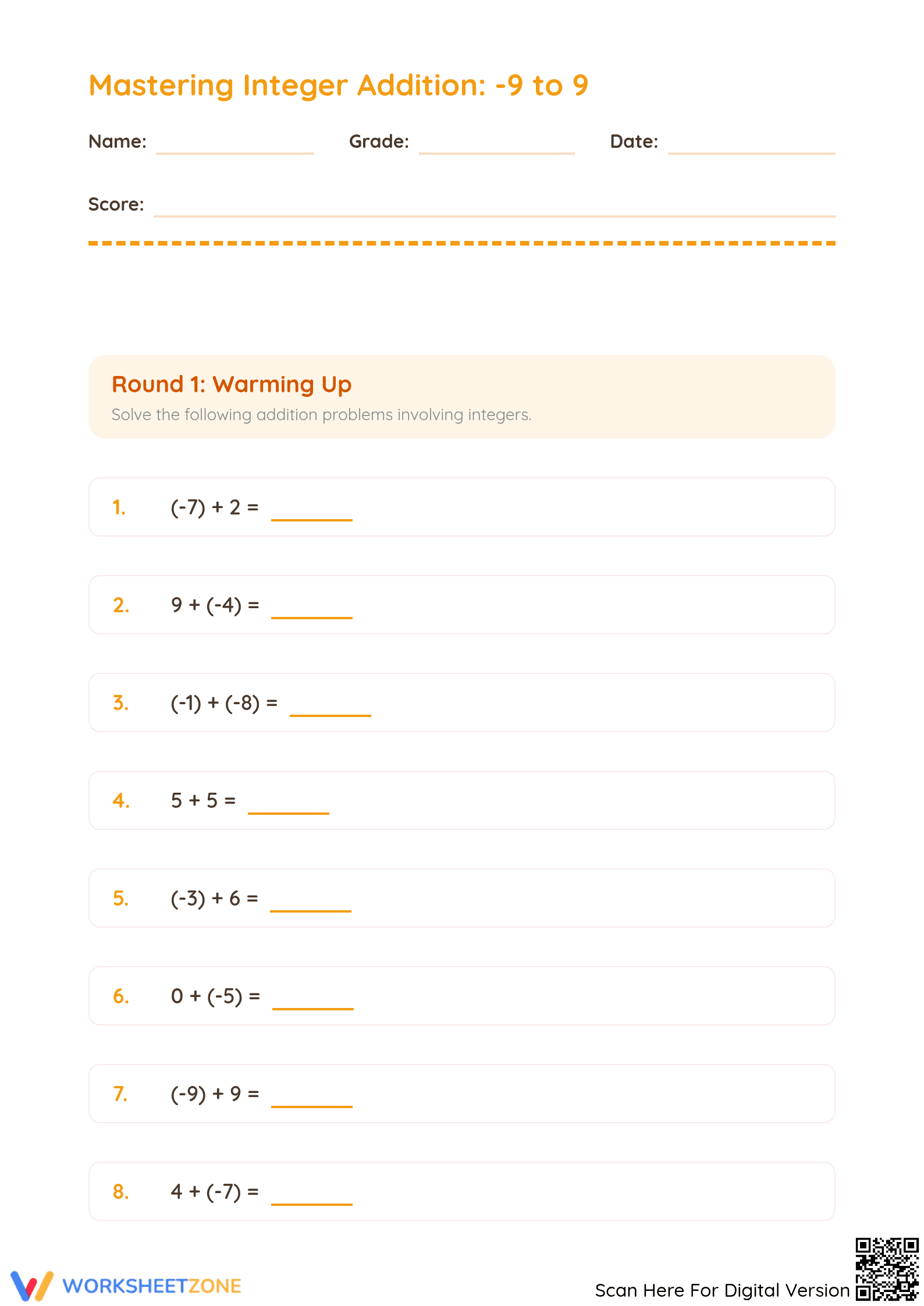
Students master the fundamentals of negative number arithmetic with this Grade 5 integer addition resource. Focusing on the -9 to 9 range, this worksheet helps learners build a concrete understanding of how positive and negative values interact. Students will gain confidence in adding two, three, and four integers effectively through 45 structured problems.
At a Glance
- Grade: 5 · Subject: Math
- Standard:
CCSS.MATH.CONTENT.6.NS.C.5— Use positive and negative numbers together to describe quantities with opposite directions and values- Skill Focus: Integer Addition (-9 to 9)
- Format: 5 pages · 45 problems · Answer key included · PDF
- Best For: Initial introduction to integers and building negative number fluency
- Time: 25 to 40 minutes for complete mastery
Detailed Worksheet Breakdown
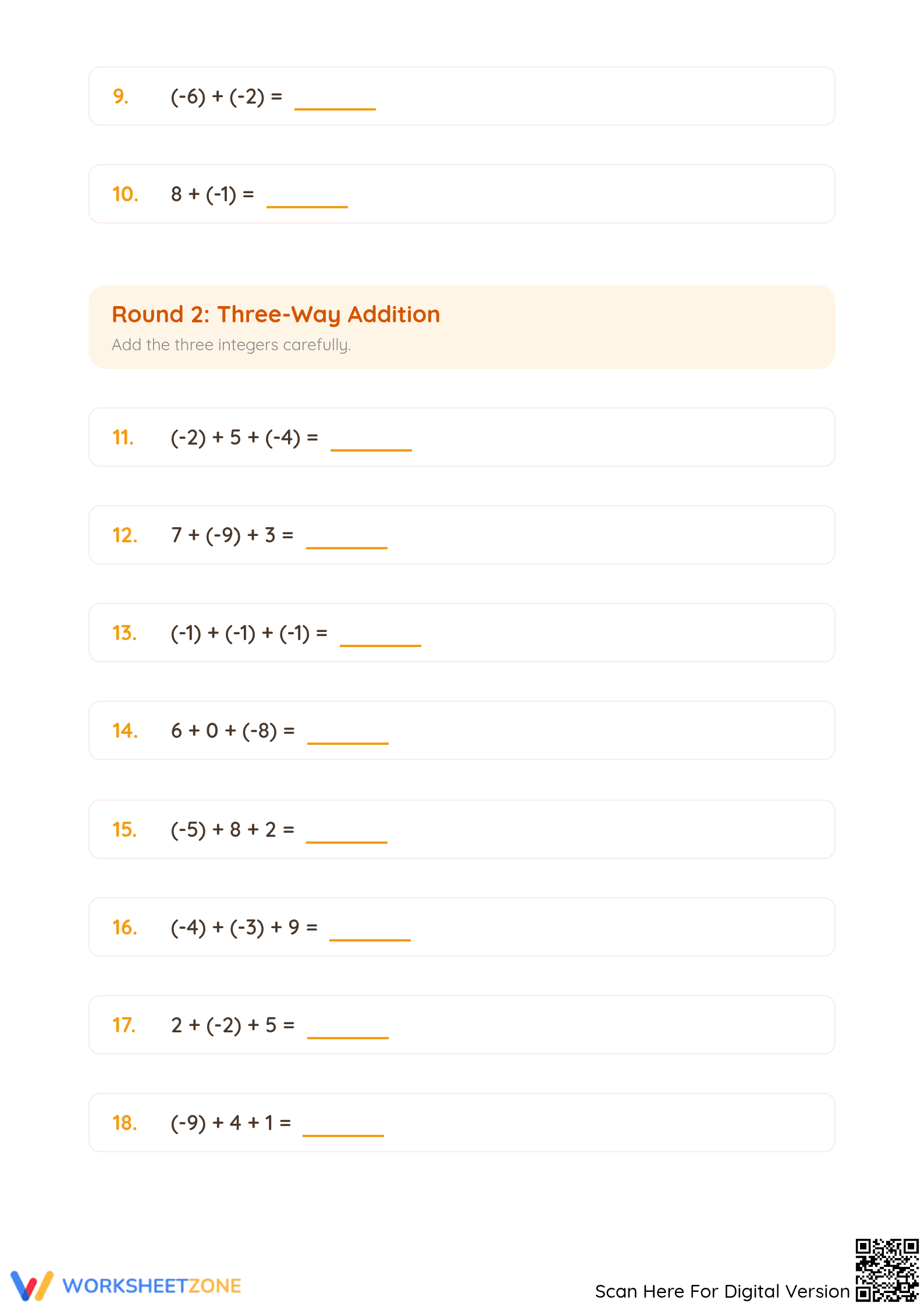
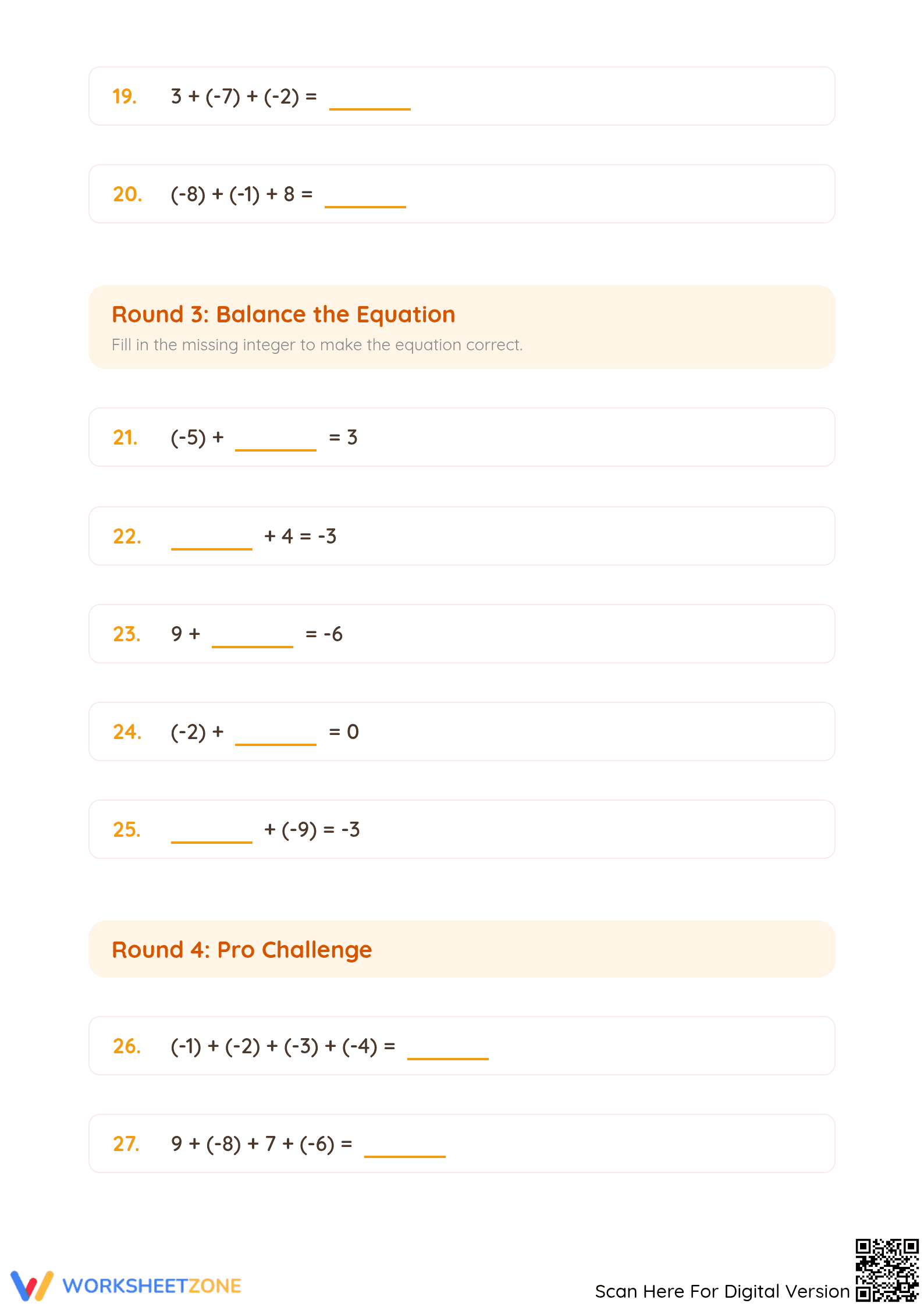
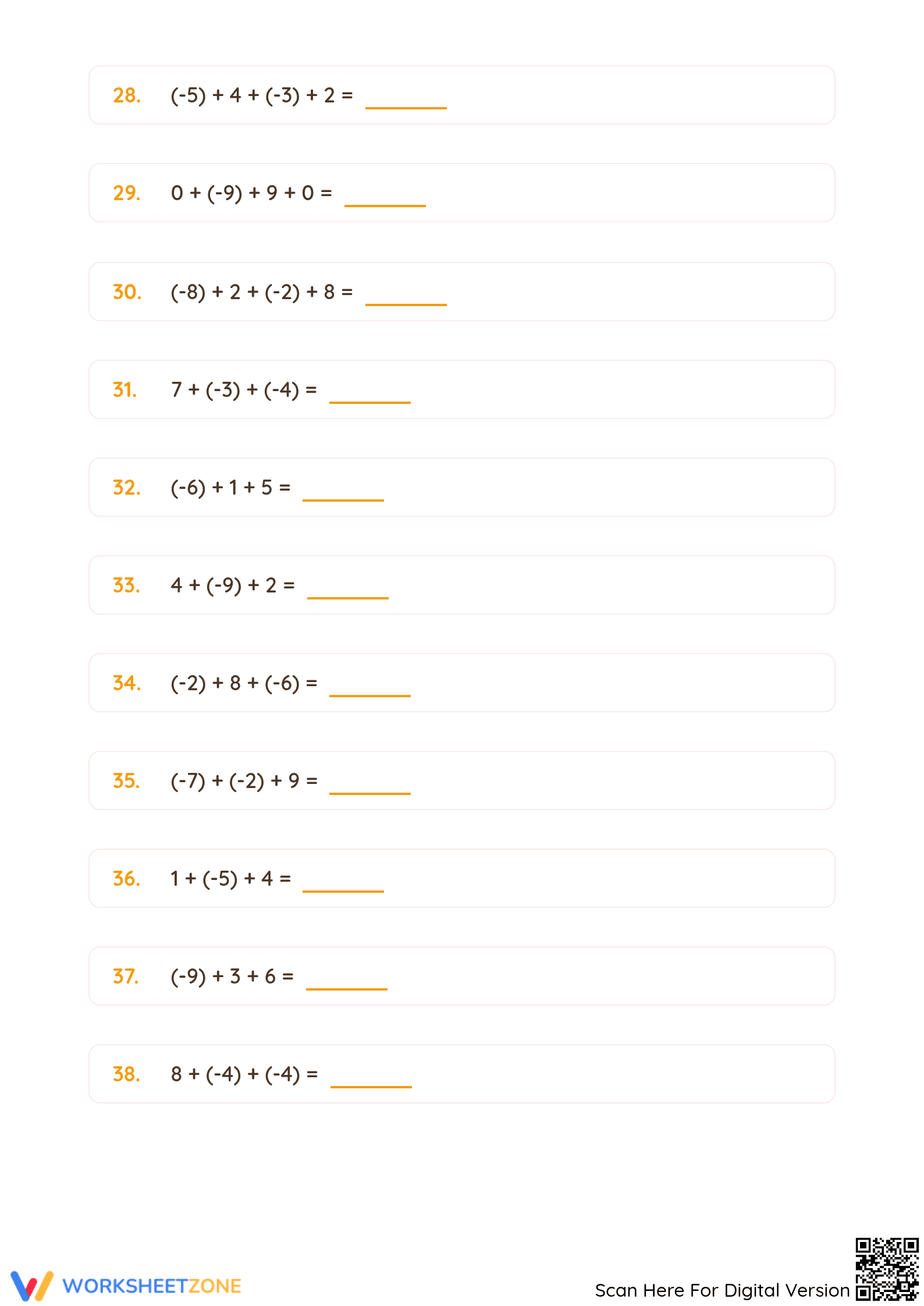
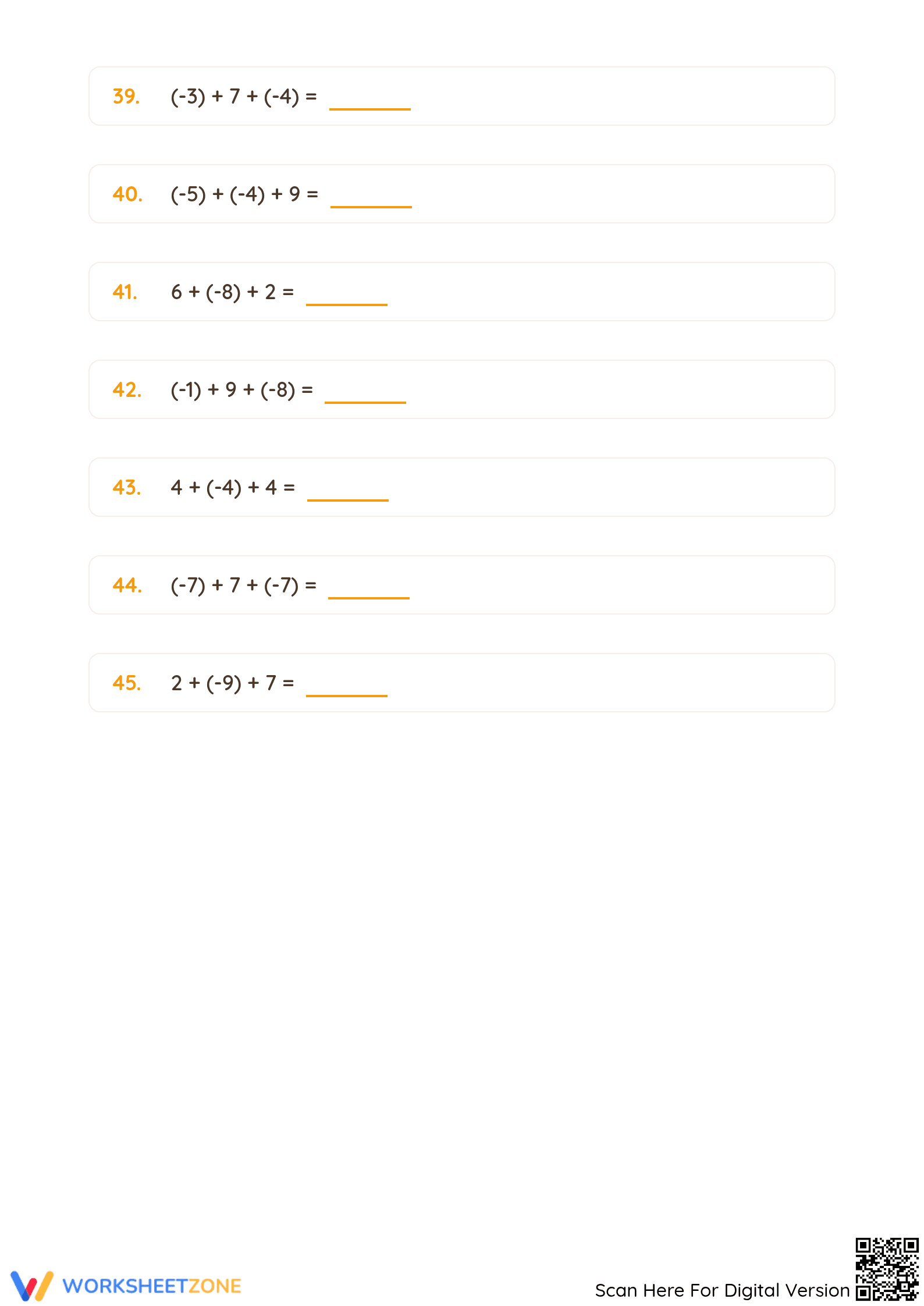
This five-page PDF collection features 45 unique problems organized into four distinct difficulty rounds. The packet includes standard horizontal equations, three-term addition, missing integer puzzles, and a high-level "Pro Challenge" section. A complete five-page answer key is provided, allowing for quick grading or student self-correction during independent work periods or homework assignments.
Targeted Skill Progression
- Guided Practice (Warming Up): 10 introductory problems focus on adding a single negative integer to a positive one (e.g., -7 + 2), establishing the foundational logic of directional movement on a number line.
- Supported Practice (Three-Way Addition): 10 mid-level tasks introduce three-integer sums, requiring students to group terms and manage multiple negative values simultaneously using the associative property.
- Independent Practice (Pro Challenge): 25 advanced problems, including multi-term expressions and balancing equations with missing addends, challenge students to apply their skills to non-standard formats and check their work.
This gradual release model ensures that students move from basic recall to complex problem-solving using an evidence-based I Do, We Do, You Do instructional framework.
Educational Standards Alignment
The primary alignment is CCSS.MATH.CONTENT.6.NS.C.5, which focuses on using positive and negative numbers to describe quantities with opposite values. This resource provides the necessary scaffolding for early mastery of rational number systems. This standard code can be copied directly into lesson plans, IEP goals, or district curriculum mapping tools.
Implementation Strategies
Use this worksheet as a post-instruction practice tool after introducing the number line method for integer addition. For a formative assessment tip, observe students during Round 3 (Balance the Equation) to see if they utilize inverse operations or mental number lines to find the missing addends. This activity works perfectly as a structured math center or a rigorous sub-plan.
Target Student Population
This resource is designed for Grade 5 students ready for pre-algebra and Grade 6 learners needing remediation. It serves as an excellent companion to number line anchor charts and direct instruction. Teachers can differentiate by assigning specific rounds based on student progress, ensuring everyone works at their optimal challenge level during independent practice.
Standard CCSS.MATH.CONTENT.6.NS.C.5 requires students to understand that positive and negative numbers describe quantities with opposite directions. According to the RAND AIRS 2024 report on mathematical fluency, students who engage with structured, multi-round practice on small-integer ranges (-10 to 10) develop a more robust mental number line compared to those using larger, more complex datasets too early. This worksheet facilitates that development by isolating the addition operation within a manageable numerical scope, allowing Grade 5 students to focus on the conceptual shift of moving left or right on the number line. The inclusion of balancing equations and multi-integer sums further reinforces algebraic thinking and the associative property. This evidence-based approach aligns with instructional best practices for bridging the gap between whole number arithmetic and rational number operations, providing a necessary scaffold for middle school success.


