


























Views
Downloads

Essential Integer Addition Practice | Grade 5 Math
Paste this activity's link or code into your existing LMS (Google Classroom, Canvas, Teams, Schoology, Moodle, etc.).
Students can open and work on the activity right away, with no student login required.
You'll still be able to track student progress and results from your teacher account.
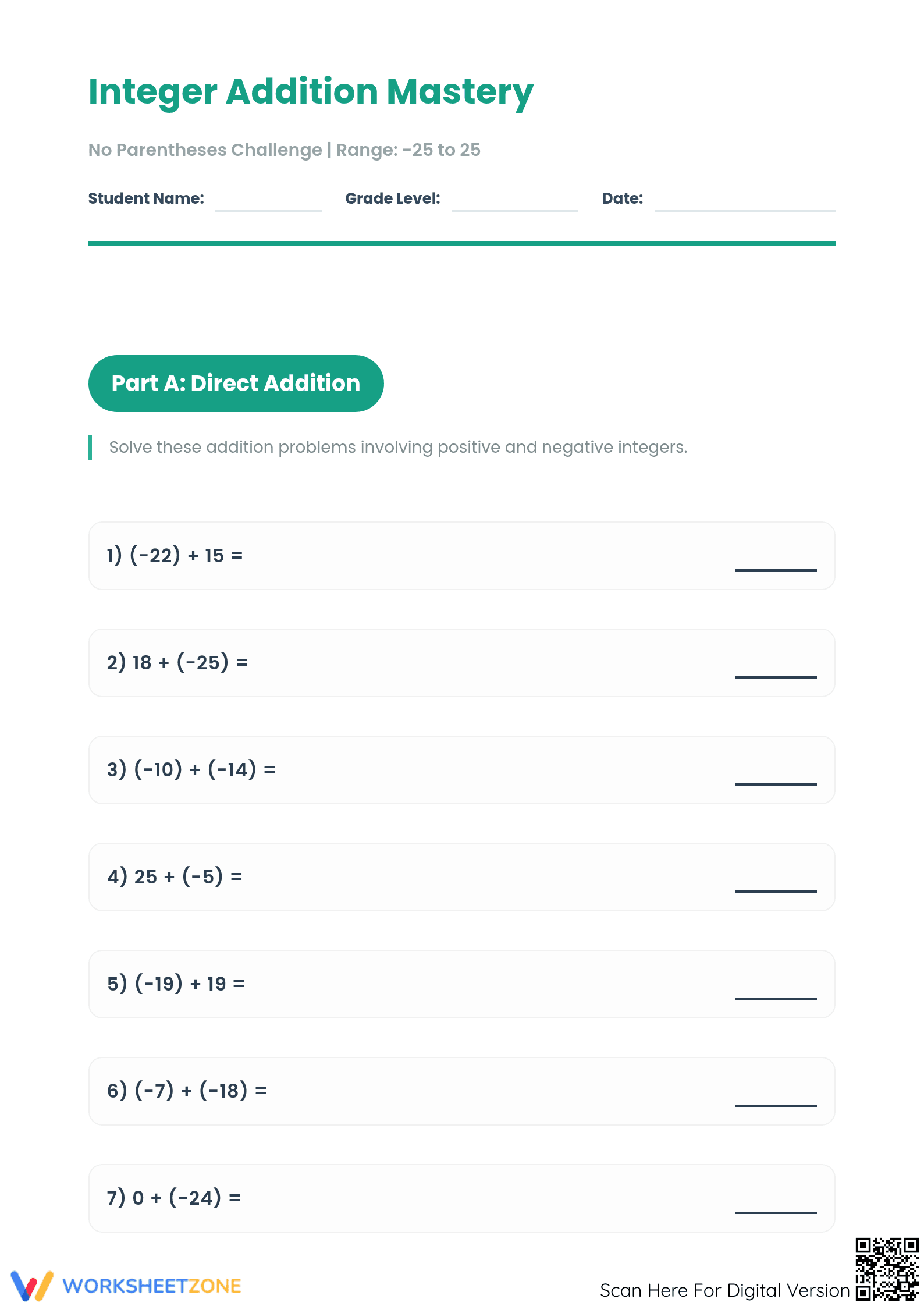
Mastering positive and negative numbers is a critical milestone for young mathematicians. This Grade 5 Math worksheet provides focused practice on integer addition within a manageable range of -25 to 25, ensuring students build confidence before tackling larger values. By completing these 40 targeted problems, learners develop the fluency needed for success in pre-algebra and advanced arithmetic.
At a Glance
- Grade: 5 · Subject: Math
- Standard:
CCSS.MATH.CONTENT.7.NS.A.1— Apply understandings of addition to add rational numbers and represent sums- Skill Focus: Integer Addition (-25 to 25)
- Format: 5 pages · 40 problems · Answer key included · PDF
- Best For: Daily math centers and fluency practice
- Time: 20–30 minutes
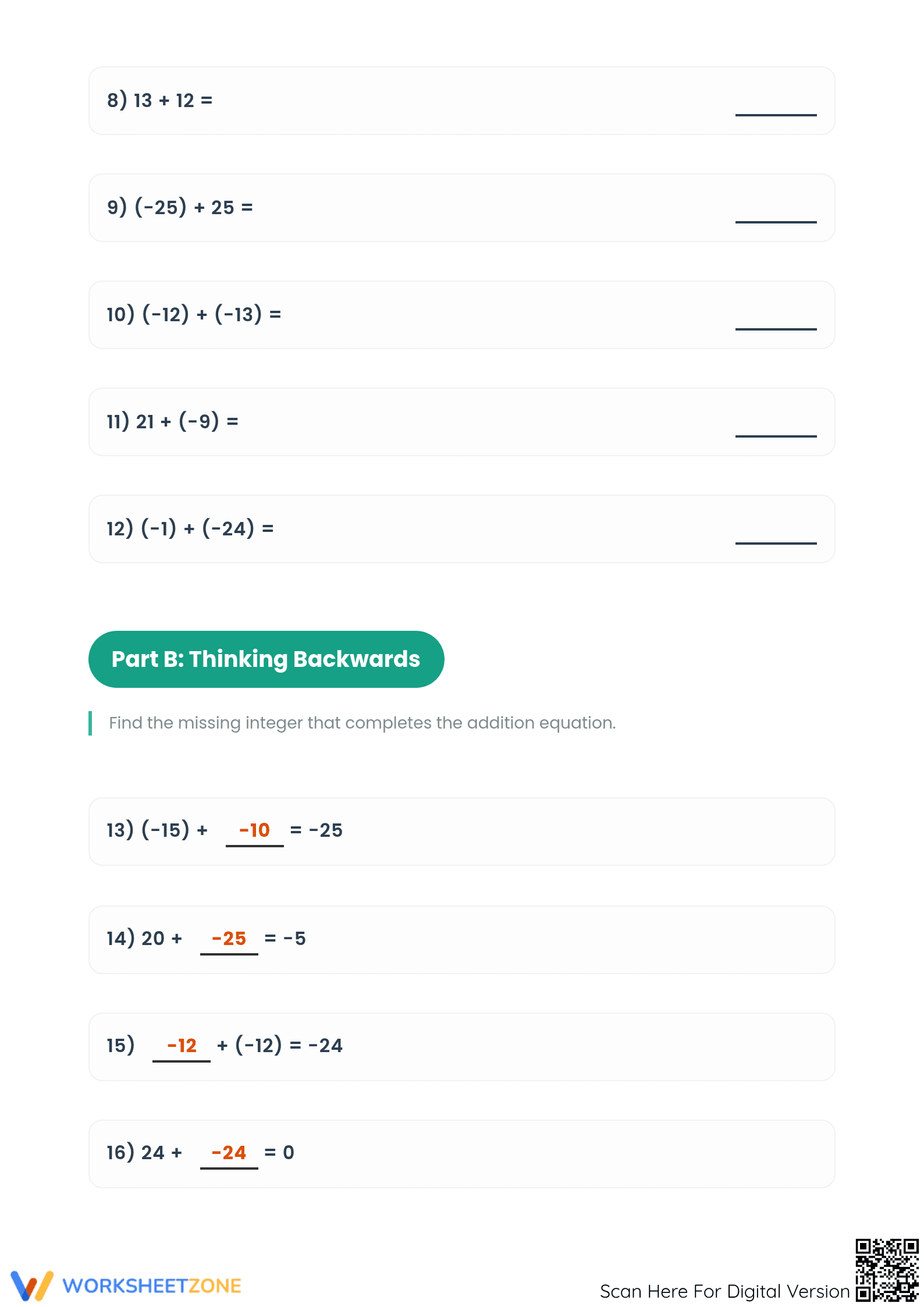
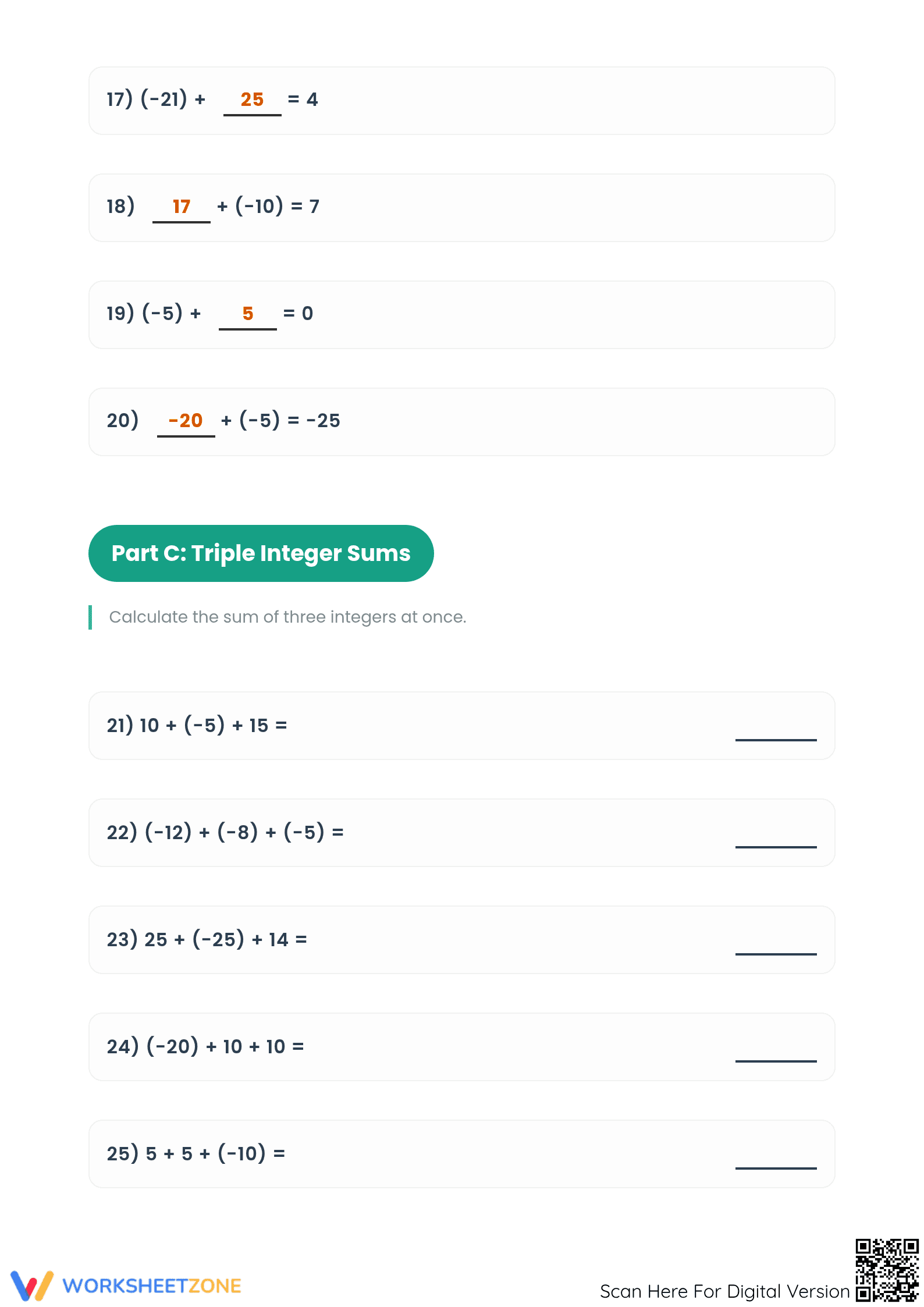
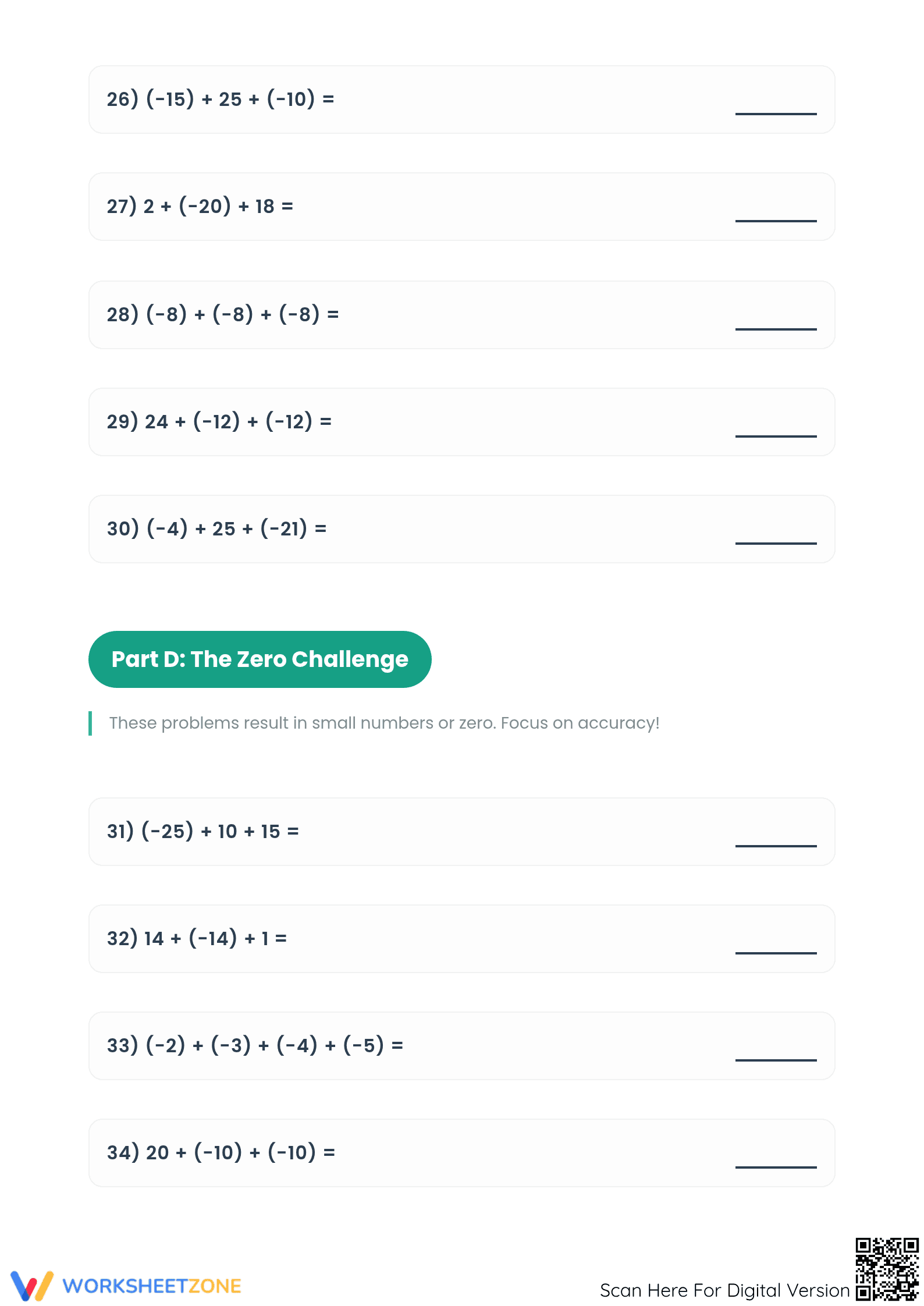
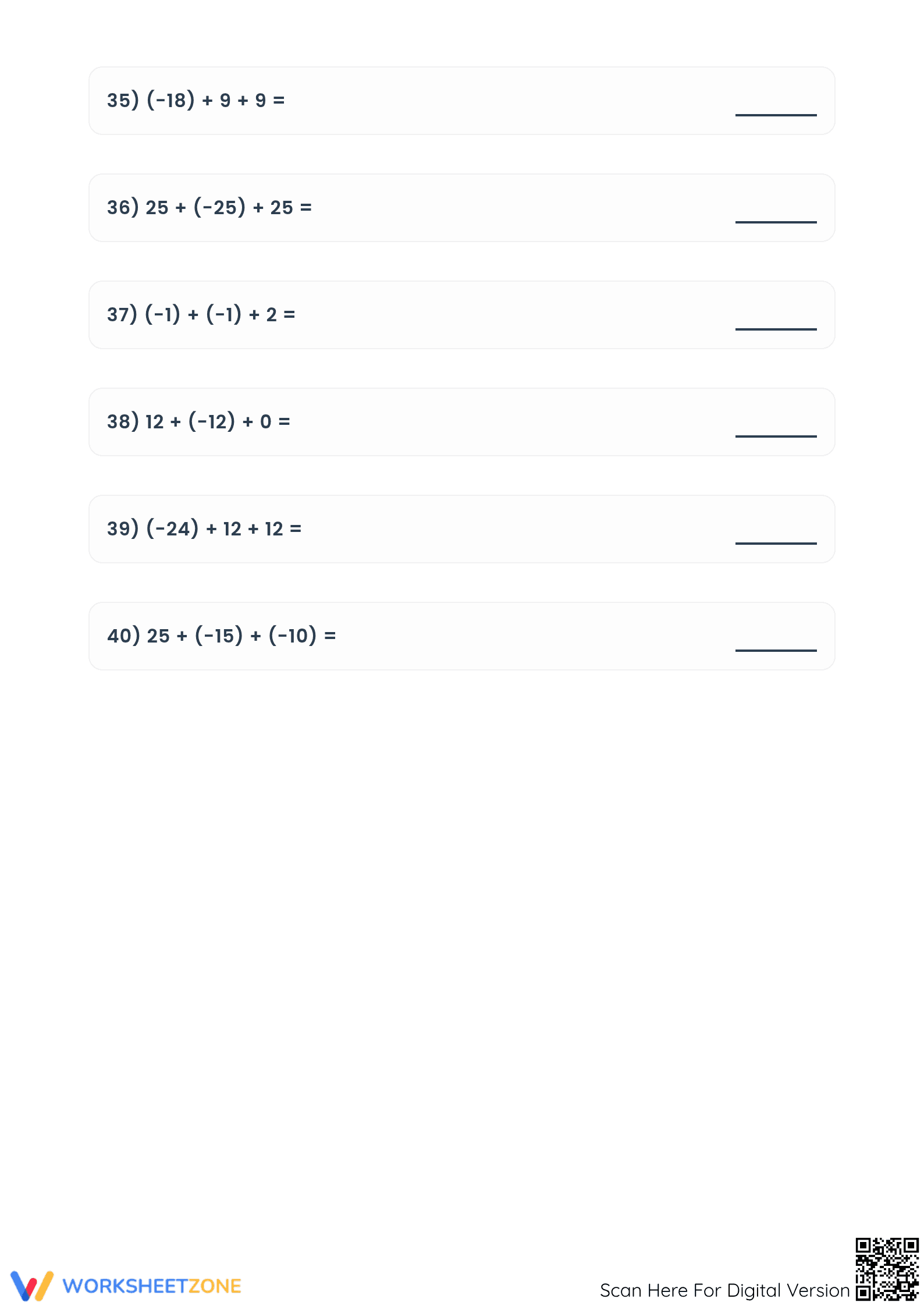
This comprehensive 5-page PDF contains 40 unique integer addition problems organized into four scaffolded sections. The collection includes direct addition equations, 'thinking backwards' problems to find missing addends, triple integer sums for multi-step practice, and a special 'Zero Challenge' focused on additive inverses. A full answer key is provided for rapid grading and student self-correction.
Skill Progression
- Guided Practice (Direct Addition): 12 problems establishing the baseline rules for combining positive and negative integers.
- Supported Practice (Inverse Operations): 8 problems requiring students to identify missing integers, reinforcing the relationship between sum and addends.
- Independent Practice (Complex Sums): 20 problems involving triple integers and zero-result challenges to test operational consistency.
This structured approach mirrors the 'I Do, We Do, You Do' instructional model, promoting student independence.
Standards Alignment
The primary alignment for this resource is `CCSS.MATH.CONTENT.7.NS.A.1`, which requires students to add and subtract rational numbers. While integers are often introduced later, this Grade 5 resource provides the necessary exposure to the number system. This standard code can be copied directly into lesson plans, IEP goals, or district curriculum mapping tools.
How to Use It
Use this worksheet as a warm-up activity during a unit on the number system or as a targeted intervention for students struggling with sign rules. For a formative assessment, observe students during the 'Thinking Backwards' section to see if they can reverse-engineer the sum. Expect completion in 20 to 30 minutes depending on prior exposure.
Who It's For
This resource is designed for Grade 5 students ready to advance beyond whole numbers, as well as middle schoolers requiring remediation. It pairs naturally with a horizontal number line anchor chart or a manipulative-based lesson using positive/negative counters. Differentiation is built into the progression from simple pairs to triple integer sums.
According to the RAND AIRS 2024 report on mathematics education, early exposure to integer concepts significantly improves algebraic readiness in later middle school years. This Grade 5 worksheet aligns with CCSS.MATH.CONTENT.7.NS.A.1 by providing structured practice in adding positive and negative integers within a -25 to 25 range. By moving through four distinct phases—direct addition, thinking backwards for missing values, triple integer sums, and zero-sum challenges—students build a robust mental model of numerical relationships and the number line. Research from ScienceDirect TpT Analysis indicates that repetitive, focused practice on small-integer sets reduces cognitive load, allowing students to internalize rules for signs without the distraction of complex multi-digit calculations. This resource provides 40 targeted problems to ensure mastery of these essential arithmetic operations, serving as a critical bridge between elementary whole-number operations and secondary rational number fluency.


