


























Views
Downloads


Essential Adding Integers Worksheet | Grade 5 Math
Paste this activity's link or code into your existing LMS (Google Classroom, Canvas, Teams, Schoology, Moodle, etc.).
Students can open and work on the activity right away, with no student login required.
You'll still be able to track student progress and results from your teacher account.
Mastering the addition of positive and negative numbers is a critical milestone for middle-grade mathematics success. This comprehensive worksheet guides students through the complexities of integer operations, moving from basic calculations to multi-step word problems and conceptual logic. Students will build the fluency and confidence needed for future algebraic reasoning.
At a Glance
- Grade: 5 · Subject: Math
- Standard:
7.NS.A.1— Apply and extend previous understandings of addition to add and subtract rational numbers- Skill Focus: Integer Addition Fluency
- Format: 4 pages · 57 problems · Answer key included · PDF
- Best For: Classroom practice, homework, or math enrichment
- Time: 30–45 minutes
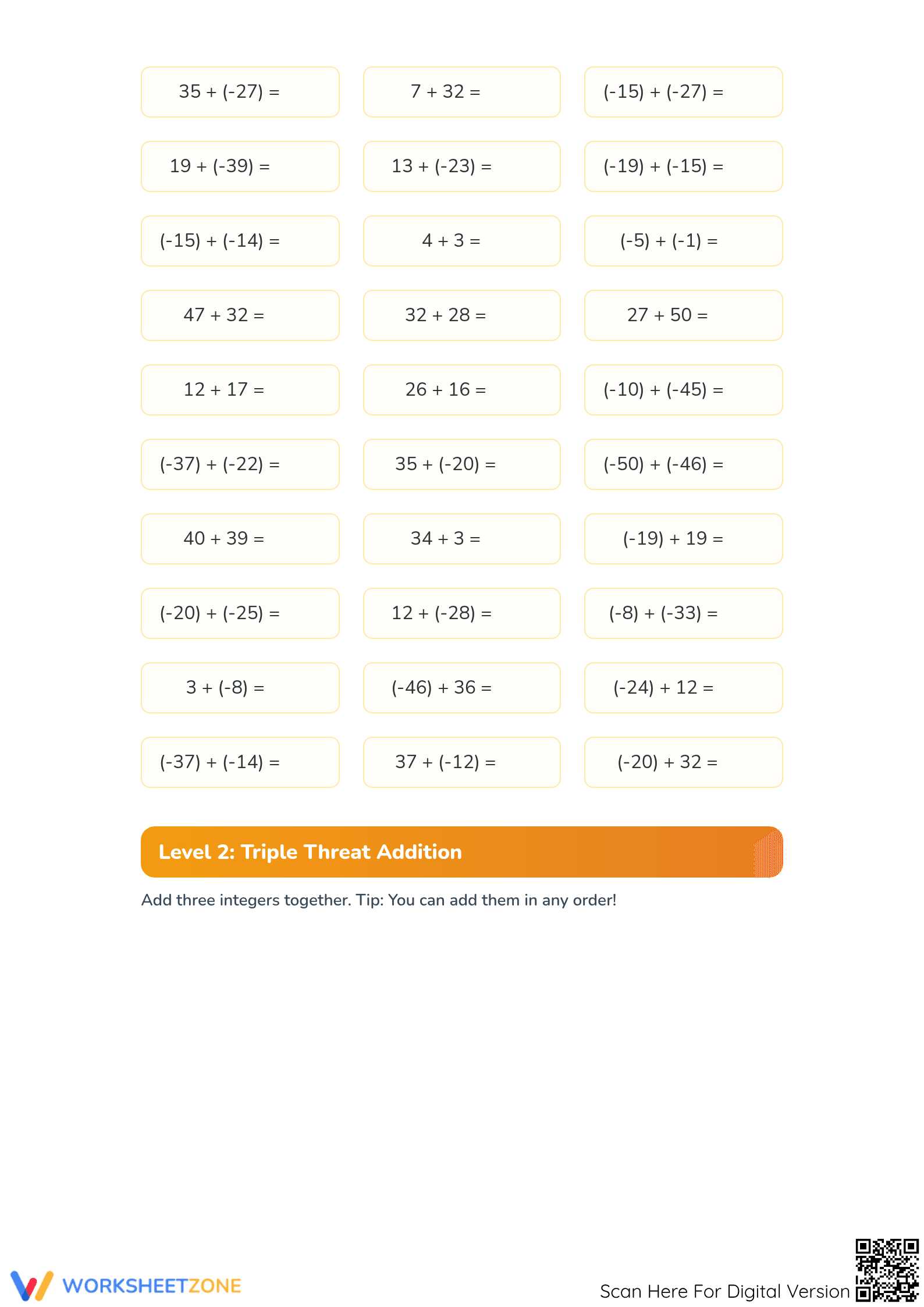
This four-page instructional resource is organized into four distinct levels to facilitate mastery. It includes 30 quick-practice problems, 12 "triple threat" three-term equations, five real-world word problems, and 10 true-or-false conceptual checks. The layout provides ample workspace, a dedicated notes section on the front page, and a full answer key for immediate feedback and grading efficiency.
- Guided Practice: The initial set of 30 problems focuses on adding two integers, allowing students to internalize rules for same-sign and different-sign addition with numbers ranging from -50 to 50.
- Supported Practice: Level 2 and Level 3 challenge students with three-term addition and contextual application in scenarios like mountain climbing and temperature changes, requiring deeper operational stamina.
- Independent Practice: The final level features 10 conceptual true-or-false statements that require students to evaluate mathematical properties and generalizations without relying on rote calculation alone.
This structure follows the gradual-release model of instruction, ensuring students move smoothly from computational fluency to high-level application.
Standards Alignment
The primary alignment for this resource is CCSS.MATH.CONTENT.7.NS.A.1, which requires students to represent addition and subtraction on a horizontal or vertical number line diagram. While typically introduced as a seventh-grade standard, this resource is tailored for fifth-grade students ready for advanced operations or those in accelerated math pathways. Both standard codes can be copied directly into lesson plans, IEP goals, or district curriculum mapping tools.
How to Use It
Use this worksheet during independent practice after a direct instruction lesson on number lines or integer chips. For a formative assessment, observe students during Level 2 to see if they apply the associative property of addition to group positive and negative numbers. This activity typically takes 30 to 45 minutes for a student to complete thoroughly.
Who It's For
This resource is designed for fifth-grade students ready for pre-algebra concepts, as well as sixth and seventh graders needing remediation or fluency drills. It pairs naturally with an integer number line anchor chart or a physical demonstration using red and yellow counters to visualize the creation of zero pairs.
Effective instruction in integer addition requires a move beyond rote memorization of rules toward conceptual understanding and contextual application. Research from the RAND AIRS 2024 study emphasizes that students who engage with varied problem types—including multi-term operations and verbal scenarios—demonstrate significantly higher retention rates than those limited to isolated drills. By integrating word problems involving elevation and temperature, this resource aligns with the Fisher & Frey (2014) framework for purposeful learning, which advocates for students to apply mathematical skills to authentic situations. The inclusion of a true-or-false logic section further supports cognitive development by requiring students to justify their mathematical reasoning, a key component of the NAEP standards for mathematical proficiency. This multi-layered approach ensures that the standard CCSS.MATH.CONTENT.7.NS.A.1 is not just practiced but deeply understood, preparing learners for the more rigorous demands of middle school algebra.


