


























Views
Downloads



Printable Adding Integers Worksheet | Grade 5 Math
Paste this activity's link or code into your existing LMS (Google Classroom, Canvas, Teams, Schoology, Moodle, etc.).
Students can open and work on the activity right away, with no student login required.
You'll still be able to track student progress and results from your teacher account.
This comprehensive Grade 5 math worksheet provides essential practice for students learning to add integers with negative values. By working through thirty-two targeted problems, learners develop a concrete understanding of number line movement and sign rules. This resource ensures students gain the confidence needed to handle complex algebraic operations in future grade levels.
At a Glance
- Grade: 5 · Subject: Math
- Standard:
CCSS.MATH.CONTENT.6.NS.C.5— Use positive and negative numbers to represent quantities in real-world contexts- Skill Focus: Adding integers with negative numbers
- Format: 4 pages · 32 problems · Answer key included · PDF
- Best For: Independent practice and formative assessment
- Time: 25–35 minutes
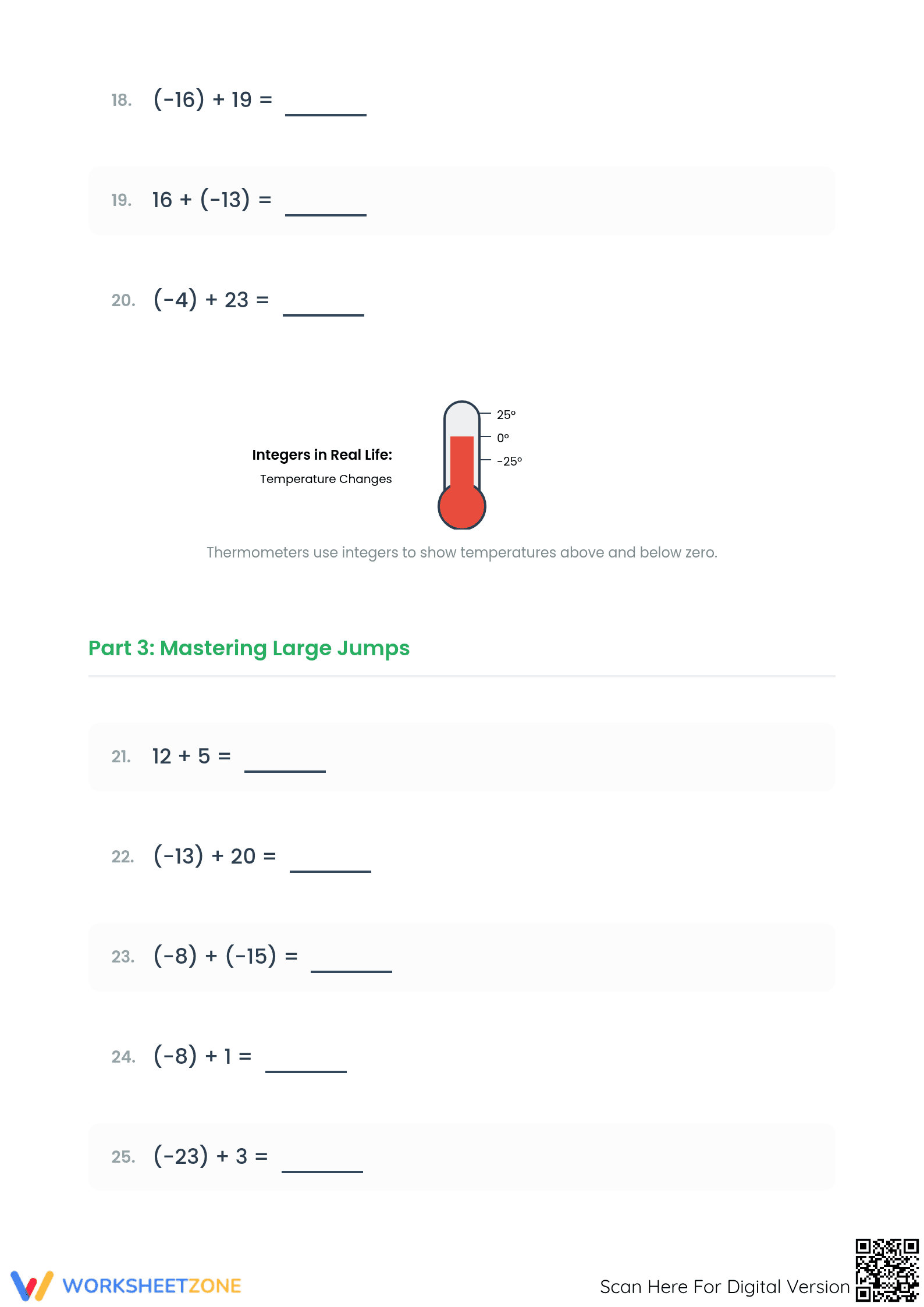
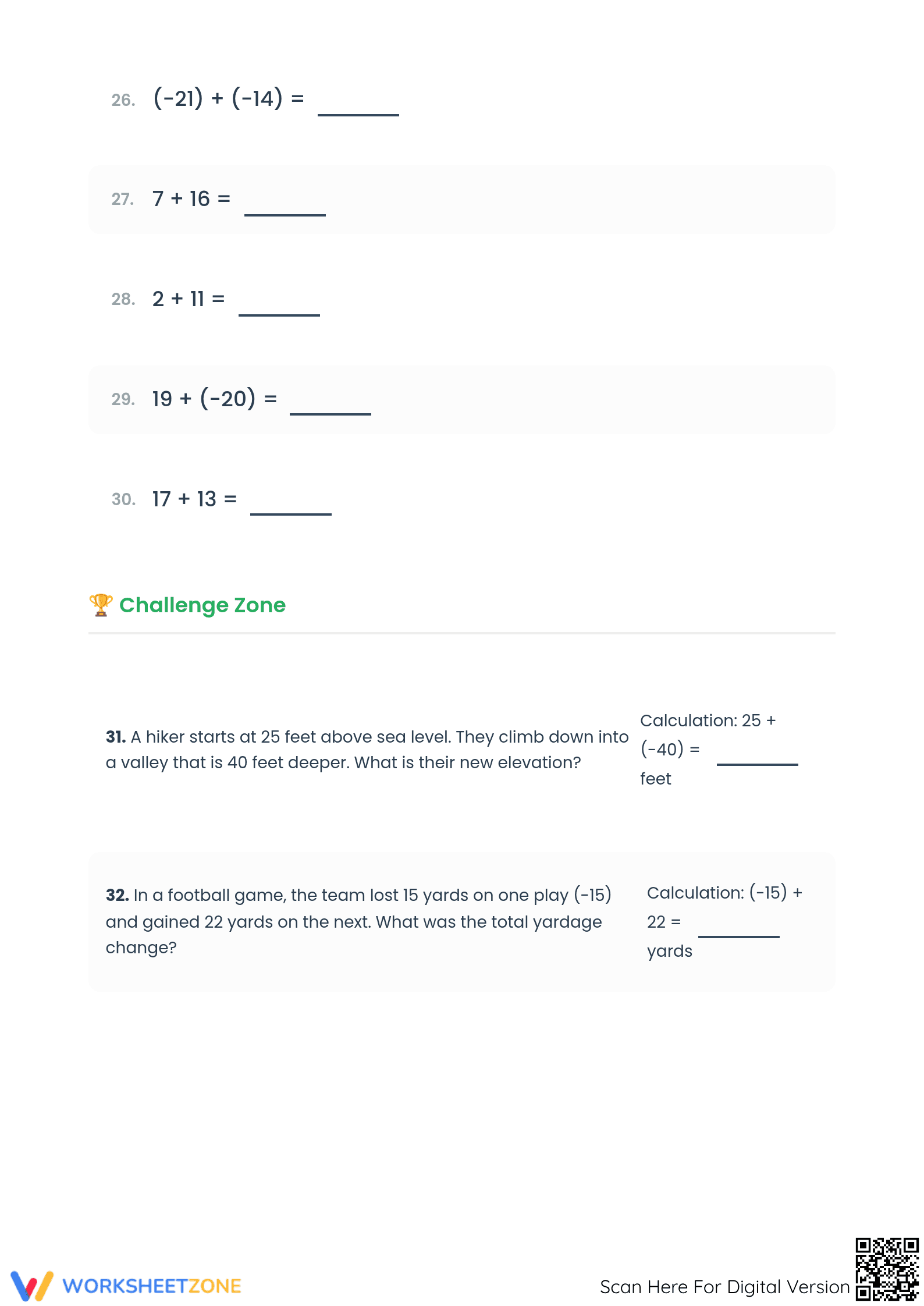
What's Inside: This four-page PDF includes three distinct practice sections and a challenge zone. It features ten basic integer sums, ten mixed-sign problems, and ten large-jump exercises. The final page contains two real-world word problems involving elevation and sports. A visual temperature gauge and a full answer key are provided to assist with self-correction and instructional modeling.
- Guided Practice: The first ten problems focus on small-digit addition (sums within 25), allowing teachers to model sign rules using a simple number line approach.
- Supported Practice: Problems 11 through 20 introduce mixed signs and parentheses, requiring students to apply consistent strategies to more abstract numerical relationships.
- Independent Practice: The final twelve tasks, including the Challenge Zone word problems, require students to transfer their skills to real-world scenarios without additional scaffolds.
Standards Alignment: This resource is aligned with `CCSS.MATH.CONTENT.6.NS.C.5`, which requires students to understand that positive and negative numbers are used together to describe quantities having opposite directions or values. Both standard codes can be copied directly into lesson plans, IEP goals, or district curriculum mapping tools to ensure instructional coherence across the grade level.
How to Use It: Assign this worksheet during the independent practice phase of a lesson on integers. Use the temperature graphic on page three to facilitate a whole-class discussion on how negative numbers function in daily life. Teachers can observe student work on the Challenge Zone word problems to identify which students require additional small-group intervention.
Who It's For: This printable is designed for Grade 5 students introduced to negative numbers, as well as Grade 6 students requiring remediation. It pairs naturally with a physical number line or a vertical thermometer anchor chart. The clear layout makes it an excellent choice for special education settings or as a self-contained substitute teacher plan.
According to the RAND AIRS 2024 report on mathematics instructional materials, the strategic use of structured problem sets is vital for students transitioning from whole number operations to integer arithmetic. This worksheet aligns with research suggesting that early exposure to negative numbers through concrete examples—such as the temperature and elevation problems included here—facilitates the development of a robust mental number line. By providing thirty-two opportunities for practice, this resource supports the gradual-release model of instruction, allowing students to move from simple integer sums to complex real-world applications. Fisher & Frey (2014) emphasize that such scaffolds are necessary for cognitive load management during the introduction of abstract mathematical concepts. The inclusion of an answer key further supports immediate feedback, a key factor in preventing the solidification of misconceptions. This resource serves as a reliable tool for Grade 5 educators looking to bridge the gap toward middle school algebraic standards like CCSS.MATH.CONTENT.6.NS.C.5 effectively.


