


























Views
Downloads

Essential Adding Integers Worksheet | Grade 5 Math
Paste this activity's link or code into your existing LMS (Google Classroom, Canvas, Teams, Schoology, Moodle, etc.).
Students can open and work on the activity right away, with no student login required.
You'll still be able to track student progress and results from your teacher account.
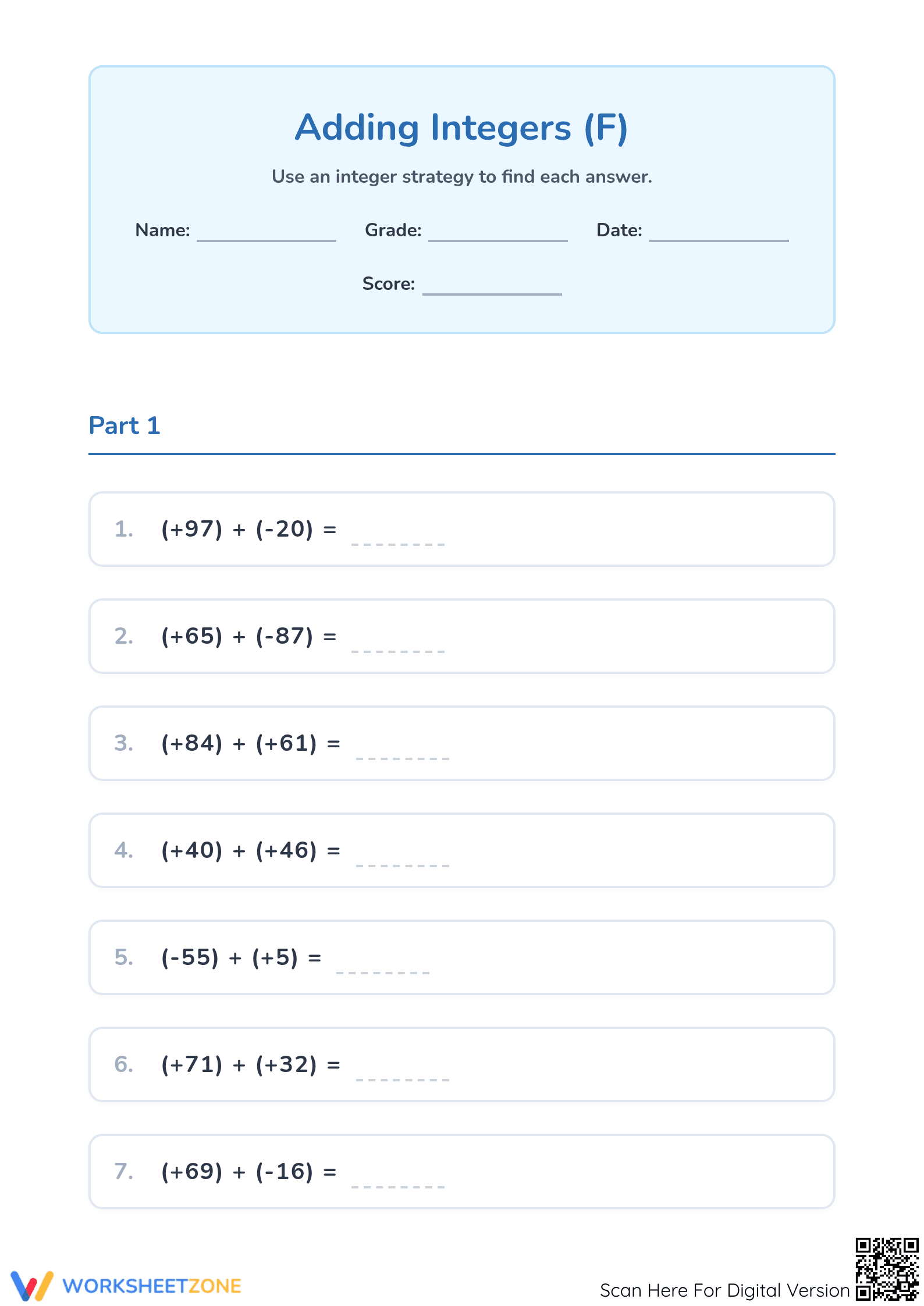
This Grade 5 Math worksheet provides essential practice for students learning to add integers ranging from -99 to 99. By working through 30 structured problems, learners develop a robust integer strategy to handle positive and negative numbers with confidence. The clear layout ensures students focus entirely on the mathematical logic required for mastery.
At a Glance
- Grade: 5 · Subject: Math
- Standard:
CCSS.MATH.CONTENT.7.NS.A.1— Apply properties of operations as strategies to add and subtract rational numbers.- Skill Focus: Adding Integers (-99 to 99)
- Format: 4 pages · 30 problems · Answer key included · PDF
- Best For: Independent practice and formative assessment
- Time: 20–30 minutes
What's Inside
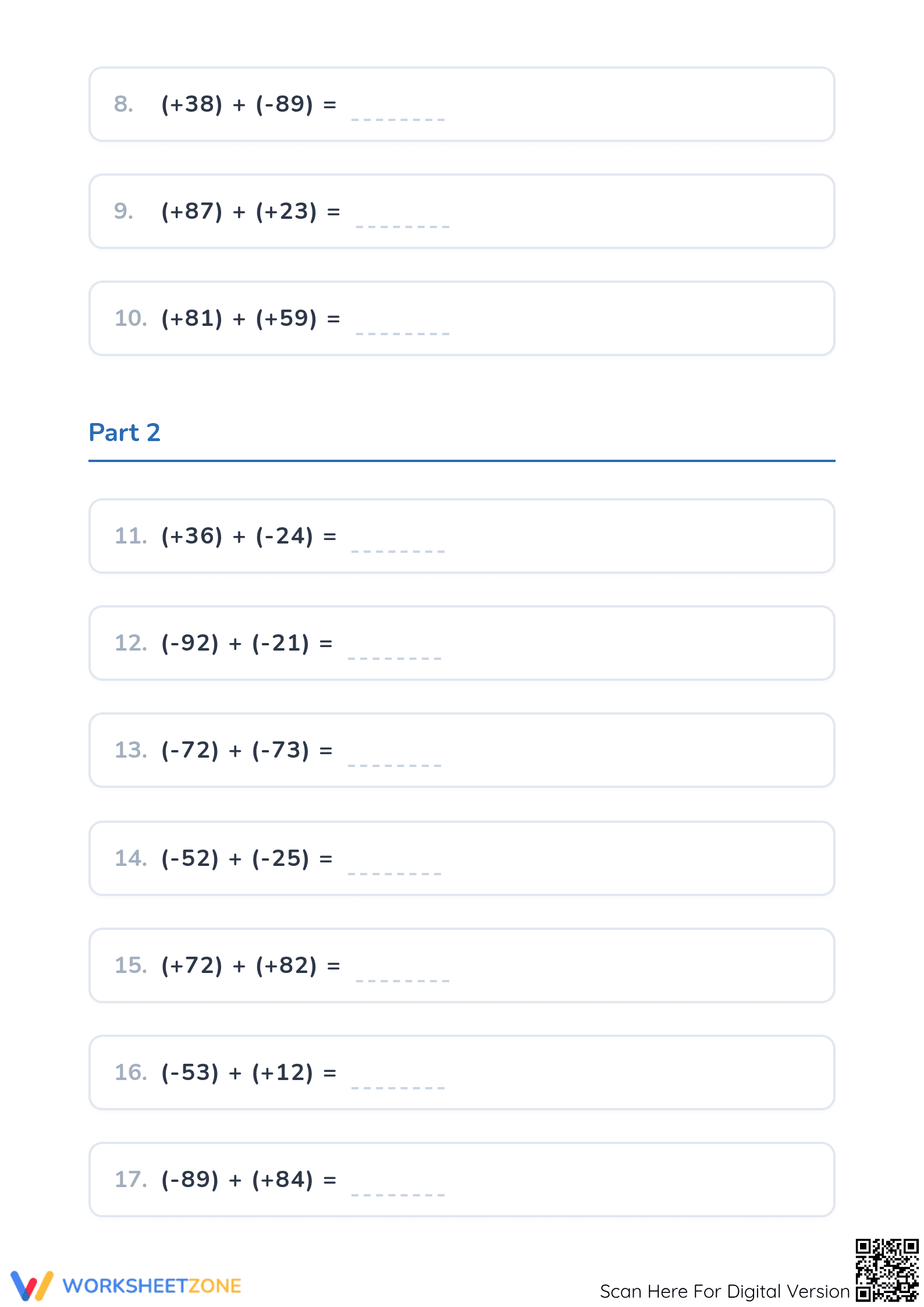
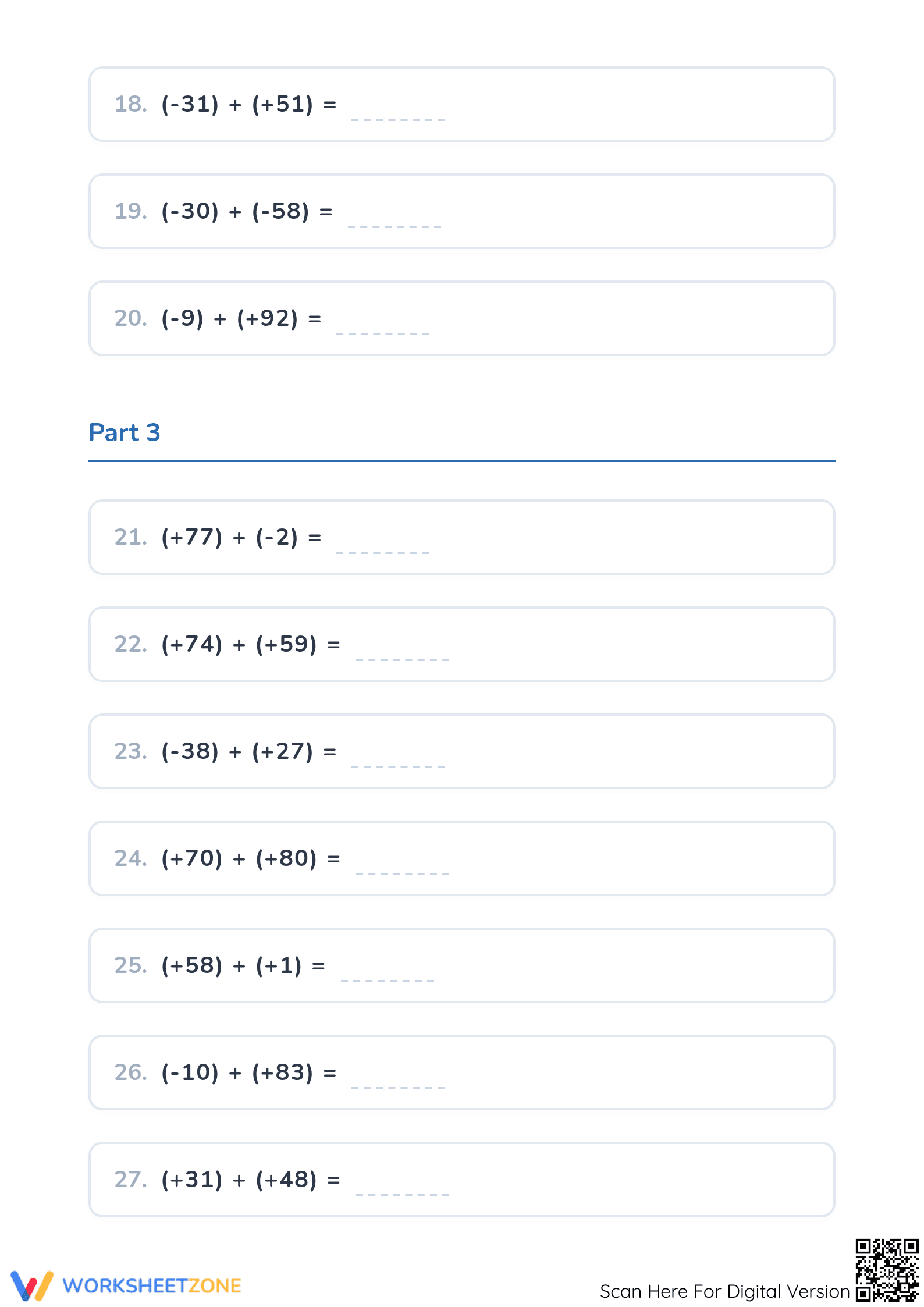
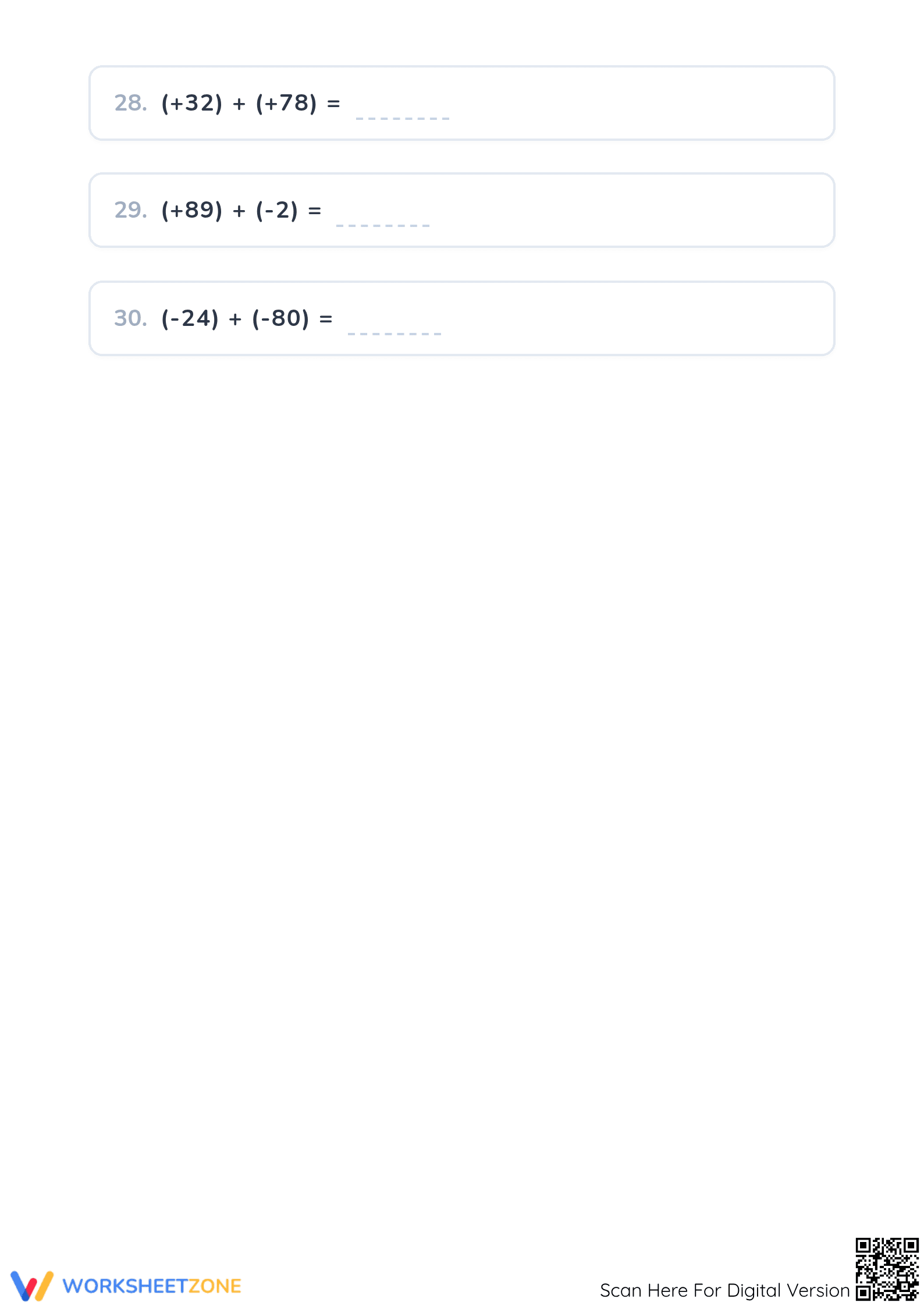
This comprehensive 4-page PDF contains three distinct parts, totaling 30 horizontal addition equations. Each problem is presented within its own visual box to reduce cognitive load. The set includes combinations of positive plus negative, negative plus negative, and positive plus positive integers. A complete four-page answer key is provided, mirroring the worksheet layout for rapid, one-to-one grading and immediate student feedback.
Zero-Prep Workflow
Using this resource requires exactly zero minutes of teacher preparation. Simply follow these steps:
- Print: Download the PDF and print the student pages.
- Distribute: Hand out the worksheets for independent seatwork or as a quick-start bell ringer.
- Review: Use the included answer keys for rapid self-grading or to quickly spot check student progress across the 30 tasks.
This "print-and-go" design makes it an ideal choice for emergency sub plans or high-frequency skill reinforcement without adding to your planning time.
Standards Alignment
This resource aligns primarily with `CCSS.MATH.CONTENT.7.NS.A.1`, focusing on the addition of rational numbers (integers). Specifically, it supports the understanding that p + q is the number located a distance |q| from p, in the positive or negative direction depending on whether q is positive or negative. The standard code can be copied directly into lesson plans, IEP goals, or district curriculum mapping tools to ensure instructional compliance.
How to Use It
Use this worksheet during the "Independent Practice" phase of a lesson on the number line or absolute value. For a formative assessment, assign "Part 1" as an exit ticket to observe if students are correctly applying the rules for adding integers with different signs. The 20-30 minute completion time makes it perfect for a standard math block station or as a targeted homework assignment to reinforce classroom instruction.
Who It's For
This worksheet is designed for students beginning their journey with integers, specifically in Grade 5 or 6. It is particularly beneficial for learners who need repetitive, low-distraction practice to internalize signs. Pair this with a horizontal number line anchor chart to provide a visual scaffold for students who are still developing their mental integer strategies.
Mastery of integer operations is a critical gateway to algebraic thinking. Research by Fisher & Frey (2014) emphasizes the importance of repetitive practice in developing fluency with abstract concepts like negative numbers. This worksheet facilitates that process by providing 30 tasks that allow students to test their mental models against concrete problems. By centering the activity on `CCSS.MATH.CONTENT.7.NS.A.1`, educators ensure student practice is linked to the rigorous demands of national frameworks. The -99 to 99 range pushes students beyond single-digit arithmetic, requiring place value knowledge alongside integer rules. This dual-demand structure builds the fluency necessary for navigating the complexities of middle school mathematics. It serves as a reliable evidence-based tool for both general education and intervention settings, allowing for clear data collection on student mastery of essential rational number operations.


