


























Views
Downloads

Integers Addition Worksheet | Essential Grade 5 Aligned
Paste this activity's link or code into your existing LMS (Google Classroom, Canvas, Teams, Schoology, Moodle, etc.).
Students can open and work on the activity right away, with no student login required.
You'll still be able to track student progress and results from your teacher account.
Mastering integer operations is a pivotal milestone in a student's mathematical journey, serving as the foundation for algebra and advanced arithmetic. This comprehensive worksheet provides the essential practice required to build confidence when adding positive and negative numbers. By moving from abstract calculations to concrete real-world scenarios, students develop a versatile understanding of how integers function in daily life.
At a Glance
- Grade: Grade 5 · Subject: Math
- Standard:
CCSS.MATH.CONTENT.7.NS.A.1— Apply previous understandings of addition and subtraction to add and subtract integers- Skill Focus: Adding integers with same and different signs
- Format: 4 pages · 38 problems · Answer key included · PDF
- Best For: Advanced elementary practice and secondary review
- Time: 30–45 minutes
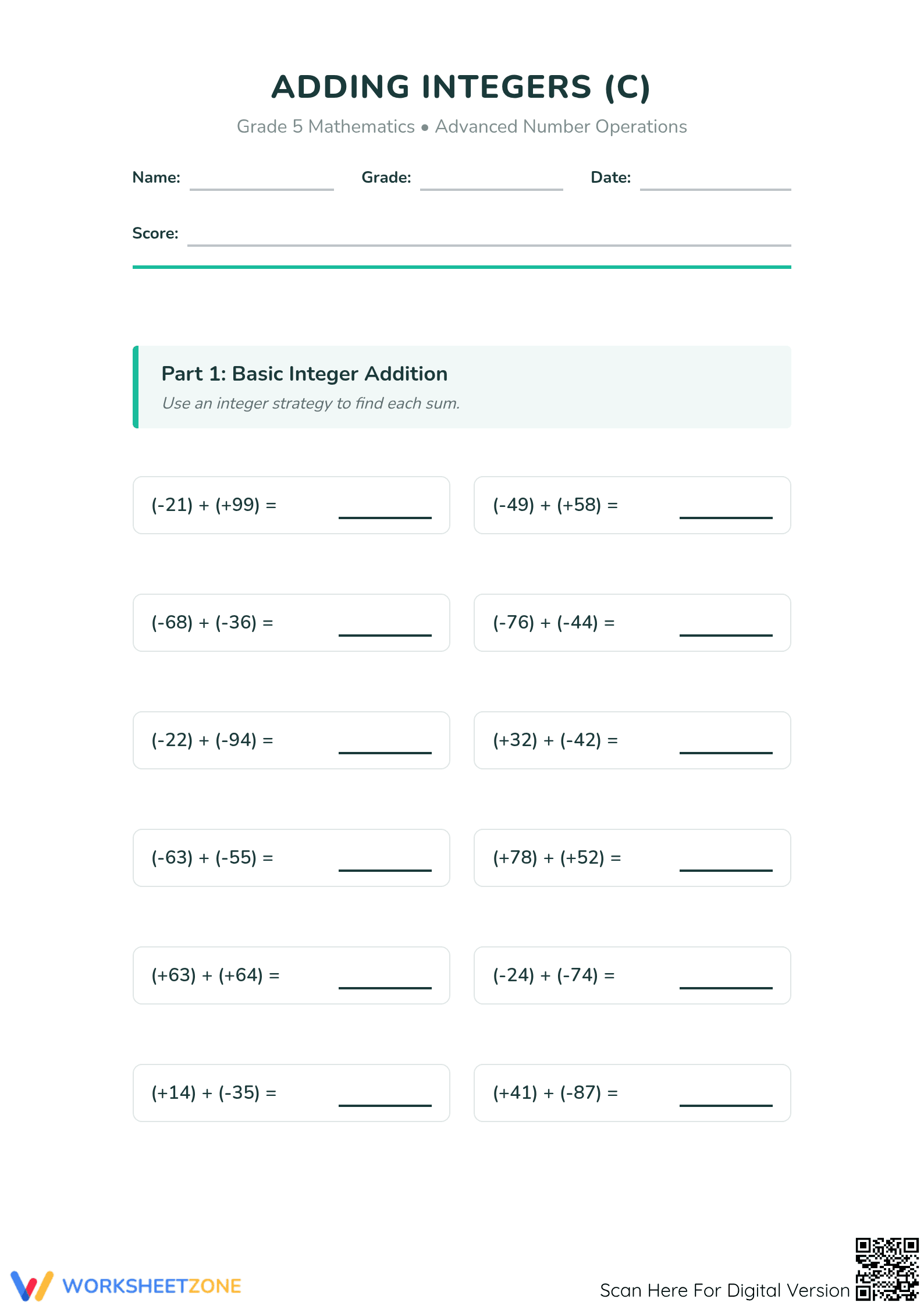
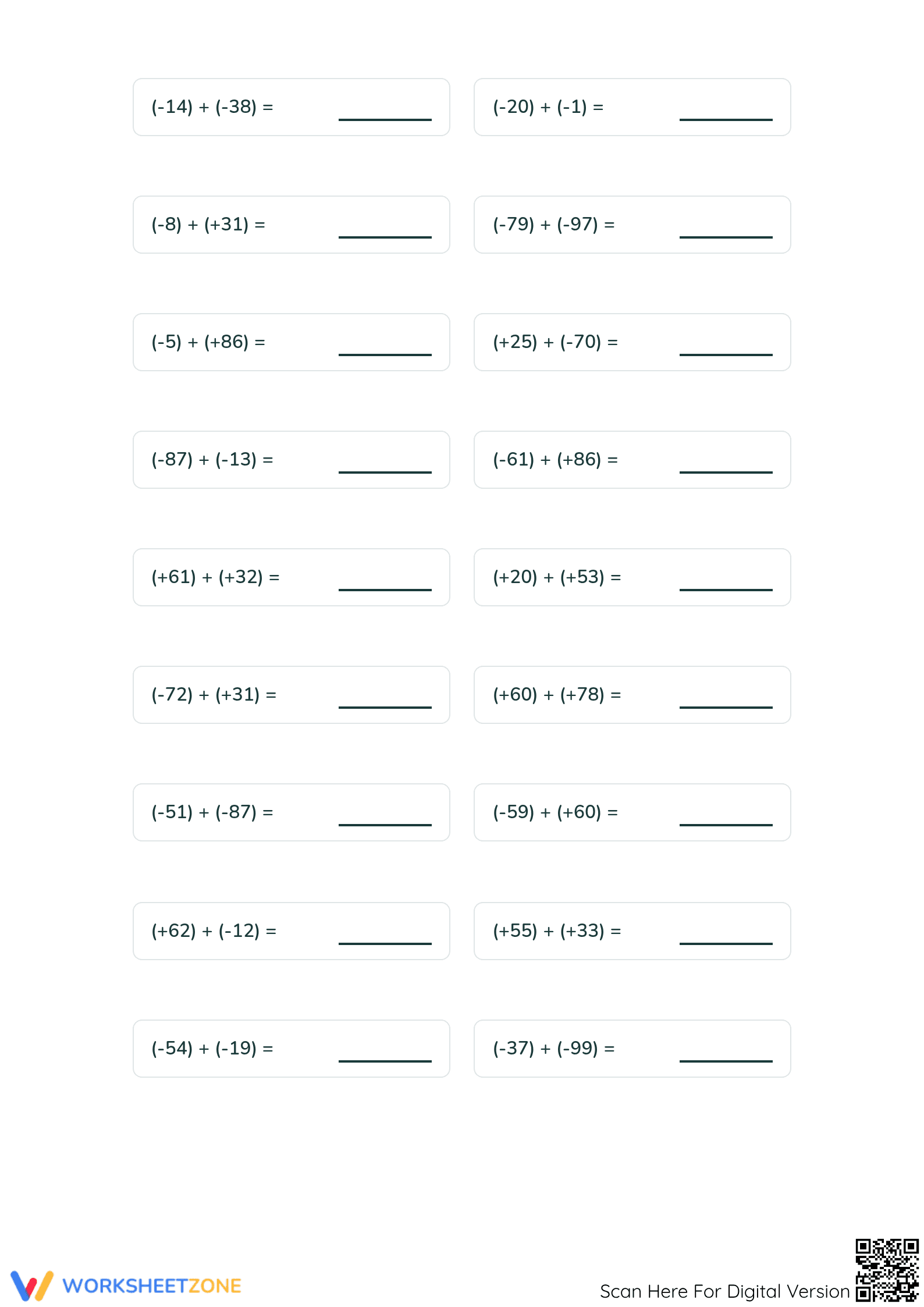
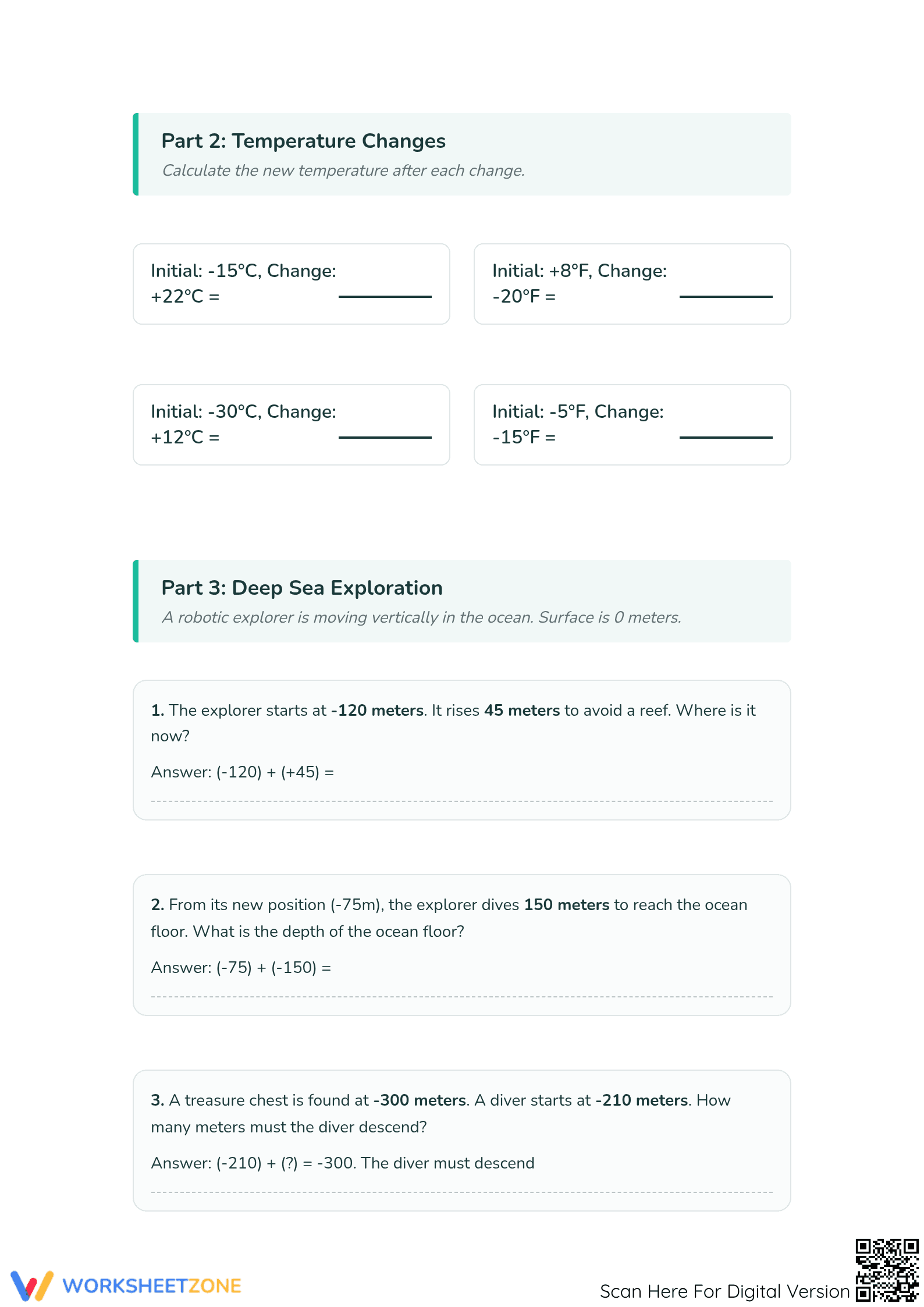
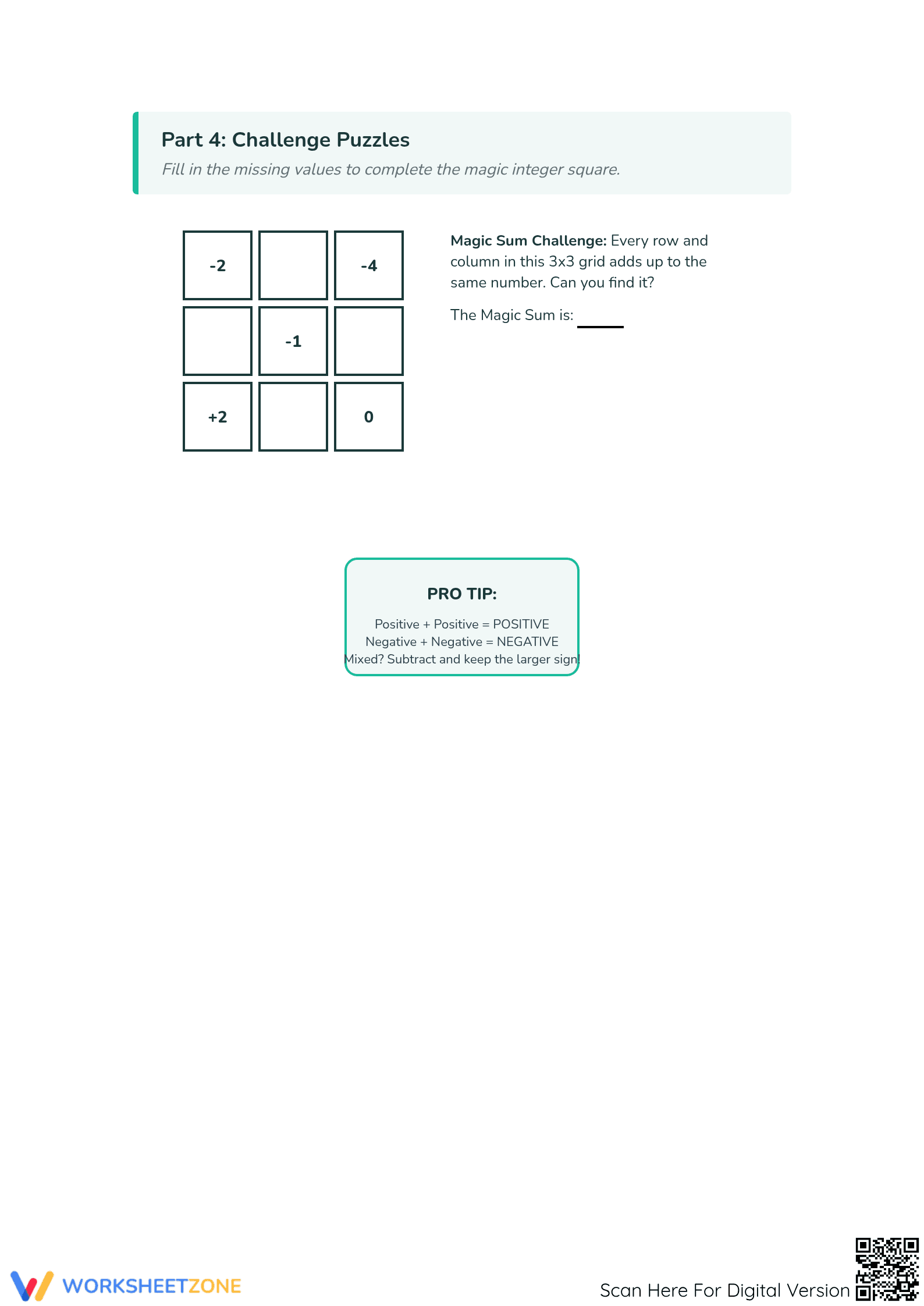
What's Inside: This 4-page PDF contains 38 unique tasks divided into four specialized sections. It begins with 30 procedural addition problems featuring parentheses for clarity, followed by contextual word problems involving temperature shifts and ocean depths. The final page includes a high-interest magic square puzzle. A complete answer key is included to facilitate immediate feedback and student self-grading.
Zero-Prep Workflow
Designed for immediate classroom implementation, this resource requires minimal teacher effort. Teachers can print the four-page packet in under one minute and distribute it as a complete unit or individual practice sheets. The structured layout allows for a 35-minute instructional block where students work independently after a brief 5-minute warm-up. Reviewing the results is streamlined by the included answer key, making this an ideal choice for emergency sub plans or last-minute enrichment activities.
Standards Alignment
This resource is meticulously aligned with CCSS.MATH.CONTENT.7.NS.A.1, which requires students to represent addition and subtraction on a horizontal or vertical number line diagram. While labeled for advanced Grade 5 learners, it also supports Grade 6 and Grade 7 expectations for number system fluency. This standard code can be copied directly into lesson plans, IEP goals, or district curriculum mapping tools.
How to Use It
Deploy this worksheet as a formative assessment mid-way through your integers unit to gauge student mastery of the signs. It works exceptionally well during independent practice rotations or as a tiered intervention for students ready for advanced operations. During the lesson, observe how students handle the "magic square" to identify those who have moved beyond rote calculation toward conceptual fluency. Expect completion within 45 minutes.
Who It's For
This resource is tailored for Grade 5 students working above grade level, as well as middle schoolers requiring additional support with integer foundations. It pairs naturally with a number line anchor chart or a direct instruction lesson on absolute value. The varied task types ensure that all learners remain engaged through multiple cognitive entry points.
According to the RAND AIRS 2024 report on mathematics instructional materials, the integration of multiple representations—ranging from abstract numerical expressions to contextualized word problems—is vital for building a robust understanding of number systems. This worksheet adheres to those findings by bridging the gap between basic integer operations and real-world applications in science and geography. By challenging students to apply CCSS.MATH.CONTENT.7.NS.A.1 to temperature fluctuations and ocean depths, the resource reinforces the conceptual link between addition and directional movement. The inclusion of a magic square puzzle serves as a high-cognitive-demand task that encourages perseverance and self-correction, key components of mathematical fluency. Educational researchers suggest that such variety prevents rote memorization and instead fosters flexible thinking when students navigate positive and negative values. This comprehensive practice ensures that learners internalize the logic of integer addition, preparing them for more complex algebraic concepts and multi-step problem-solving in subsequent secondary math curricula.


