


























Views
Downloads

Adding Integers Worksheet | Grade 5 Math Printable
Paste this activity's link or code into your existing LMS (Google Classroom, Canvas, Teams, Schoology, Moodle, etc.).
Students can open and work on the activity right away, with no student login required.
You'll still be able to track student progress and results from your teacher account.
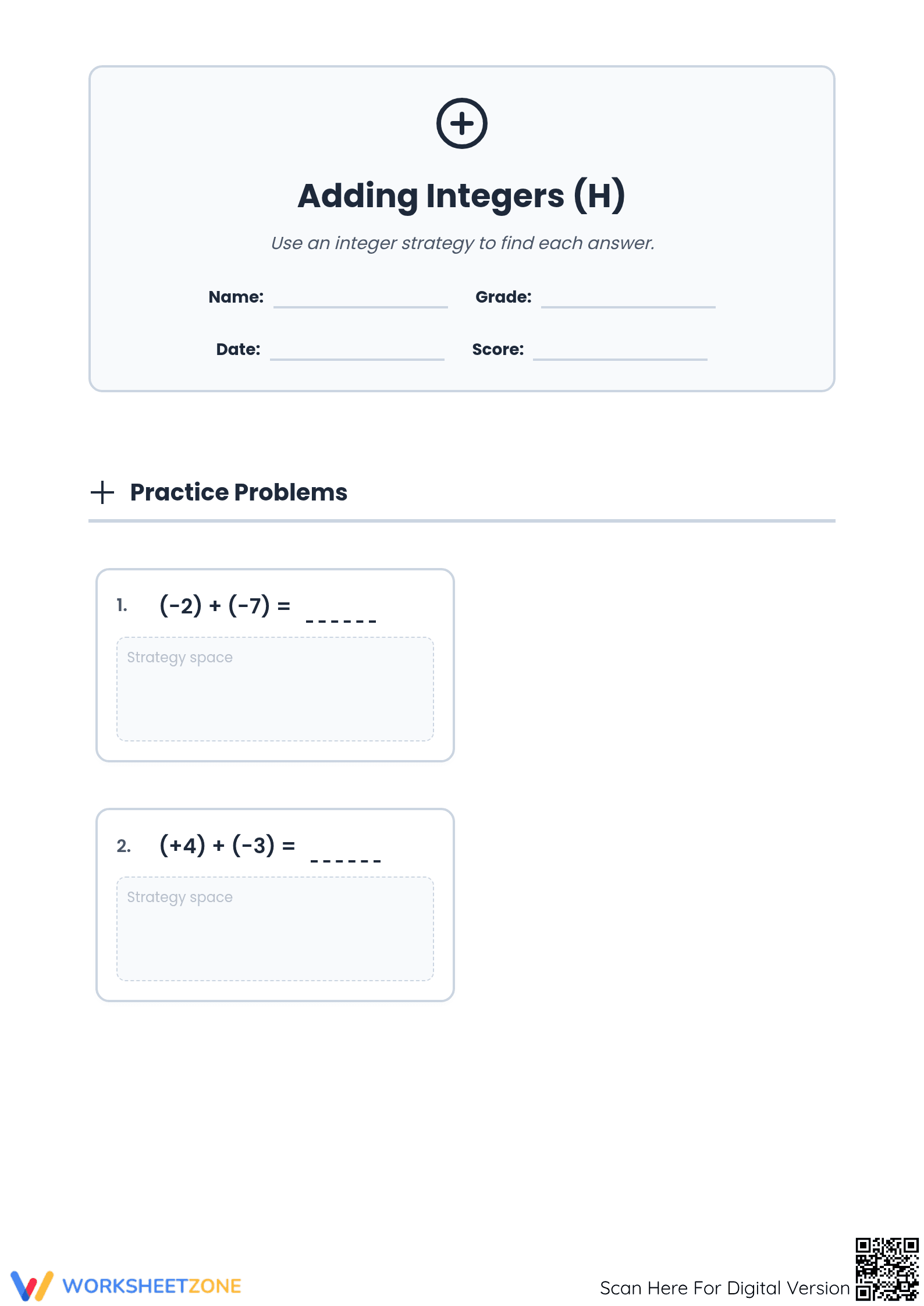
Students master the fundamental operations of number systems with this focused integer addition worksheet. By practicing with values from -9 to 9, fifth graders build the conceptual framework necessary for success in middle school algebra. This resource provides the structural support needed to move from concrete understanding to abstract computation with positive and negative numbers.
At a Glance
- Grade: 5 · Subject: Math
- Standard:
CCSS.MATH.CONTENT.7.NS.A.1— Apply and extend previous understandings of addition and subtraction to add and subtract integers- Skill Focus: Integer addition within -9 to 9
- Format: 5 pages · 18 problems · Answer key included · PDF
- Best For: Small group instruction and independent practice
- Time: 25–35 minutes
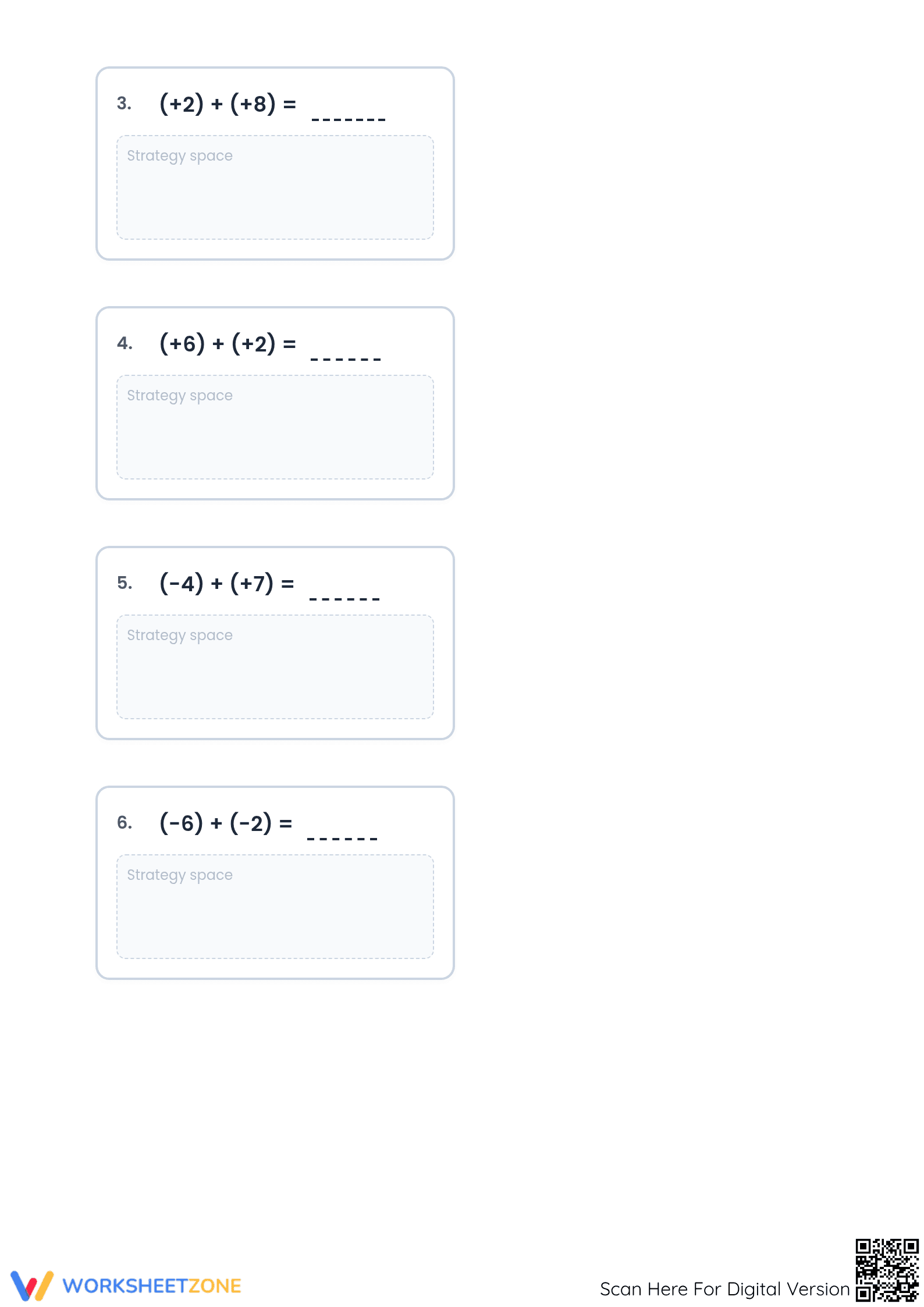
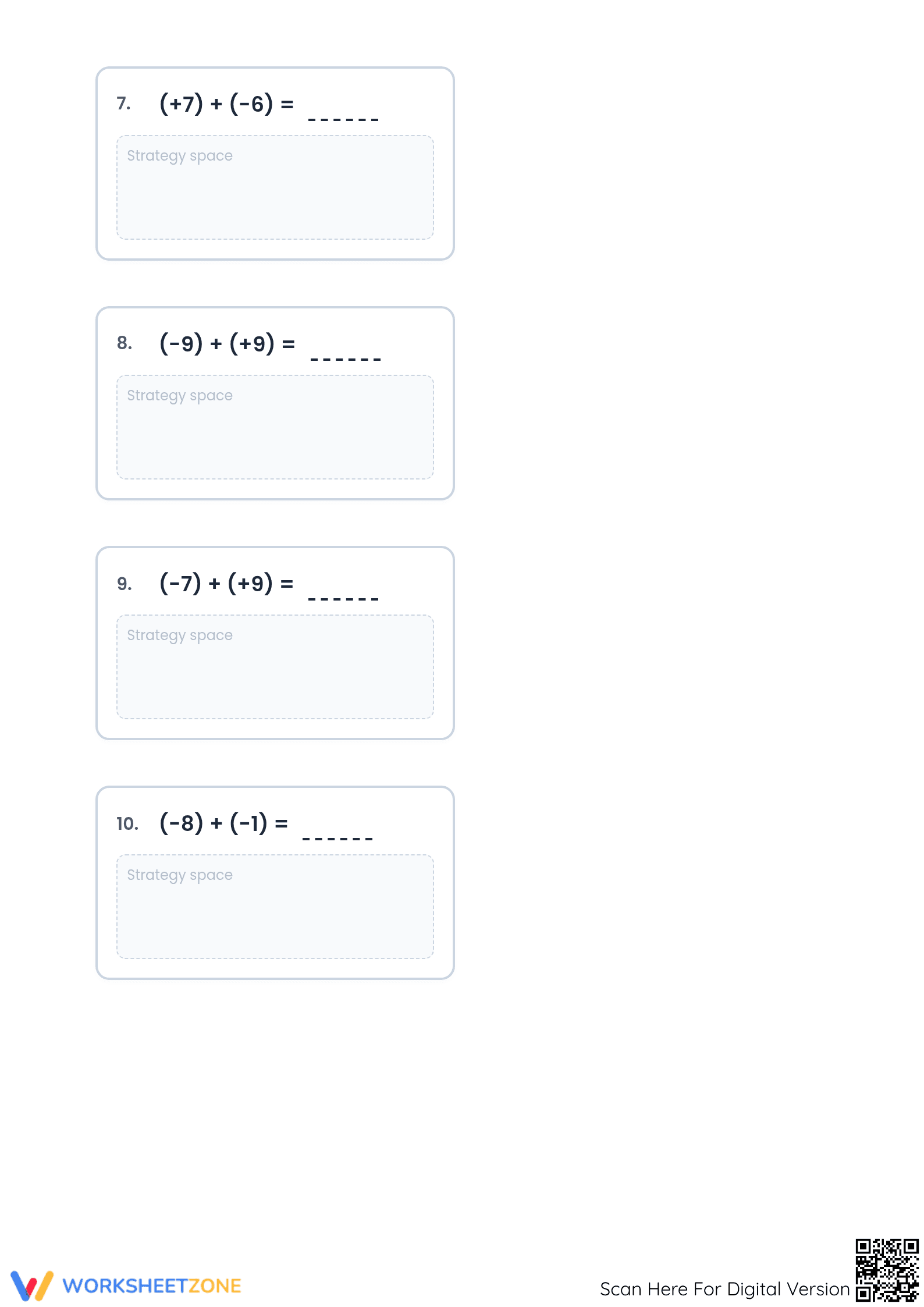
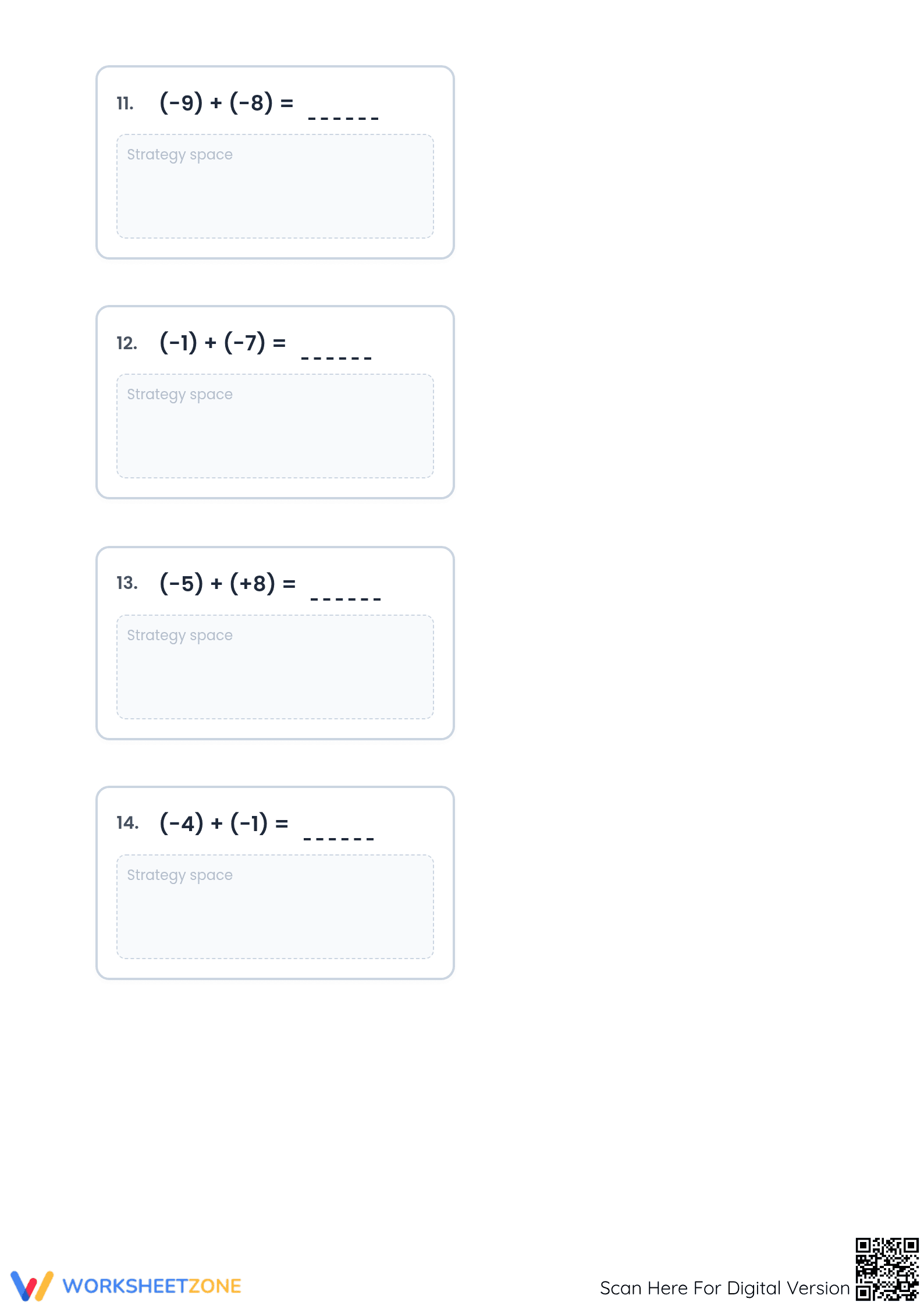
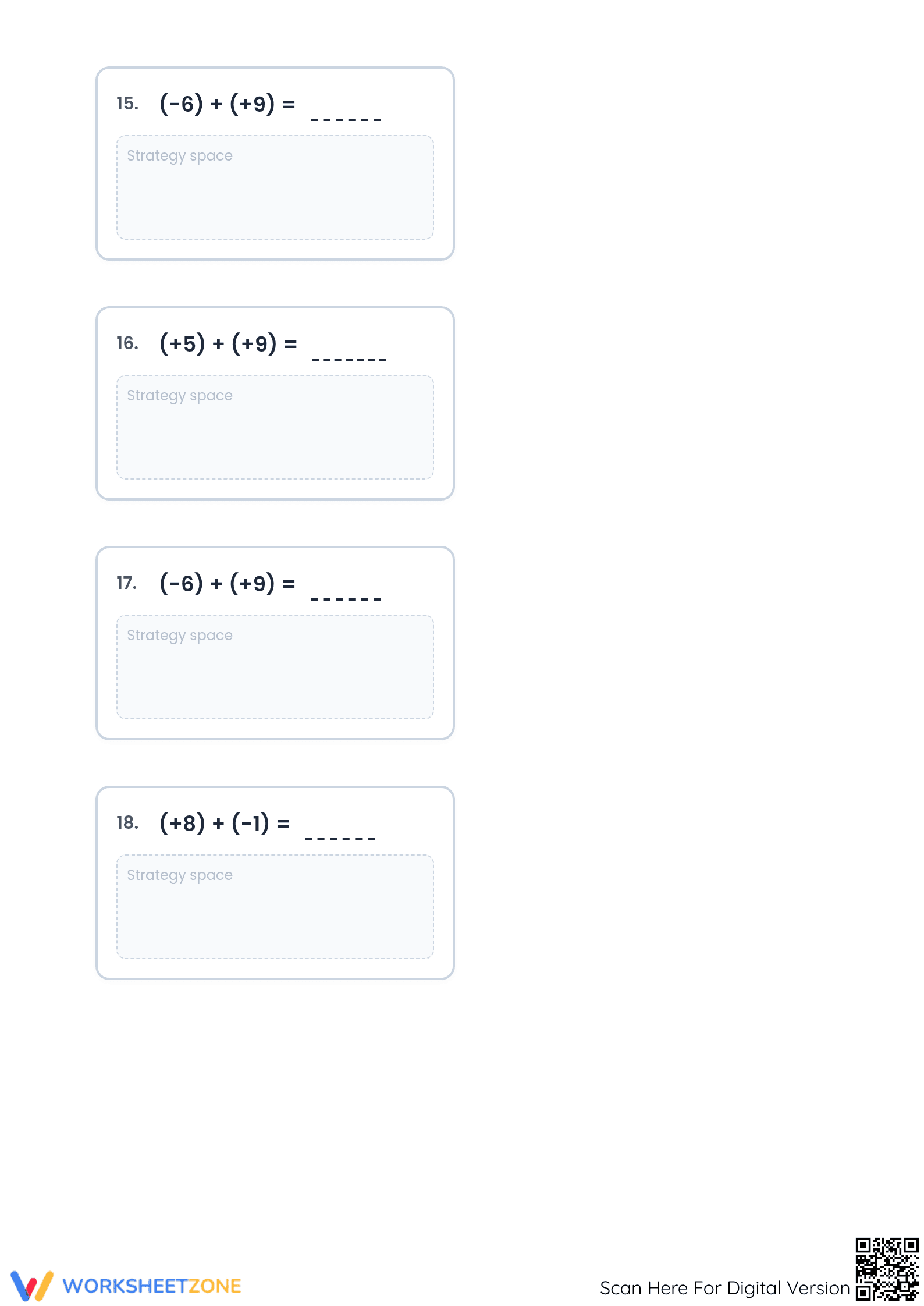
This five-page PDF collection features 18 horizontally aligned addition problems involving both positive and negative integers. Each problem is contained within a dedicated "Strategy space" box, encouraging students to show their work through number lines, counters, or absolute value calculations. A complete answer key is provided to facilitate quick grading or student self-correction.
- Guided Practice: The initial problems involve small absolute values, allowing teachers to model integer strategies such as "the elevator method" or "integer chips" in the provided workspace.
- Supported Practice: Problems 7 through 12 introduce zero pairs and additive inverses, requiring students to apply consistent rules while still having ample space for visual scaffolding.
- Independent Practice: The final tasks involve varied sign combinations and larger magnitudes up to 9, challenging students to demonstrate mastery of integer addition without external prompts.
The primary alignment for this resource is `CCSS.MATH.CONTENT.7.NS.A.1`, which requires students to "apply and extend previous understandings of addition and subtraction to add and subtract rational numbers; represent addition and subtraction on a horizontal or vertical number line diagram." While typically introduced in 7th grade, this Grade 5 adaptation serves as a high-quality bridge for advanced learners or specific state curricula. Both standard codes can be copied directly into lesson plans, IEP goals, or district curriculum mapping tools.
How to Use It
Use this worksheet during the "You Do" phase of a math workshop to assess student grasp of integer rules. It is particularly effective as a formative assessment tool; teachers should observe the "Strategy space" to see if students are relying on mental math or consistently applying a visual model. Expected completion time ranges from 25 to 35 minutes depending on student familiarity with negative values.
Who It's For
This resource is designed for Grade 5 students ready for algebraic extensions, as well as middle school students needing remedial support. It pairs naturally with a vertical number line anchor chart or a direct instruction lesson on "The Battle of the Signs." The clean, uncluttered layout is ideal for students who benefit from reduced visual noise and clear boundaries for their work.
According to a ScienceDirect TpT Analysis, high-quality math resources that emphasize strategy-sharing over rote computation significantly improve student retention of abstract concepts like negative numbers. This worksheet aligns with CCSS.MATH.CONTENT.7.NS.A.1 by providing 18 specific tasks that bridge the gap between whole number arithmetic and rational number operations. Fisher & Frey (2014) highlight that providing dedicated workspace, as seen in this resource's "Strategy space," is crucial for the "Check for Understanding" phase of the gradual release of responsibility. By focusing on the -9 to 9 range, students build a strong mental map of the number line without being overwhelmed by large digit computation. This intentional design ensures that cognitive load remains focused on the sign changes and absolute value relationships. Educators can utilize the included answer key to provide immediate feedback, a practice shown to be essential for correcting misconceptions early in the learning cycle.


