


























Views
Downloads



Printable Integers Addition Worksheet | Grade 5 Math
Paste this activity's link or code into your existing LMS (Google Classroom, Canvas, Teams, Schoology, Moodle, etc.).
Students can open and work on the activity right away, with no student login required.
You'll still be able to track student progress and results from your teacher account.
Developing a strong grasp of negative numbers is a pivotal step in elementary mathematics. This Grade 5 integers addition worksheet provides students with a structured environment to practice adding signed numbers within the -50 to 50 range. By mastering these operations, students build the numerical fluency required for success in middle school algebra and complex problem-solving tasks.
At a Glance
- Grade: 5 · Subject: Math
- Standard:
CCSS.MATH.CONTENT.7.NS.A.1— Apply and extend previous understandings of addition to add integers- Skill Focus: Integer Addition (-50 to 50)
- Format: 5 pages · 30 problems · Answer key included · PDF
- Best For: Independent practice and mental math drills
- Time: 20–30 minutes
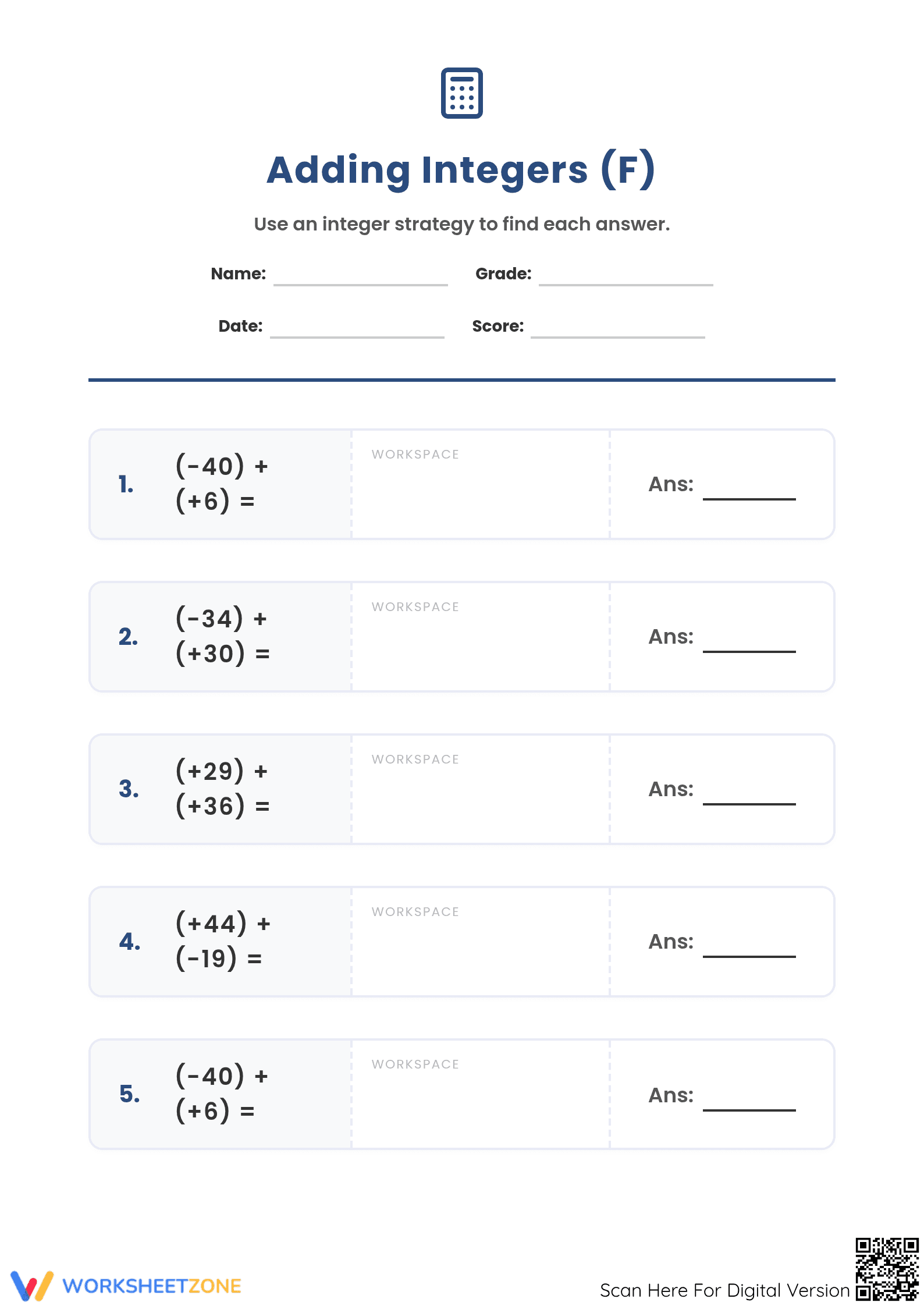
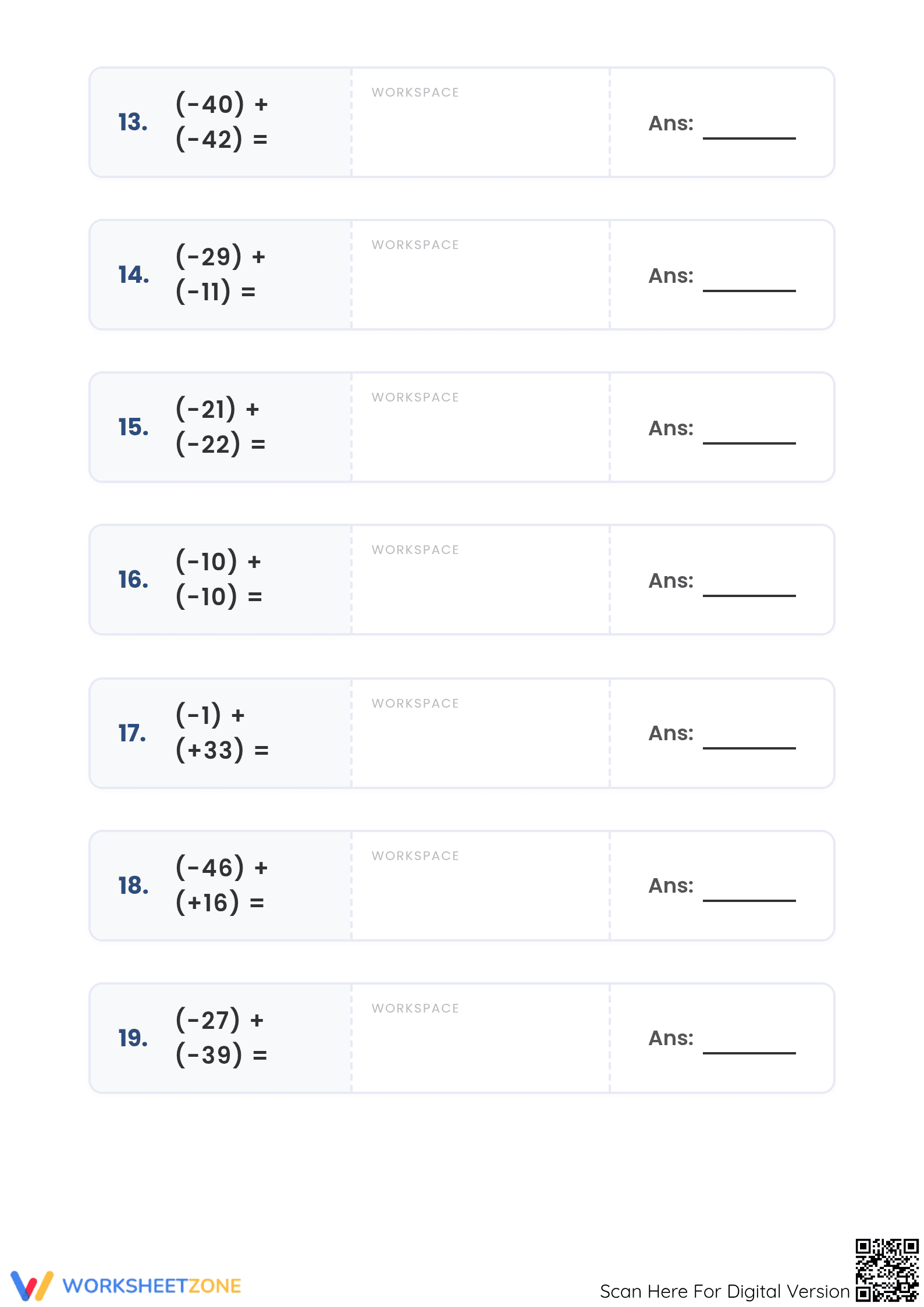
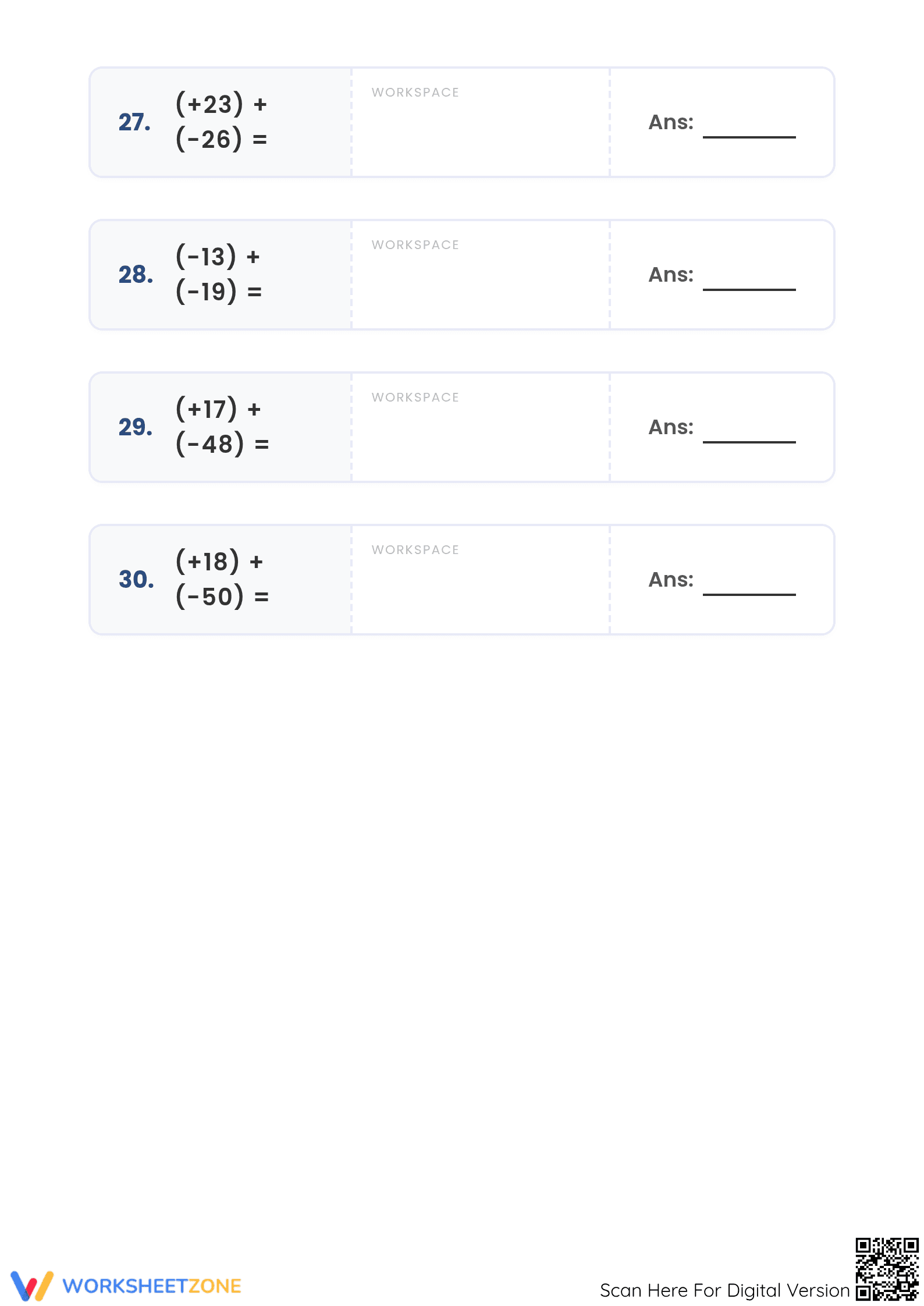
This resource contains five comprehensive pages featuring 30 unique addition problems. Each task is presented with a dedicated workspace box, allowing students to draw models or show their scratch work before recording their final result in the provided answer line. The worksheet focuses on two-digit integers, providing a rigorous challenge for fifth graders. A full answer key is included for rapid grading.
- Guided Practice: The initial problems provide ample workspace to encourage the use of concrete models like integer chips or number lines to visualize signs.
- Supported Practice: The middle section introduces varying sign combinations to challenge student misconceptions about absolute value and the rules of addition.
- Independent Practice: The concluding problems allow for independent practice to solidify mental calculation speed and accuracy with larger two-digit magnitudes.
This scaffolded progression ensures students move from model-based understanding to abstract fluency, mirroring the effective I Do, We Do, You Do instructional sequence.
This worksheet is specifically aligned with CCSS.MATH.CONTENT.7.NS.A.1, which states that students must apply and extend previous understandings of addition to add and subtract rational numbers. It focuses on representing addition on a vertical or horizontal number line diagram. These standard codes can be copied directly into lesson plans, IEP goals, or district curriculum mapping tools to ensure instructional compliance and tracking.
This resource is ideal for independent practice. After demonstrating integer strategies, distribute these pages as a quiet seatwork activity. For a formative assessment tip, observe the workspace areas to see if students are correctly using zero pairs or number line jumps. Completion typically takes between 20 and 30 minutes depending on learner proficiency.
This worksheet is designed for fifth-grade students ready for pre-algebra enrichment, as well as sixth and seventh graders needing additional reinforcement in signed number operations. It is particularly effective for intervention groups or as a clear, no-prep sub plan. This resource pairs naturally with a vertical number line anchor chart or a manipulative-based lesson on positive and negative counters.
Standard CCSS.MATH.CONTENT.7.NS.A.1 requires students to fluently add integers, a foundational skill for algebraic success. According to Fisher & Frey (2014), the gradual release of responsibility model—moving from workspace-supported modeling to abstract calculation—is essential for internalizing the rules of signed numbers. This Grade 5 math worksheet provides the repetition to bridge the gap between concrete manipulatives and mental fluency. By presenting 30 distinct problems with workspace cues, the resource allows educators to observe student integer strategies in real-time. Research from ScienceDirect TpT Analysis suggests that structured workspace for integer addition reduces sign errors among middle school learners by encouraging visual representation. This alignment ensures that learners develop a robust conceptual framework for the number system that persists into high school mathematics, meeting rigorous state and national benchmarks for numerical operations and algebraic thinking.


