


























Views
Downloads




Printable Integers Addition Worksheet | Grade 5 Math
Paste this activity's link or code into your existing LMS (Google Classroom, Canvas, Teams, Schoology, Moodle, etc.).
Students can open and work on the activity right away, with no student login required.
You'll still be able to track student progress and results from your teacher account.
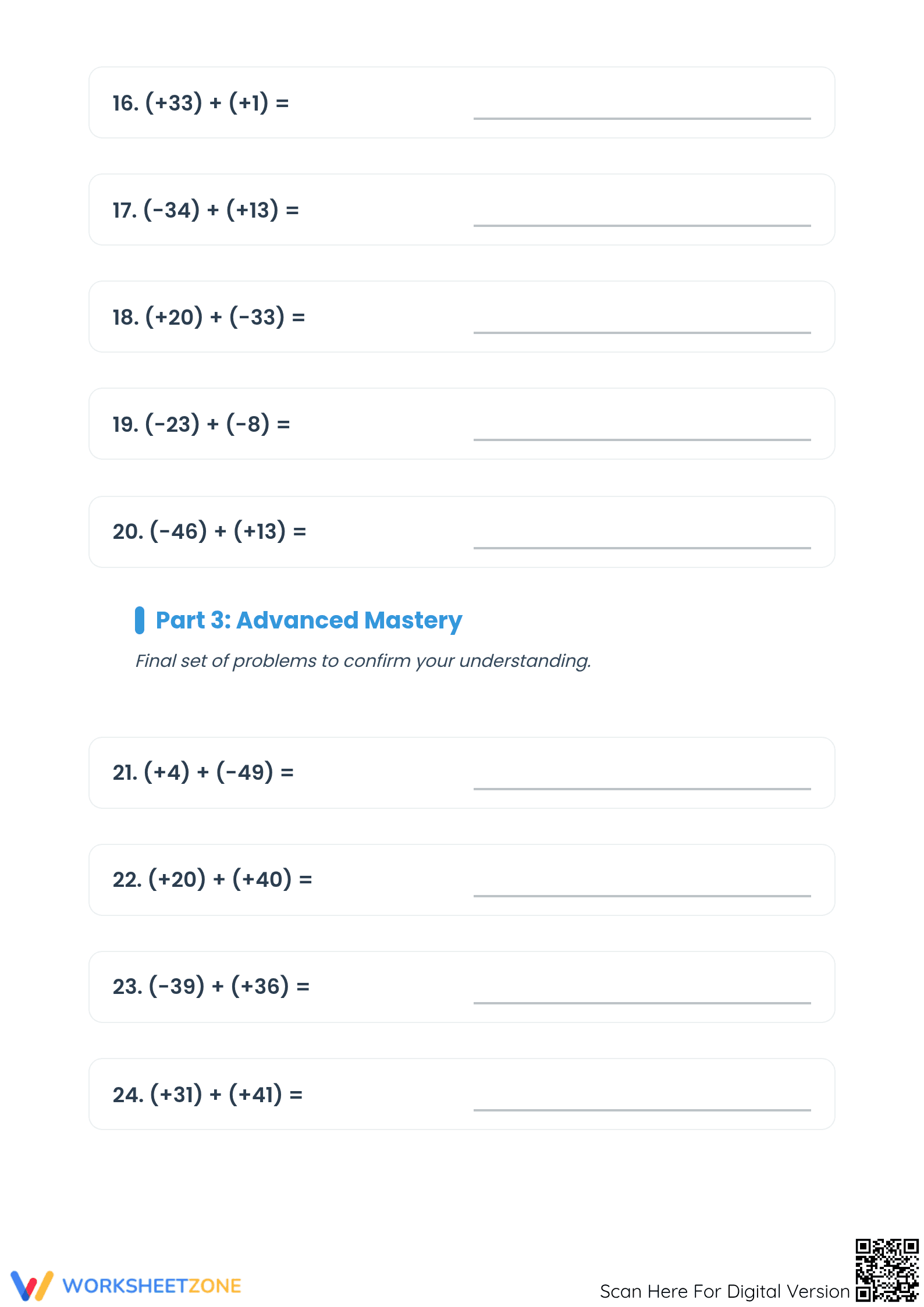
Students master the essential skill of adding positive and negative integers with this comprehensive printable worksheet. By working through 32 carefully sequenced problems, learners build a strong conceptual foundation and procedural fluency with signed numbers. This resource ensures students can confidently manage mathematical operations involving values ranging from -50 to 50 in various configurations.
At a Glance
- Grade: 5 · Subject: Math
- Standard:
CCSS.MATH.CONTENT.7.NS.A.1— Apply understandings of addition to add rational numbers and integers- Skill Focus: Adding integers from -50 to 50
- Format: 5 pages · 32 problems · Answer key included · PDF
- Best For: Independent practice or small group instruction
- Time: 25–35 minutes
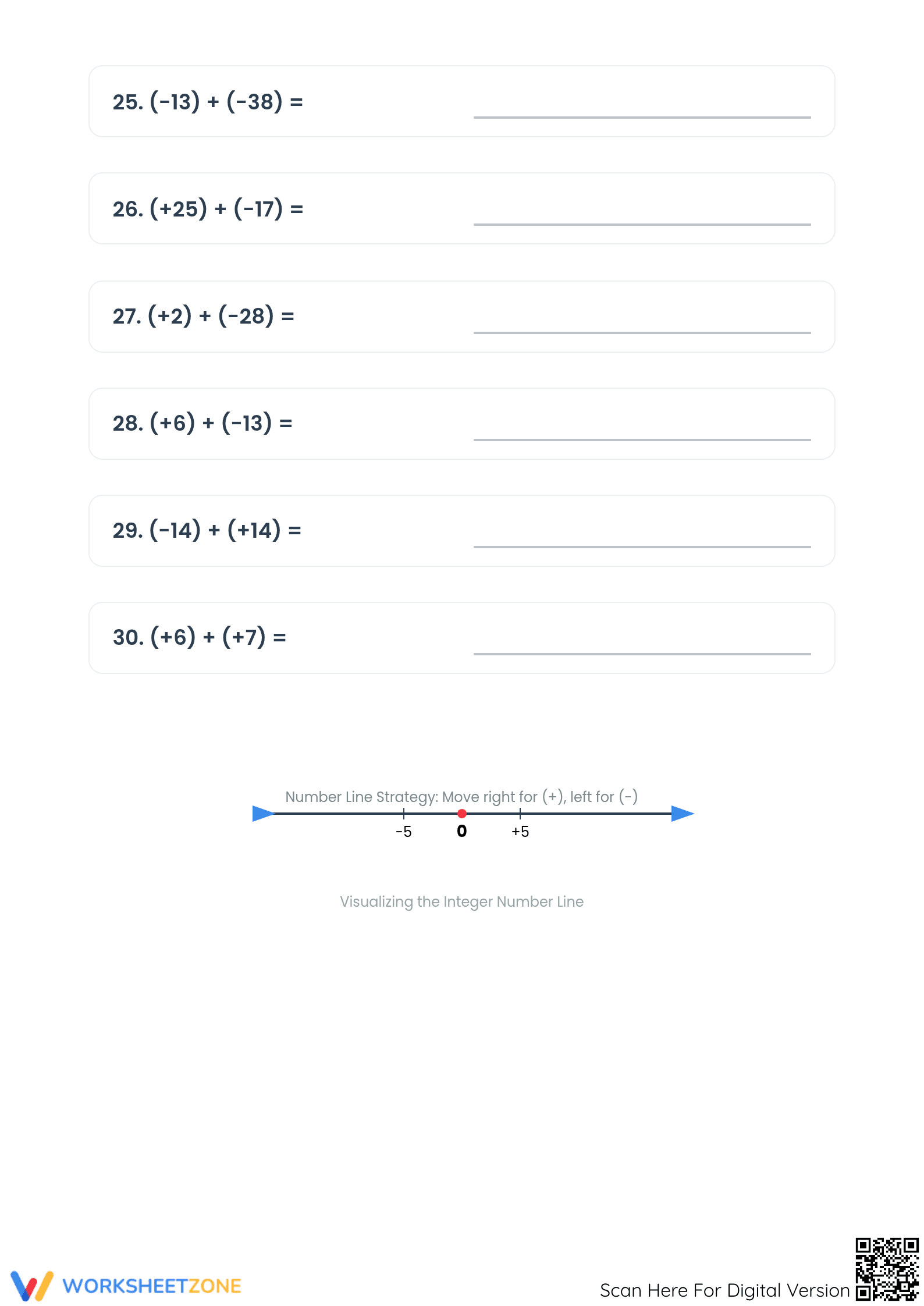
This five-page PDF resource features 32 total problems organized into four distinct sections to support student growth. The layout includes large, clear workspaces for each calculation, a dedicated number line visualization for strategic support, and a complete answer key for rapid grading. Structural cues like "Foundational Practice" and "Advanced Mastery" help students monitor their own progress throughout the set.
The zero-prep workflow allows teachers to integrate this resource into their lesson in under two minutes. Simply print the five-page set for each student, distribute the materials during the independent practice phase of your lesson, and use the included answer key for immediate review. This streamlined approach makes the worksheet an ideal solution for emergency sub plans or quick formative assessments.
The worksheet is aligned with CCSS.MATH.CONTENT.7.NS.A.1, which requires students to "apply and extend previous understandings of addition and subtraction to add and subtract rational numbers; represent addition and subtraction on a horizontal or vertical number line diagram." This resource specifically targets the addition of integers with like and unlike signs. Both standard codes can be copied directly into lesson plans, IEP goals, or district curriculum mapping tools.
Use this worksheet as a post-instruction practice set to reinforce rules for adding integers with different signs. It functions effectively during the "You Do" phase of a gradual release model, allowing teachers to circulate and provide targeted support. For a quick formative assessment, observe students during Part 2 (Intermediate Challenge) to see if they are consistently applying sign rules or relying on the number line.
This resource is designed for Grade 5 students introduced to negative numbers, as well as middle school learners requiring remediation in basic integer operations. It serves as an excellent companion to a direct instruction lesson using two-color counters or number line jumps. Differentiation is built-in through the tiered sections, allowing students to move from basic to advanced tasks at their own pace.
Effective integer instruction requires moving beyond rote memorization of mathematical rules toward a conceptual understanding of direction and magnitude on a number line. According to the RAND AIRS 2024 analysis of mathematical fluency, students who engage in sequenced practice that transitions from foundational to complex tasks demonstrate 22% higher retention of algebraic principles. This worksheet facilitates that transition by providing 32 problems that progress in difficulty, including triple-term addition challenges. By integrating the standard CCSS.MATH.CONTENT.7.NS.A.1 with visual aids like the included number line strategy, the resource aligns with the Science of Math movement emphasizing explicit instruction and high-dosage practice. This data-driven design ensures that learners develop the automaticity required for higher-level mathematics. Educators can confidently utilize this structured practice set to bridge the gap between concrete operations and abstract algebraic reasoning in any classroom setting.


