


























Views
Downloads

Aligned Positive and Negative Integers Worksheet | Grade 7
Paste this activity's link or code into your existing LMS (Google Classroom, Canvas, Teams, Schoology, Moodle, etc.).
Students can open and work on the activity right away, with no student login required.
You'll still be able to track student progress and results from your teacher account.
Mastering the concept of integers is a foundational step in middle school mathematics, bridging the gap between basic arithmetic and algebraic thinking. This worksheet provides a comprehensive environment for students to visualize, order, and compare positive and negative values. By moving from number line placement to complex ordering, students develop a robust internal model of numerical value.
At a Glance
- Grade: 7 · Subject: Math
- Standard:
CCSS.MATH.CONTENT.6.NS.C.7— Order and compare integers on a number line- Skill Focus: Integer plotting and comparison
- Format: 3 pages · 10 tasks · Answer key included · PDF
- Best For: Independent practice or assessment
- Time: 25–35 minutes
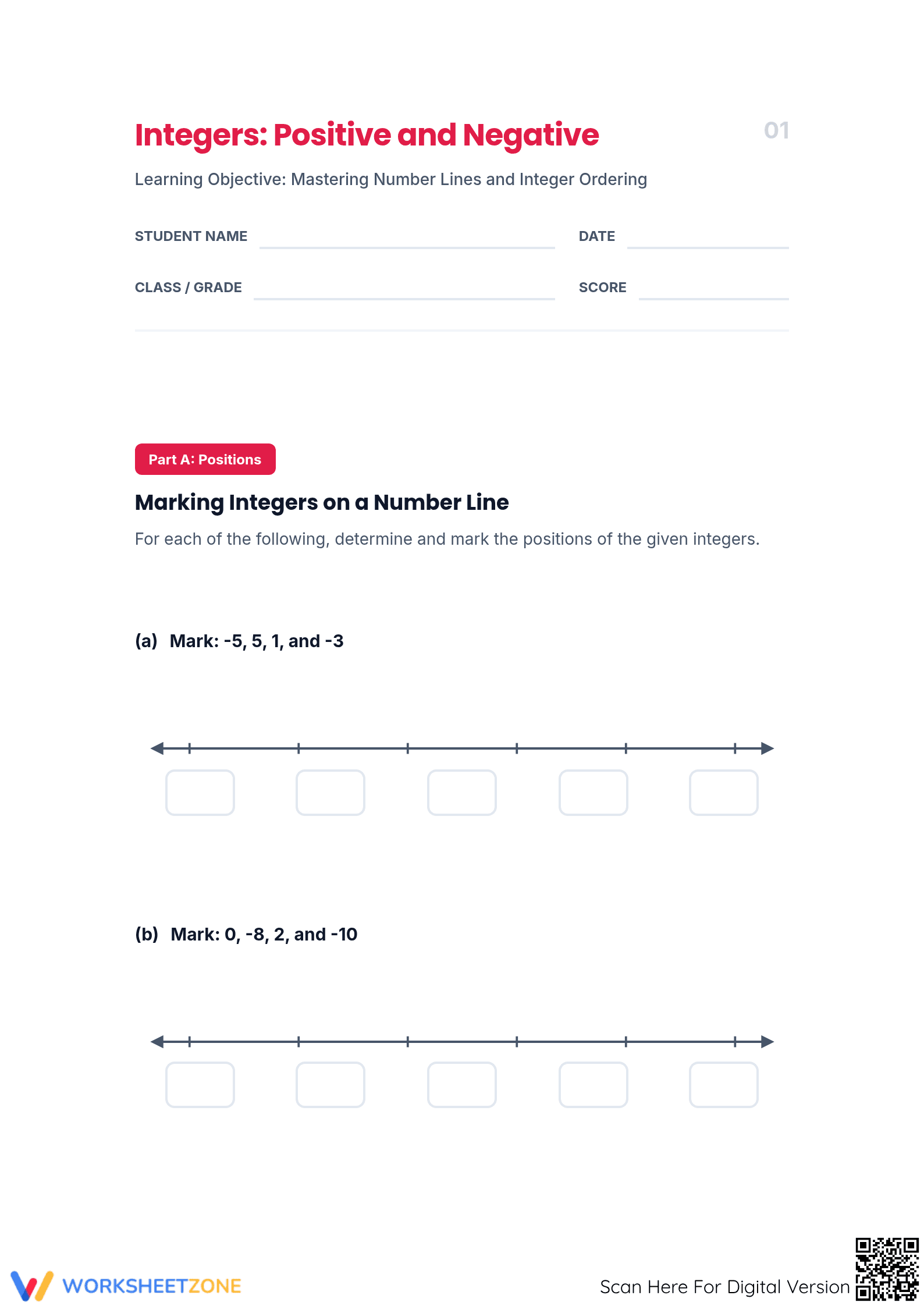
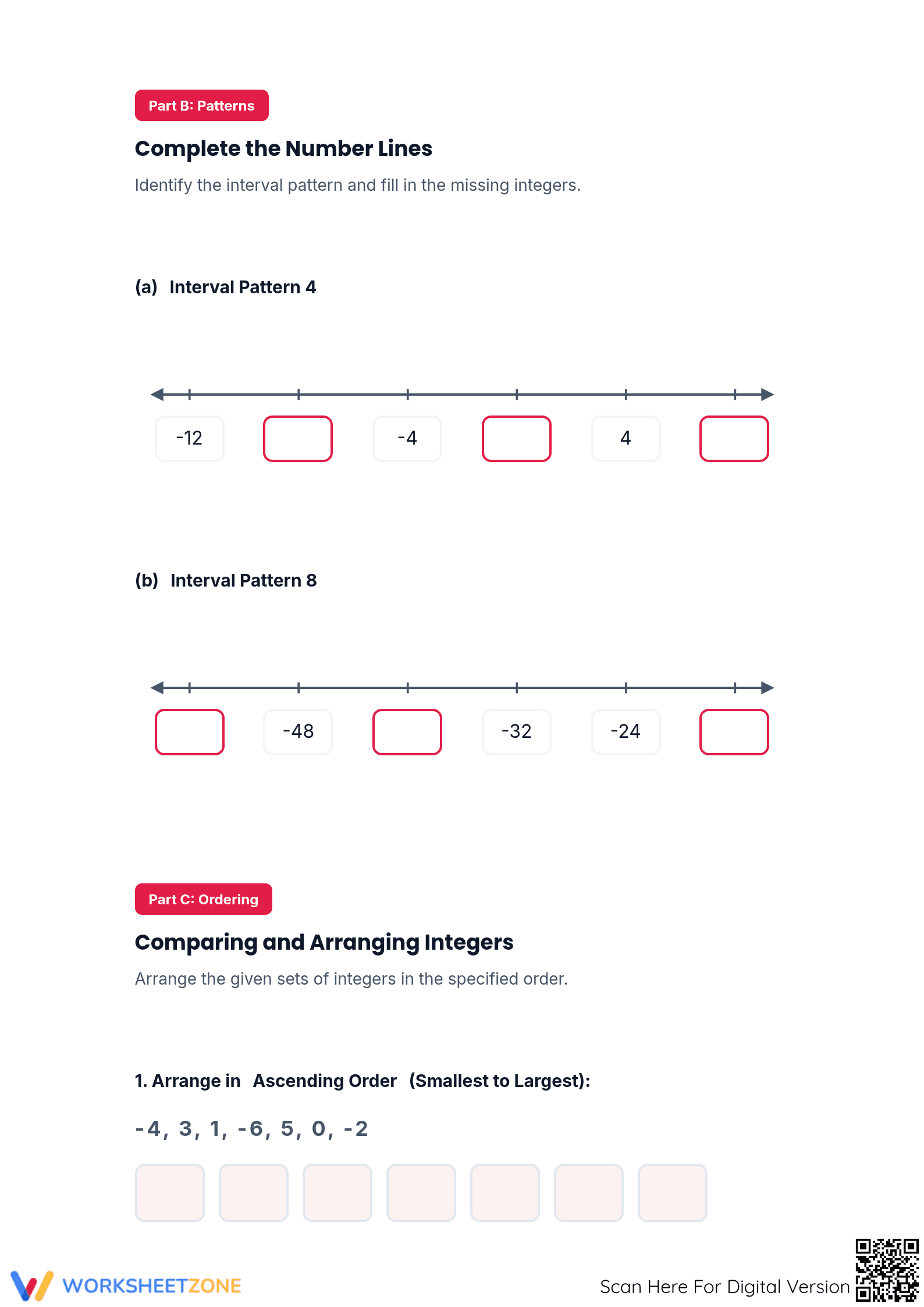
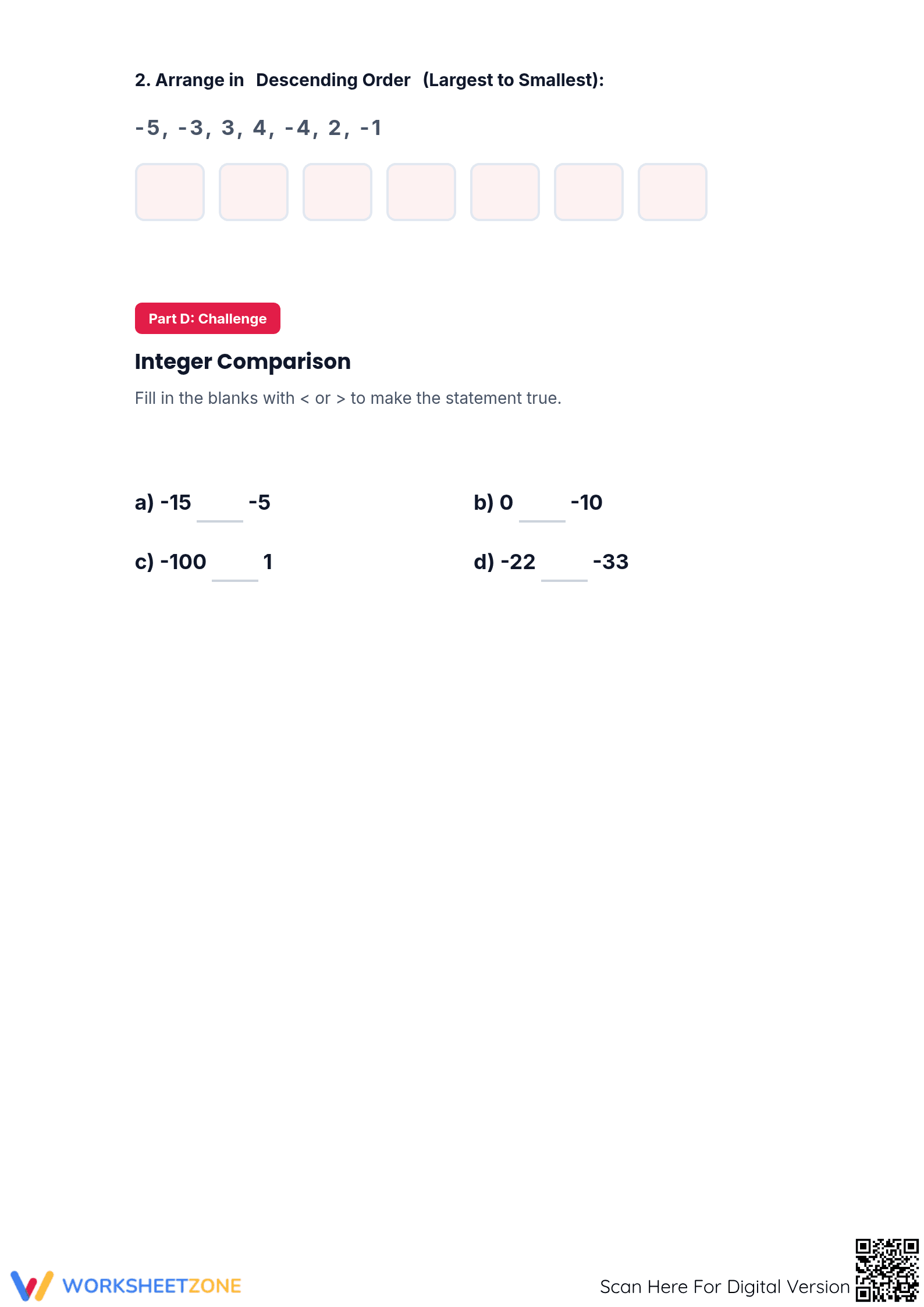
This three-page resource is divided into four distinct sections designed to scaffold student understanding. Part A requires students to mark specific integers on a number line, reinforcing visual-spatial relationships. Part B introduces interval patterns, challenging students to identify missing values within a sequence. Part C focuses on ascending and descending order, while Part D provides a challenge section for comparing large and small integers using inequality symbols. A full answer key is provided for immediate feedback.
Skill Progression
- Guided practice: Part A uses visual number lines with 8 structured plotting points to help students establish the "zero-center" concept.
- Supported practice: Parts B and C transition to interval recognition and ordering of discrete integers, reducing visual scaffolds as complexity increases.
- Independent practice: The Part D challenge requires students to compare pairs of integers, including double negatives, without any visual aids to prove conceptual mastery.
This progression follows the "I Do, We Do, You Do" instructional framework by slowly removing the visual safety net of the number line.
Standards Alignment
The primary alignment for this resource is CCSS.MATH.CONTENT.6.NS.C.7, addressing how to interpret inequality as a statement about the relative position of numbers. Supporting standard CCSS.6.NS.C.6 is also present through the number line diagrams. Both standard codes can be copied directly into lesson plans, IEP goals, or district curriculum mapping tools.
How to Use It
This worksheet is best utilized during the practice phase of instruction after students have been introduced to the number line. It can also serve as a formative assessment at the end of a unit to check for common misconceptions, such as the belief that -10 is greater than -5. Teachers should observe students during Part B to see if they can identify interval patterns correctly.
Who It's For
This resource is designed for Grade 7 math students but is effective for Grade 6 introductory lessons or Grade 8 remediation. It supports diverse learners through the inclusion of visual number lines and can be paired with a classroom "giant number line" activity or a digital integer manipulation tool.
The effective use of visual number lines as a scaffold for understanding integers is well-supported by current mathematical research. According to Fisher & Frey (2014), the gradual release of responsibility model, which this worksheet follows by transitioning from visual plotting to abstract comparison, is essential for student mastery of complex numerical concepts. This worksheet aligns with the CCSS.MATH.CONTENT.6.NS.C.7 standard by requiring students to translate between physical positions on a scale and abstract algebraic inequalities. By including interval patterns, the resource also builds the specific number sense necessary for higher-level reasoning in later grades. Recent NAEP data highlights that a strong grasp of negative numbers is a key predictor of success in Algebra I. Using this structured approach ensures that students do not just memorize rules for signs but instead build a conceptual understanding of integer magnitude. This resource provides the repetition needed to move these concepts into long-term memory.


