


























Views
Downloads
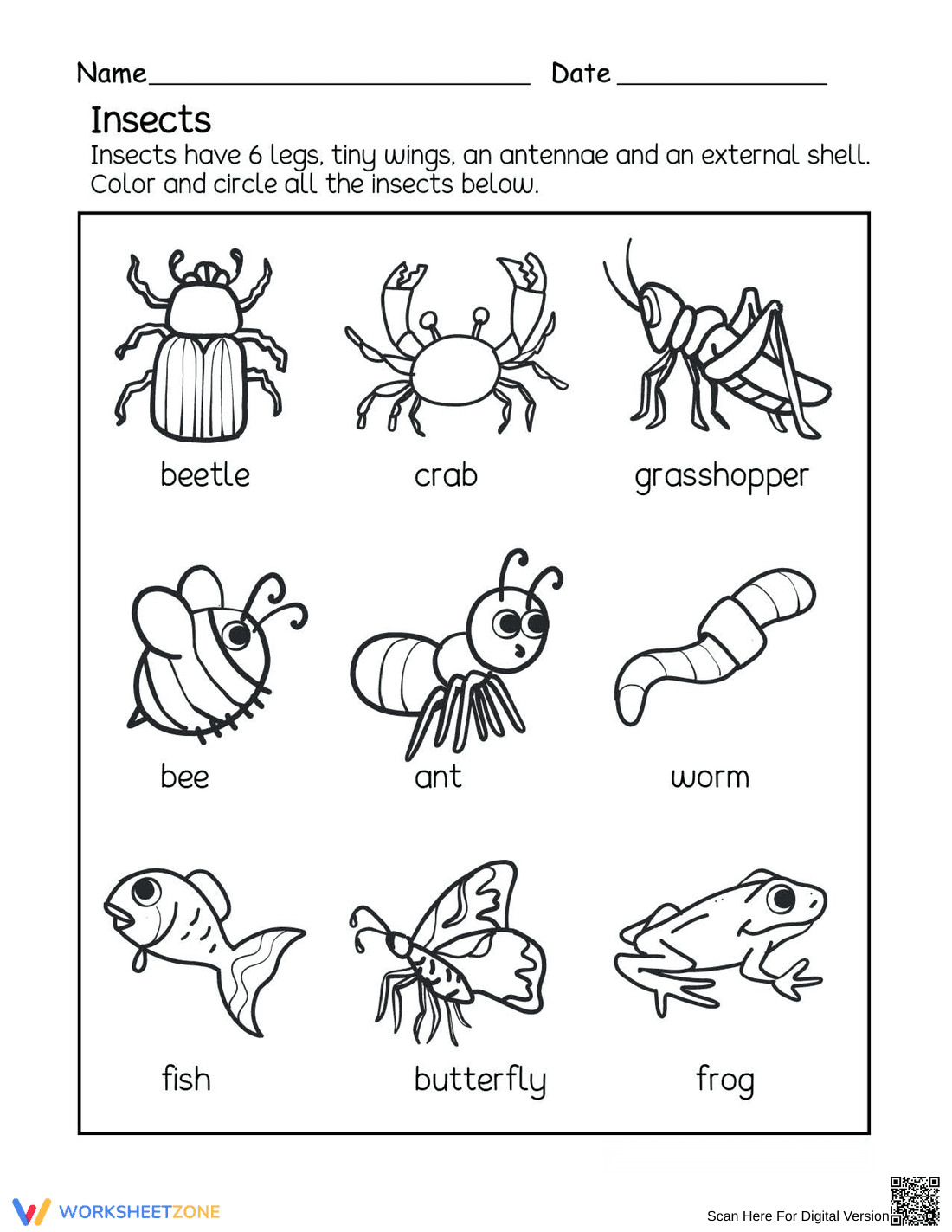

Grade 1 Insects — Printable No-Prep Worksheet
Paste this activity's link or code into your existing LMS (Google Classroom, Canvas, Teams, Schoology, Moodle, etc.).
Students can open and work on the activity right away, with no student login required.
You'll still be able to track student progress and results from your teacher account.
This Grade 1 science worksheet provides young learners with a foundational activity to distinguish insects from other animals. By observing specific physical traits like leg count and the presence of wings, students develop critical classification skills. This printable resource ensures students can accurately identify living things in their environment.
At a Glance
- Grade: 1 · Subject: Science
- Standard:
K-LS1-1— Use observations to describe patterns in the natural world- Skill Focus: Identifying insects by physical characteristics
- Format: 1 page · 9 tasks · Answer key included · PDF
- Best For: Early finishers and introductory science lessons
- Time: 10–15 minutes
What's Inside
This one-page science printable features nine distinct animal illustrations, ranging from beetles and ants to frogs and fish. At the top, students are provided with a clear, child-friendly definition of an insect, noting the presence of six legs, tiny wings, antennae, and an external shell. The worksheet includes identifying text labels for every creature, which supports early literacy alongside scientific inquiry.
Zero-Prep Workflow
- Print (1 minute): Select the single-page PDF and print enough copies for your science center or entire classroom.
- Distribute (1 minute): Hand out the sheets along with crayons or colored pencils for the dual coloring and circling task.
- Review (3 minutes): Use the included answer key to quickly verify student identification of the correct insects featured on the page.
Standards Alignment
The primary standard for this activity is K-LS1-1, which focuses on using observations to describe patterns in the natural world. By analyzing the physical structures of the animals shown, students practice the cross-cutting concept of patterns and structure. Both standard codes can be copied directly into lesson plans, IEP goals, or district curriculum mapping tools.
How to Use It
Use this worksheet as a formative assessment after a direct instruction lesson on animal classification. Ask students to think aloud as they count the legs on the crab versus the beetle to observe their reasoning. It also serves as an excellent quiet activity for morning work or as a supplementary resource during a unit on local habitats. Expect students to complete this task in about 10 to 15 minutes.
Who It's For
This resource is designed for kindergarten and first-grade students who are beginning to explore biological diversity. It provides scaffolded support through clear visuals and text cues, making it ideal for English Language Learners and students receiving special education services. Pair this worksheet with a live observation walk or an insect-themed anchor chart for maximum engagement.
Classification activities like this insects worksheet are vital for early cognitive development, as they require students to move beyond surface-level recognition to criteria-based identification. According to RAND AIRS 2024, utilizing structured observation tasks in early science curricula significantly improves a student's ability to categorize information and recognize biological patterns. By focusing on observable traits—such as the presence of six legs or antennae—learners build the schema necessary for more complex life science concepts. This worksheet bridges the gap between casual nature observation and systematic scientific inquiry by providing a clear framework for what constitutes an insect. Educators can rely on this standard-aligned tool to provide measurable evidence of a student's ability to identify living things based on specific morphological characteristics. This resource supports the development of precision in scientific vocabulary and observation, which are essential precursors to meeting K-LS1-1 expectations where students use observations to describe patterns in the natural world.


