


























Views
Downloads

Printable School Vocabulary Worksheet | Grade K ELA
Paste this activity's link or code into your existing LMS (Google Classroom, Canvas, Teams, Schoology, Moodle, etc.).
Students can open and work on the activity right away, with no student login required.
You'll still be able to track student progress and results from your teacher account.
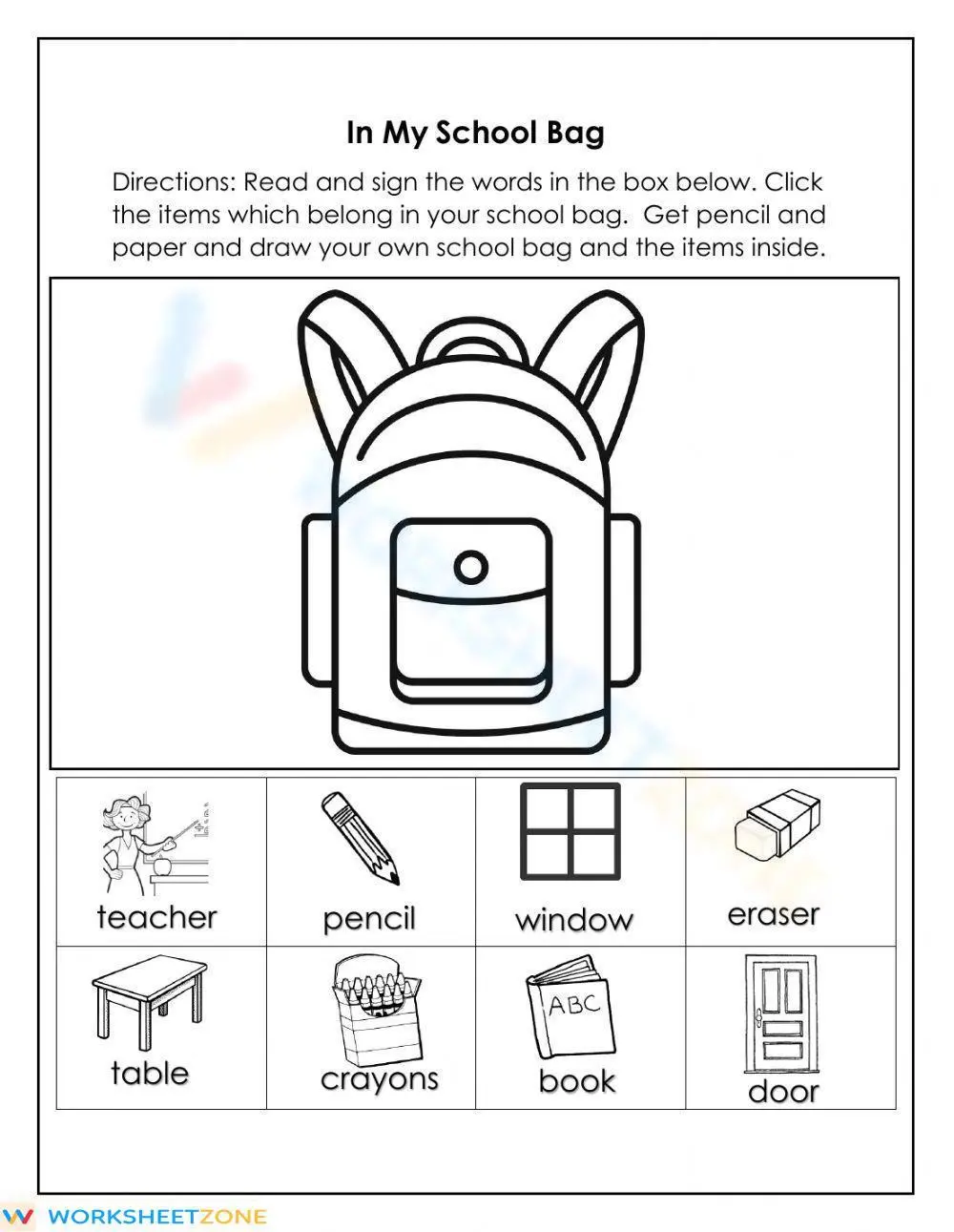
This foundational ELA worksheet helps Preschool to Grade 1 students master essential school vocabulary. By identifying and sorting 8 common objects, learners practice categorization, a key skill for early literacy. The activity requires students to distinguish between items that belong in a school bag and those that do not, building conceptual frameworks.
At a Glance
- Grade: Kindergarten · Subject: English Language Arts
- Standard:
CCSS.ELA-LITERACY.L.K.5.A— Sort common objects into categories to gain a sense of the concepts they represent- Skill Focus: School supply vocabulary and categorization
- Format: 1 page · 8 problems · Answer key included · PDF
- Best For: Early vocabulary practice or morning work
- Time: 15–20 minutes
What's Inside
This printable resource features a large, clear graphic of a backpack as the central sorting hub. Below the main image, a grid contains eight distinct illustrations paired with their corresponding labels, such as "pencil," "crayons," and "book." The layout is optimized for young learners, utilizing high-contrast lines and a dyslexia-friendly font to ensure accessibility.
Skill Progression
- Guided practice: Students read labels in the word bank with teacher assistance to identify familiar school items.
- Supported practice: Learners analyze eight illustrations, determining which objects belong in a school bag versus those that do not.
- Independent practice: Students complete the sorting task autonomously and can extend learning through an optional creative drawing prompt.
This model utilizes the I Do, We Do, You Do framework to ensure students move from simple recognition to conceptual application within a single session.
Standards Alignment
This resource is directly aligned with CCSS.ELA-LITERACY.L.K.5.A, which requires students to sort common objects into categories to gain a sense of the concepts the categories represent. By distinguishing "school items" from other objects, students develop critical organizational skills. Both standard codes can be copied directly into lesson plans, IEP goals, or district curriculum mapping tools.
How to Use It
Use this worksheet as a formative assessment to gauge student vocabulary or as a post-instruction activity after a story about school. During the task, observe whether students can identify distractor items, providing insight into their categorization logic. Expect a total completion time of 15 to 20 minutes for most early learners.
Who It's For
The worksheet is tailored for early childhood education, including Preschool, Kindergarten, and Grade 1. It is particularly effective for English Language Learners (ELLs) who need visual support to acquire basic classroom nouns. Pair this resource with a physical "show and tell" of a real school bag to reinforce the vocabulary concretely.
This worksheet provides targeted practice for CCSS.ELA-LITERACY.L.K.5.A, requiring students to sort common objects into categories. This skill is a critical precursor to developing more complex classification and comprehension abilities. Drawing on research by Fisher & Frey (2014), the design emphasizes using visual cues and matching tasks, which are proven methods for effective early vocabulary acquisition. The activity moves students beyond simple rote memorization and toward functional language application by having them analyze 8 illustrated objects in the context of a school setting. According to the NAEP framework, such foundational organizational skills are integral to later reading comprehension success. This self-contained, print-ready resource offers a concrete, evidence-based tool for solidifying students' conceptual understanding of categories, directly supporting their ability to make sense of the world and the words used to describe it.


