


























Views
Downloads


"Impressions" Reading Worksheet | Grade 4 Essential
Paste this activity's link or code into your existing LMS (Google Classroom, Canvas, Teams, Schoology, Moodle, etc.).
Students can open and work on the activity right away, with no student login required.
You'll still be able to track student progress and results from your teacher account.
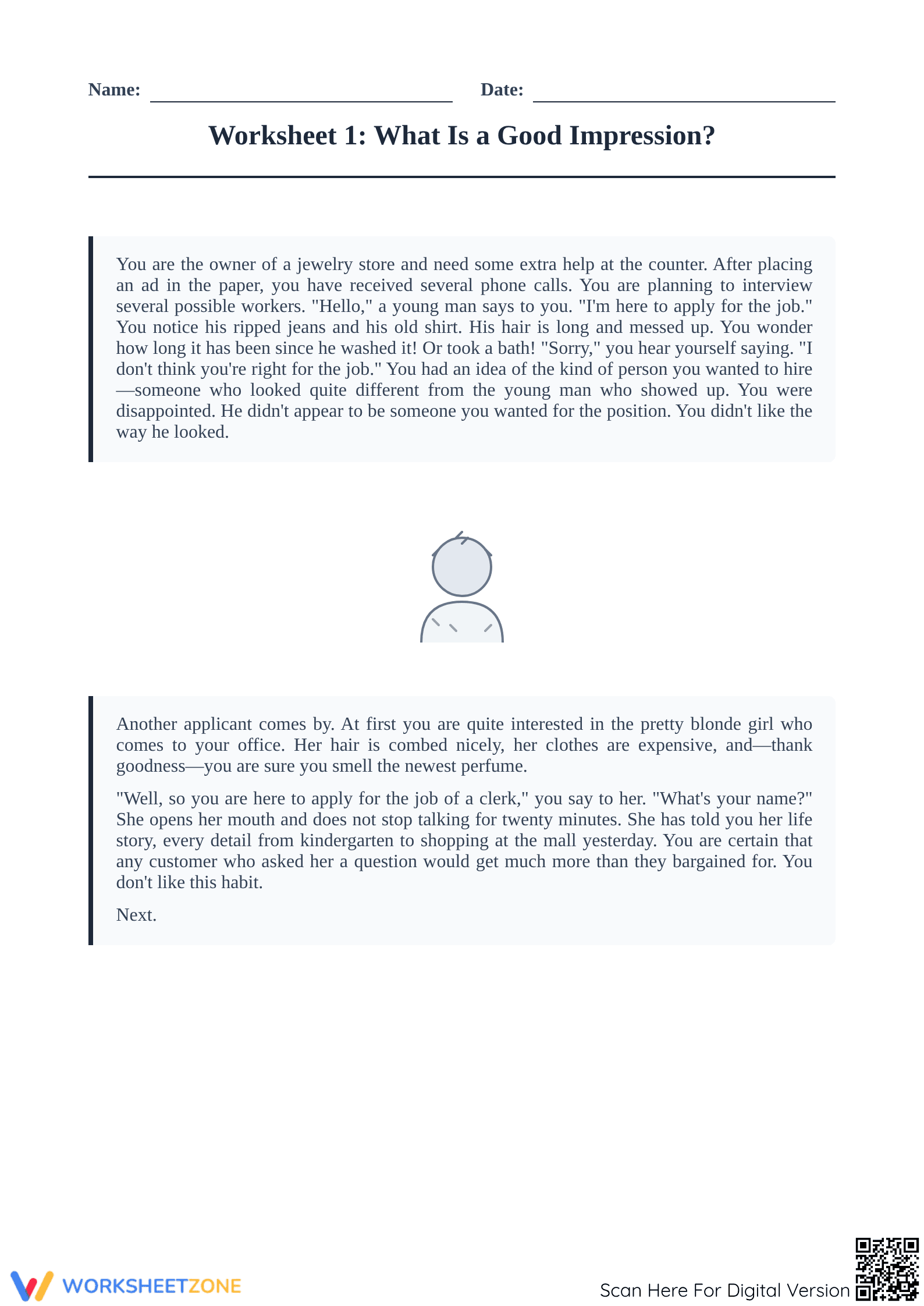
This Grade 4 reading comprehension worksheet helps students identify key details and make inferences about character behavior. By analyzing a narrative about job interviews, learners practice extracting specific evidence to explain why certain impressions are formed. It provides a practical context for understanding social cues and professional expectations.
At a Glance
- Grade: 4 · Subject: ELA
- Standard:
CCSS.ELA-LITERACY.RI.4.1— Refer to details and examples when explaining text and drawing inferences- Skill Focus: Making Inferences & Text Evidence
- Format: 2 pages · 4 problems · Answer key included · PDF
- Best For: Independent practice or sub plans
- Time: 15–20 minutes
The resource contains a multi-paragraph narrative spread across two pages, featuring three distinct character profiles. Students encounter 4 fill-in-the-blank comprehension questions that require them to synthesize information from the text. A complete answer key is provided to facilitate quick grading or student self-correction during independent work time.
The zero-prep workflow is designed for maximum efficiency. First, print the two-page PDF (30 seconds). Next, distribute the sheets to students for independent reading and response (15 minutes). Finally, use the included answer key to review responses as a whole group or for individual grading (2 minutes). This makes it an ideal choice for emergency sub plans.
This worksheet aligns with `CCSS.ELA-LITERACY.RI.4.1`, focusing on the student's ability to refer to specific details when explaining what the text says explicitly. It also supports character analysis by asking students to describe traits and events in depth. Both standard codes can be copied directly into lesson plans, IEP goals, or district curriculum mapping tools.
Use this worksheet during the independent practice phase of a lesson after teaching the concept of first impressions. It serves as an excellent formative assessment to check if students can distinguish between explicit facts and inferred traits. Expect students to complete the reading and the four questions within a 20-minute window during your literacy block.
This resource is designed for general education fourth-grade students, but it also serves as a valuable tool for English Language Learners (ELLs) due to its clear, high-interest narrative. It pairs naturally with an anchor chart on character traits or a direct instruction lesson on social-emotional learning and professional communication skills.
According to the RAND AIRS 2024 report, high-quality reading materials that integrate real-world scenarios, such as job interviews, significantly improve student engagement and retention of inference-making skills. This worksheet targets CCSS.ELA-LITERACY.RI.4.1, which requires students to refer to details and examples in a text when explaining what the text says explicitly and when drawing inferences. By focusing on the concept of "impressions," the material bridges the gap between literal comprehension and higher-order social analysis. Research from Fisher & Frey (2014) emphasizes that structured practice with short, focused narratives allows students to build the stamina needed for complex text analysis. This resource provides exactly that type of scaffolded experience, ensuring that Grade 4 learners can successfully navigate the nuances of character motivation and evidence-based reasoning. The inclusion of a clear answer key supports immediate feedback, a critical component for mastery in elementary literacy.


