


























Views
Downloads
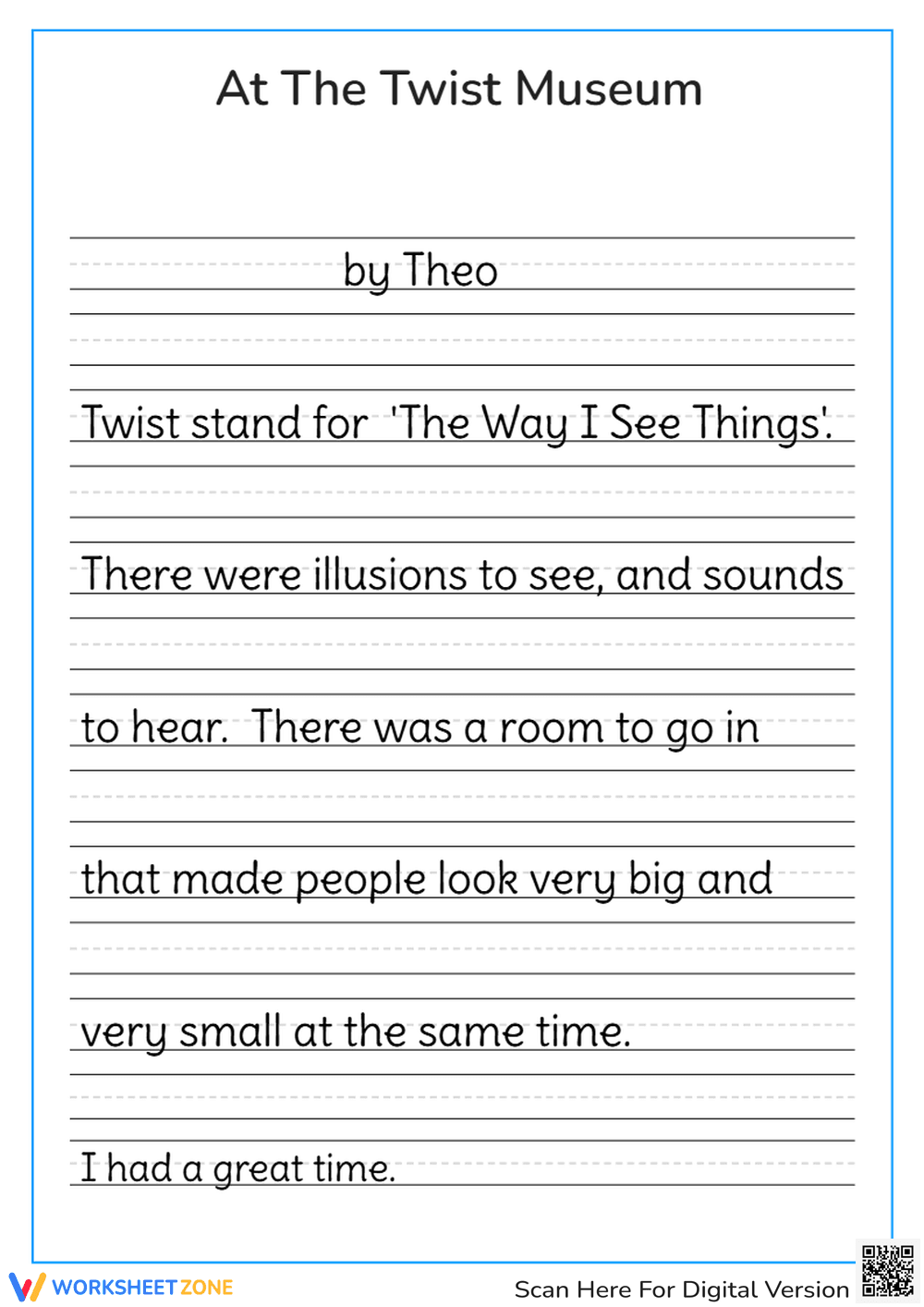

Printable Handwriting Practice: At The Twist Museum
Paste this activity's link or code into your existing LMS (Google Classroom, Canvas, Teams, Schoology, Moodle, etc.).
Students can open and work on the activity right away, with no student login required.
You'll still be able to track student progress and results from your teacher account.
This Grade 1 handwriting worksheet helps students master letter formation and spacing through a narrative copying task. By transcribing a short story about a museum visit, learners practice consistent sizing and alignment on primary ruled lines. This activity bridges the gap between isolated letter practice and functional writing, ensuring students develop legible, fluid penmanship for daily classroom tasks.
At a Glance
- Grade: 1 · Subject: Handwriting
- Standard:
CCSS.ELA-LITERACY.L.1.1.A— Print all upper- and lowercase letters legibly and accurately- Skill Focus: Letter formation and spacing
- Format: 1 page · 7 lines · No answer key needed · PDF
- Best For: Morning work or literacy centers
- Time: 10–15 minutes
The worksheet features a single page titled "At The Twist Museum." It provides seven distinct lines of text for students to copy onto primary-ruled dotted lines. The text includes a mix of high-frequency words and descriptive language, providing a comprehensive workout for both uppercase and lowercase letter construction. The layout is clean and distraction-free to help young writers maintain focus.
The zero-prep workflow for this resource is designed for efficiency. First, print the single-page PDF (30 seconds). Next, distribute the sheets during your handwriting block or as a transition activity (1 minute). Finally, review the work for proper letter height and baseline adherence (30 seconds per student). This makes it an ideal sub-plan or emergency filler for busy primary classrooms.
This resource is aligned to CCSS.ELA-LITERACY.L.1.1.A, which requires students to print all upper- and lowercase letters. By copying full sentences, students also touch upon supporting conventions like capitalization and end punctuation. Both standard codes can be copied directly into lesson plans, IEP goals, or district curriculum mapping tools to ensure compliance with state frameworks.
Use this worksheet as a formative assessment after a direct instruction lesson on specific letter groups, such as "tall letters" or "descenders." Observe students as they write to identify common errors in stroke order or pencil grip. It also serves as an excellent quiet-time activity for students who finish their primary literacy assignments early, requiring approximately 12 minutes for careful completion.
This practice sheet is designed for first-grade students but is also suitable for kindergarteners ready for sentence-level work or second graders needing remedial penmanship support. It pairs naturally with a read-aloud about museums or a science lesson on optical illusions. The structured lines provide the necessary scaffolding for students struggling with spatial awareness on blank paper.
Effective handwriting instruction requires frequent, short bursts of practice. This worksheet targets CCSS.ELA-LITERACY.L.1.1.A, focusing on the plain-English skill of printing letters legibly within a narrative context. According to the RAND AIRS 2024 report, consistent penmanship practice in early elementary grades is strongly correlated with improved orthographic mapping and reading fluency. When students no longer struggle with the mechanics of letter formation, cognitive resources are freed for higher-order composition. Fisher & Frey (2014) emphasize that copying well-structured sentences provides a model for both syntax and physical writing mechanics. This resource provides the necessary repetition to build muscle memory and automaticity. By integrating handwriting into a meaningful story, the task becomes more engaging than repetitive drills, supporting long-term retention of motor patterns required for academic success across all subjects.


