


























Views
Downloads

Identifying the Six Simple Machines | Grade 3 Essential
Paste this activity's link or code into your existing LMS (Google Classroom, Canvas, Teams, Schoology, Moodle, etc.).
Students can open and work on the activity right away, with no student login required.
You'll still be able to track student progress and results from your teacher account.
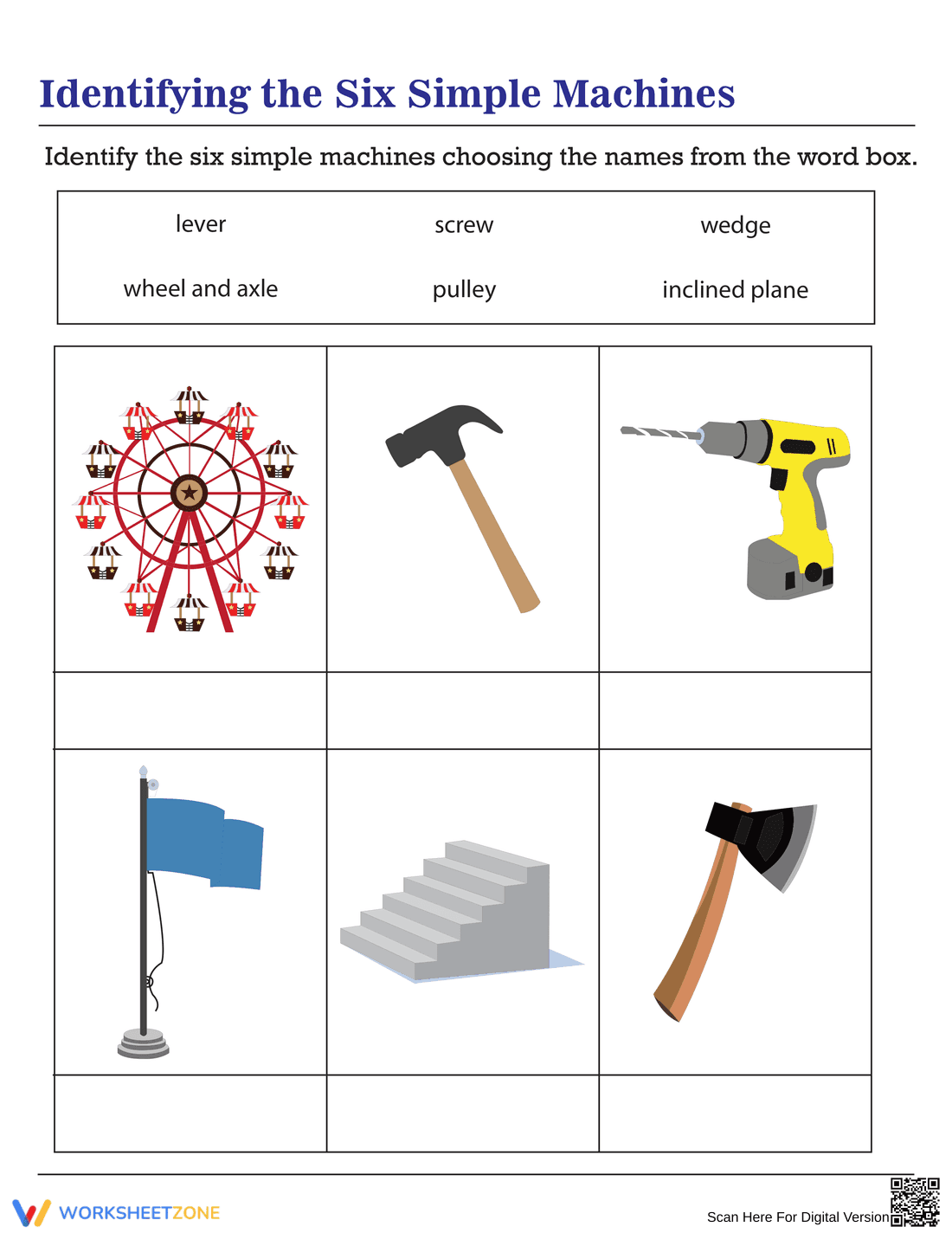
This Grade 3 science worksheet helps students master the identification of basic mechanical tools. By connecting abstract concepts to real-world objects like ferris wheels and hammers, learners build a concrete understanding of how simple machines function. Students will observe 6 distinct illustrations and categorize them using a provided vocabulary word bank.
At a Glance
- Grade: 3 · Subject: Science
- Standard:
3-PS2-1— Plan and conduct an investigation to provide evidence of the effects of balanced and unbalanced forces- Skill Focus: Simple machine identification
- Format: 2 pages · 6 problems · Answer key included · PDF
- Best For: Introduction to forces and motion
- Time: 10–15 minutes
What's Inside
This 2-page PDF includes a primary student worksheet and a full-color answer key. The layout features a clear word bank containing the six fundamental machines: lever, screw, wedge, wheel and axle, pulley, and inclined plane. Below the bank, six high-quality illustrations represent each machine in a familiar context, such as a flagpole or a set of stairs.
Zero-Prep Workflow
- Print: Generate copies of the single-page student sheet in seconds.
- Distribute: Hand out during the independent practice phase of your physics lesson.
- Review: Use the included answer key for a rapid visual check or display it for student self-correction.
Total teacher preparation time is under 2 minutes, making this an ideal resource for substitute folders or last-minute lesson supplements.
Standards Alignment
The primary standard addressed is `3-PS2-1`, which focuses on observing the effects of forces on objects. By identifying simple machines, students recognize the tools used to manipulate force and motion. This standard code can be copied directly into lesson plans, IEP goals, or district curriculum mapping tools.
How to Use It
Use this worksheet as a formative assessment immediately following a direct instruction session on mechanical advantage. It also serves as an excellent exit ticket to gauge student comprehension before moving to complex machines. Observe if students can distinguish between the wedge and the lever to identify specific misconceptions. Expected completion time is 10 to 15 minutes.
Who It's For
This resource is designed for third-grade students but is highly effective for English Language Learners (ELL) due to the heavy visual support. It pairs naturally with a hands-on simple machine scavenger hunt or an anchor chart displaying the definitions of each mechanical category.
According to the RAND AIRS 2024 report on elementary science instruction, visual-to-text mapping is a critical component in developing scientific literacy among young learners. This worksheet utilizes this evidence-based approach by requiring students to translate visual representations of mechanical work into specific scientific terminology. By focusing on the six simple machines—lever, screw, wedge, wheel and axle, pulley, and inclined plane—the resource aligns with the 3-PS2-1 standard for forces and motion. Research from Fisher & Frey (2014) suggests that providing word banks alongside visual cues reduces cognitive load, allowing students to focus on the conceptual categorization of the objects rather than just vocabulary recall. This 6-task activity provides the necessary repetition to move these concepts into long-term memory, ensuring students are prepared for more complex engineering and physics topics in later grades.


