


























Views
Downloads
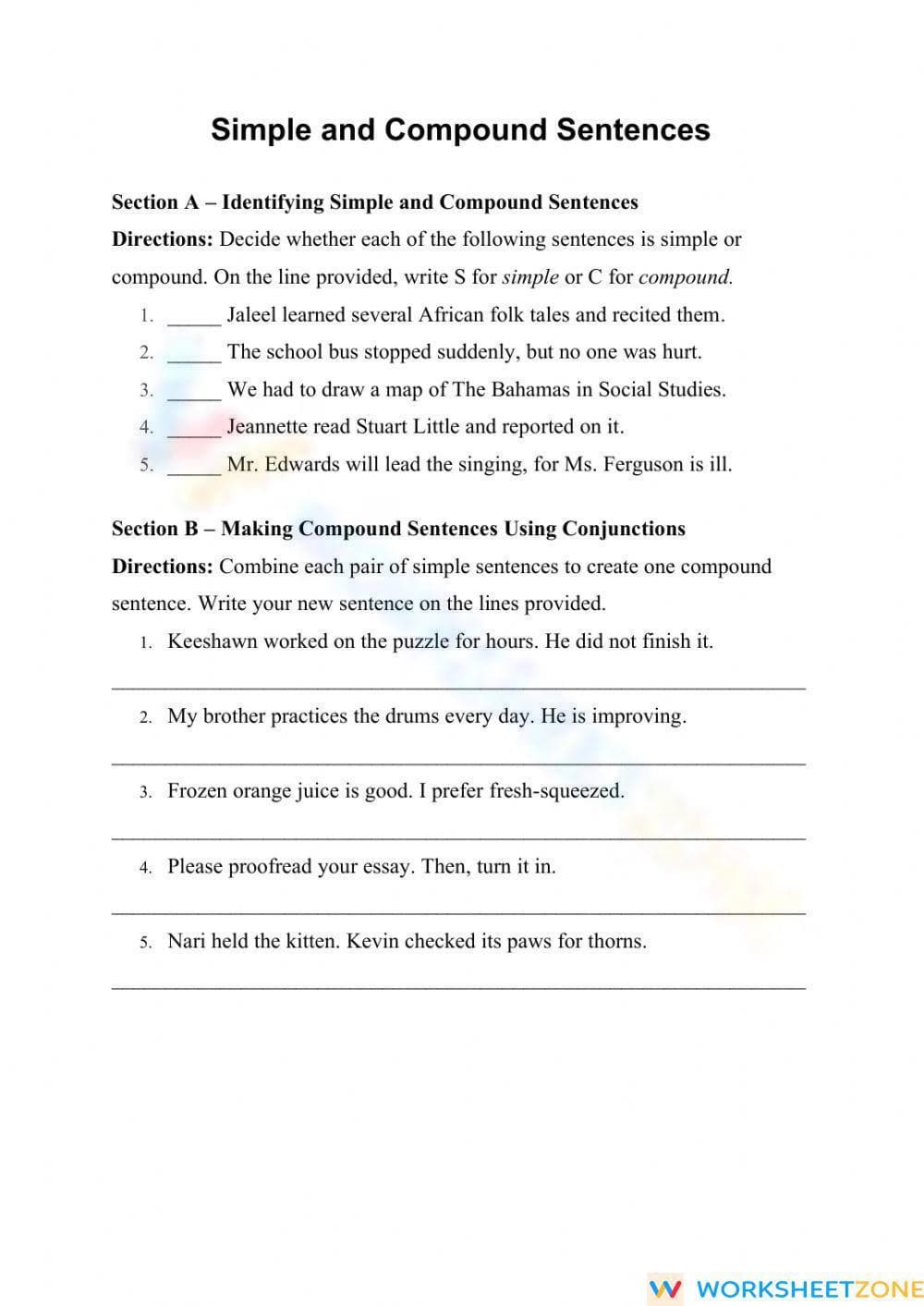

Printable Simple & Compound Sentences Worksheet | Grade 7
Paste this activity's link or code into your existing LMS (Google Classroom, Canvas, Teams, Schoology, Moodle, etc.).
Students can open and work on the activity right away, with no student login required.
You'll still be able to track student progress and results from your teacher account.
This targeted ELA worksheet for grades 7-9 provides essential practice with sentence structure. Students first identify sentences as simple or compound and then apply their knowledge by combining simple sentences to create compound sentences. It’s a straightforward tool to build foundational grammar and writing skills necessary for more complex compositions.
At a Glance
- Grade: 7–9 · Subject: ELA / Grammar
- Standard:
CCSS.ELA-LITERACY.L.7.1.b— Choose among simple and compound sentences to signal relationships.- Skill Focus: Simple and Compound Sentences
- Format: 1 page · 10 problems · Answer key included · PDF
- Best For: Bell ringer, independent practice, formative check
- Time: 10–15 minutes
What's Inside
This single-page PDF contains two distinct sections. The first part is a five-question identification task where students label given sentences as either simple or compound. The second part provides five pairs of simple sentences for students to combine into a single compound sentence using an appropriate conjunction, reinforcing their understanding in a practical application. A complete answer key is provided for easy grading.
Skill Progression
The worksheet follows a clear gradual-release model.
- Guided Practice: The first section is a knowledge check, asking students to identify existing simple and compound sentences from a list of 5 examples.
- Supported Practice: The second section scaffolds creation. Students are given 5 pairs of simple sentences, allowing them to focus on the mechanics of combining them.
- Independent Practice: Completing both sections demonstrates the ability to recognize and construct different sentence types, preparing them for application in their own writing.
This structure ensures students build confidence and master the concept.
Standards Alignment
This worksheet is directly aligned with the Common Core State Standard CCSS.ELA-LITERACY.L.7.1.b, which requires students to "Choose among simple, compound, complex, and compound-complex sentences to signal differing relationships among ideas." It provides foundational practice for this standard by focusing on the two most fundamental sentence structures. Both standard codes can be copied directly into lesson plans, IEP goals, or district curriculum mapping tools.
How to Use It
Use this worksheet after direct instruction on simple and compound sentences. It serves as an excellent bell ringer to activate prior knowledge or as an exit ticket to assess understanding. For formative assessment, observe which conjunctions students choose in Section B; this reveals their understanding of idea relationships. Estimated completion time is 10-15 minutes.
Who It's For
This resource is designed for middle school ELA students (Grades 7-9) who are learning or reviewing sentence structure. It is particularly helpful for students who struggle to vary their sentence patterns in writing. For differentiation, pair this worksheet with an anchor chart of FANBOYS conjunctions to support students who need help with Section B.
Foundational grammar skills, such as distinguishing between and constructing simple and compound sentences, are critical for writing proficiency. This worksheet provides practice aligned with CCSS.ELA-LITERACY.L.7.1.b. Research shows explicit instruction in sentence combining improves the syntactic maturity of student writing. According to Fisher & Frey (2014), instructional strategies focusing on sentence-level mechanics yield significant gains. This resource applies that principle by breaking down sentence construction into two manageable steps: identification and creation. By mastering control over simple and compound sentences, students build a necessary foundation for crafting more complex prose, a skill essential for academic success.


