


























Views
Downloads

Essential Participles Worksheet | Grade 4-5 Grammar Ready
Paste this activity's link or code into your existing LMS (Google Classroom, Canvas, Teams, Schoology, Moodle, etc.).
Students can open and work on the activity right away, with no student login required.
You'll still be able to track student progress and results from your teacher account.
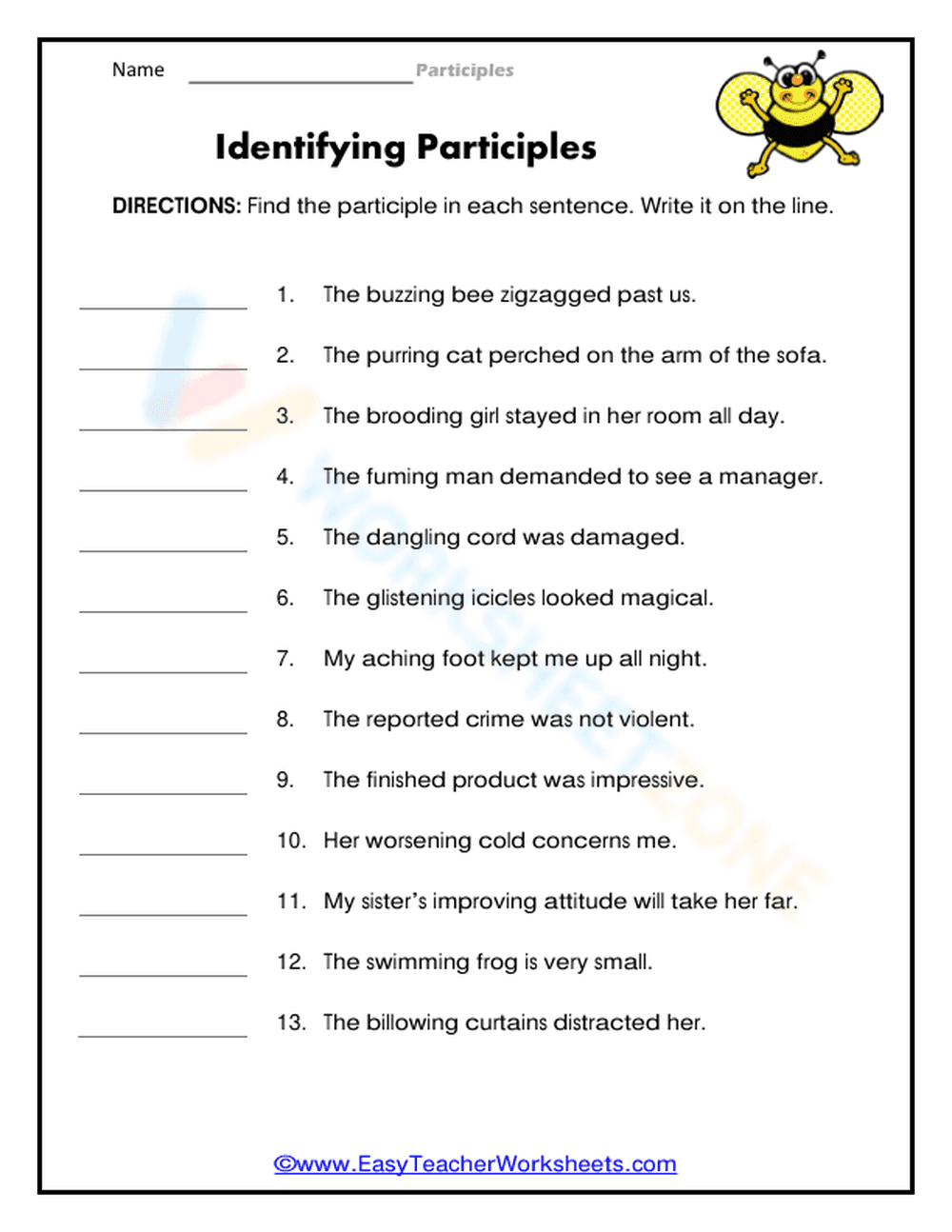
This identifying participles worksheet provides middle elementary students with targeted grammar practice to distinguish verbals functioning as adjectives within various sentence structures. Students isolate thirteen specific present and past participles, strengthening their understanding of how verbs can modify nouns. This immediate application ensures students master the nuance of descriptive grammar effectively.
At a Glance
- Grade: 4 · Subject: ELA Grammar
- Standard:
CCSS.ELA-LITERACY.L.4.1— Identify and use participles correctly within various sentence structures and contexts- Skill Focus: Identifying participles functioning as adjectives
- Format: 1 page · 13 problems · Answer key included · PDF
- Best For: Grammar warm-ups and formative assessments
- Time: 10–15 minutes
This resource contains a single, high-density practice page featuring thirteen unique sentences. Each sentence includes a participle—such as buzzing, purring, or reported—that students must identify and transcribe onto a designated line. The clean layout includes clear directions and a friendly visual theme, with a comprehensive answer key provided to streamline the grading process for busy educators.
Designed for maximum efficiency, the workflow for this resource requires less than two minutes of teacher preparation. First, print the desired number of copies. Second, distribute them to students for a morning warm-up or bell-ringer activity. Finally, review the 13 answers as a whole class or allow for self-correction using the included key. This streamlined process makes it an ideal choice for emergency substitute lesson plans.
The primary focus is `CCSS.ELA-LITERACY.L.4.1`, which requires students to demonstrate command of the conventions of standard English grammar and usage when writing or speaking. Specifically, this worksheet targets the identification of participles as a prerequisite for more complex sentence expansion. This standard code can be copied directly into lesson plans, IEP goals, or district curriculum mapping tools.
Use this worksheet as a focused formative assessment immediately following a direct instruction lesson on verbals. Teachers should observe whether students can distinguish between the participle (e.g., glistening) and the main verb of the sentence (e.g., looked) to gauge conceptual clarity. Expect most Grade 4 or 5 students to complete the 13 tasks in approximately twelve minutes, making it a perfect transition activity during literacy rotations.
This resource is tailored for Grade 3, 4, and 5 students who are developing their mastery of descriptive language. It provides excellent support for English Language Learners who may struggle with verb-adjective distinctions. Pair this worksheet with a short reading passage or a grammar anchor chart to reinforce the concept through multiple modalities during a language arts block.
This grammar resource is strategically aligned with `CCSS.ELA-LITERACY.L.4.1` to help students identify participles and understand their functional role as adjectives within sentences. By focusing on thirteen distinct examples, the worksheet encourages students to analyze sentence components deeply, a practice supported by the RAND AIRS 2024 report on effective literacy instruction. The report emphasizes that explicit, isolated grammar practice like identifying verbals leads to significant improvements in overall writing quality and sentence complexity. By isolating participles from other modifiers, students build the cognitive scaffolds necessary for advanced syntactic development. This structured approach ensures that students can move from simple identification to active usage in their own narrative and informational writing. The clear formatting and repetitive task structure reduce cognitive load, allowing students to focus entirely on the specific linguistic rule being practiced in the classroom setting today.


