


























Views
Plays
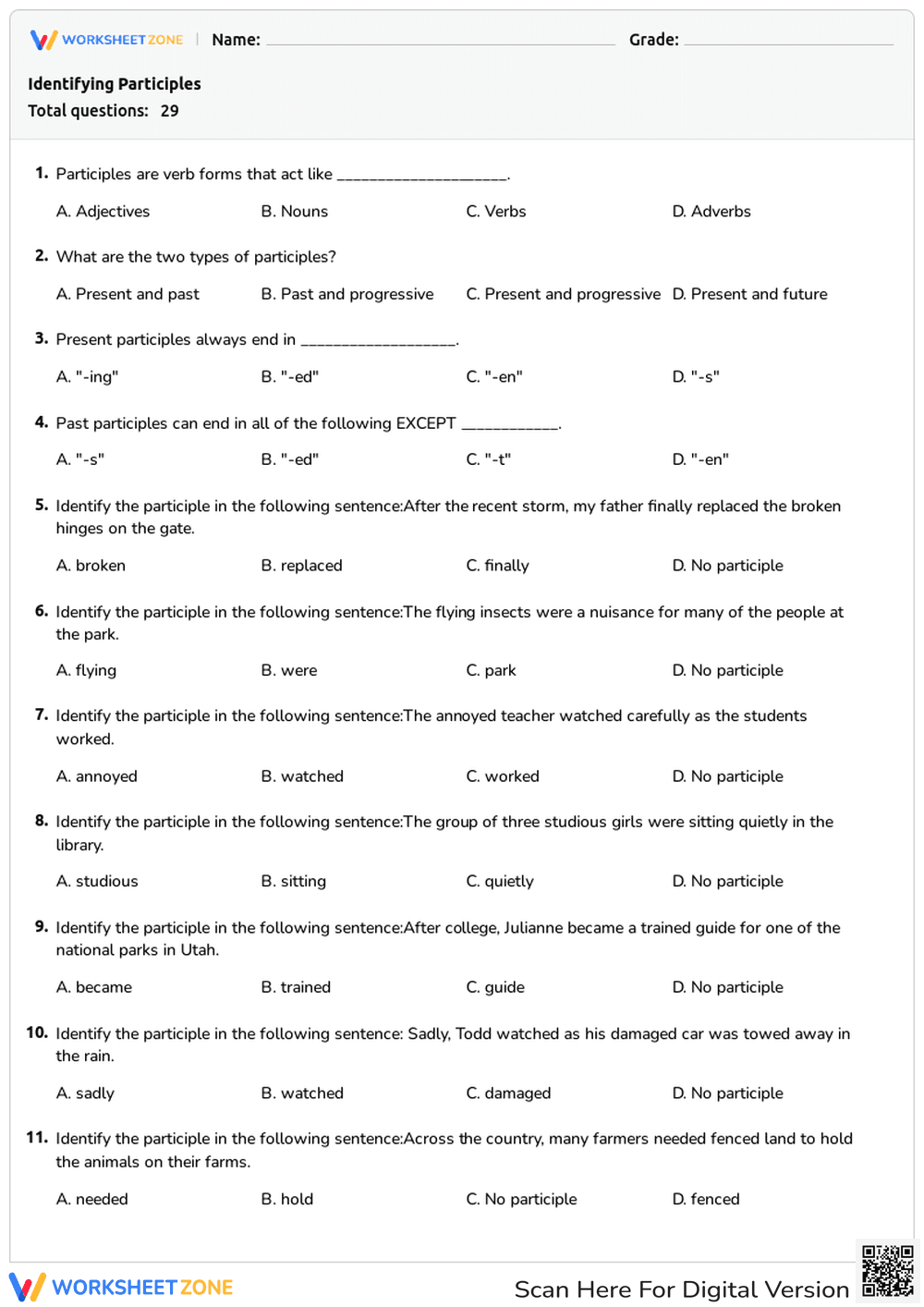


Identifying Participles Worksheet | Grade 5 ELA Printable
Paste this activity's link or code into your existing LMS (Google Classroom, Canvas, Teams, Schoology, Moodle, etc.).
Students can open and work on the activity right away, with no student login required.
You'll still be able to track student progress and results from your teacher account.
This comprehensive grammar worksheet helps students master identifying participles and understanding their function within sentences. By distinguishing between present and past participles, learners will improve their sentence variety and overall writing clarity. The structured multiple-choice format ensures students can confidently recognize when a verb form acts as an adjective.
At a Glance
- Grade: 5 · Subject: ELA
- Standard:
CCSS.ELA-LITERACY.L.5.1— Demonstrate command of standard English grammar conventions- Skill Focus: Identifying Participles
- Format: 4 pages · 29 problems · Answer key included · PDF
- Best For: Independent practice and review
- Time: 25–35 minutes
Inside this resource, educators will find a robust 29-question multiple-choice assessment spread across four pages. The tasks require students to define participles, identify them within complex sentences, determine their function as adjectives versus main verbs, and differentiate between present and past forms. A complete answer key is provided to streamline grading and ensure accurate feedback.
- Guided practice: The worksheet begins with foundational recall questions, asking students to define participles and identify their common suffixes.
- Supported practice: Students transition to sentence-level analysis, locating specific participles and determining which nouns they modify.
- Independent practice: The final section challenges learners to distinguish between participles acting as adjectives and standard main verbs in context.
This gradual-release approach ensures students build confidence before tackling more complex grammatical structures.
Aligned to primary standard CCSS.ELA-LITERACY.L.5.1, this resource ensures students demonstrate command of the conventions of standard English grammar and usage when writing or speaking. It also supports later mastery of verbals by laying the groundwork for identifying how words function differently depending on their context. Both standard codes can be copied directly into lesson plans, IEP goals, or district curriculum mapping tools.
This versatile worksheet is ideal for use after direct instruction on verbals and adjectives. Teachers can assign the first two pages as guided classwork and reserve the remaining pages for independent homework. As a formative assessment tip, review questions 13 through 17 as a class to observe how well students distinguish between a main verb and a participle modifying a noun. Expected completion time is 25 to 35 minutes.
This resource is designed for fifth and sixth-grade general education students, as well as middle school learners needing a grammar refresher. To support differentiation, teachers can reduce the number of answer choices or highlight the target sentences for students requiring accommodations. It pairs perfectly with an anchor chart detailing the differences between verbs, gerunds, and participles.
Integrating focused grammar exercises into the language arts curriculum is essential for developing strong, expressive writers. By targeting CCSS.ELA-LITERACY.L.5.1, this resource helps students demonstrate command of standard English grammar conventions. According to Fisher & Frey (2014), explicit instruction in syntax and grammatical structures significantly improves reading comprehension and writing fluency. When students practice identifying participles, they learn how to manipulate sentence structures to add descriptive detail and variety to their own writing. This targeted practice moves learners beyond basic subject-verb constructions, enabling them to craft more sophisticated and engaging texts. Providing structured, multiple-choice opportunities to analyze these verb forms ensures that students can confidently apply these conventions in both academic and creative contexts, ultimately strengthening their overall communication skills.


