


























Views
Downloads
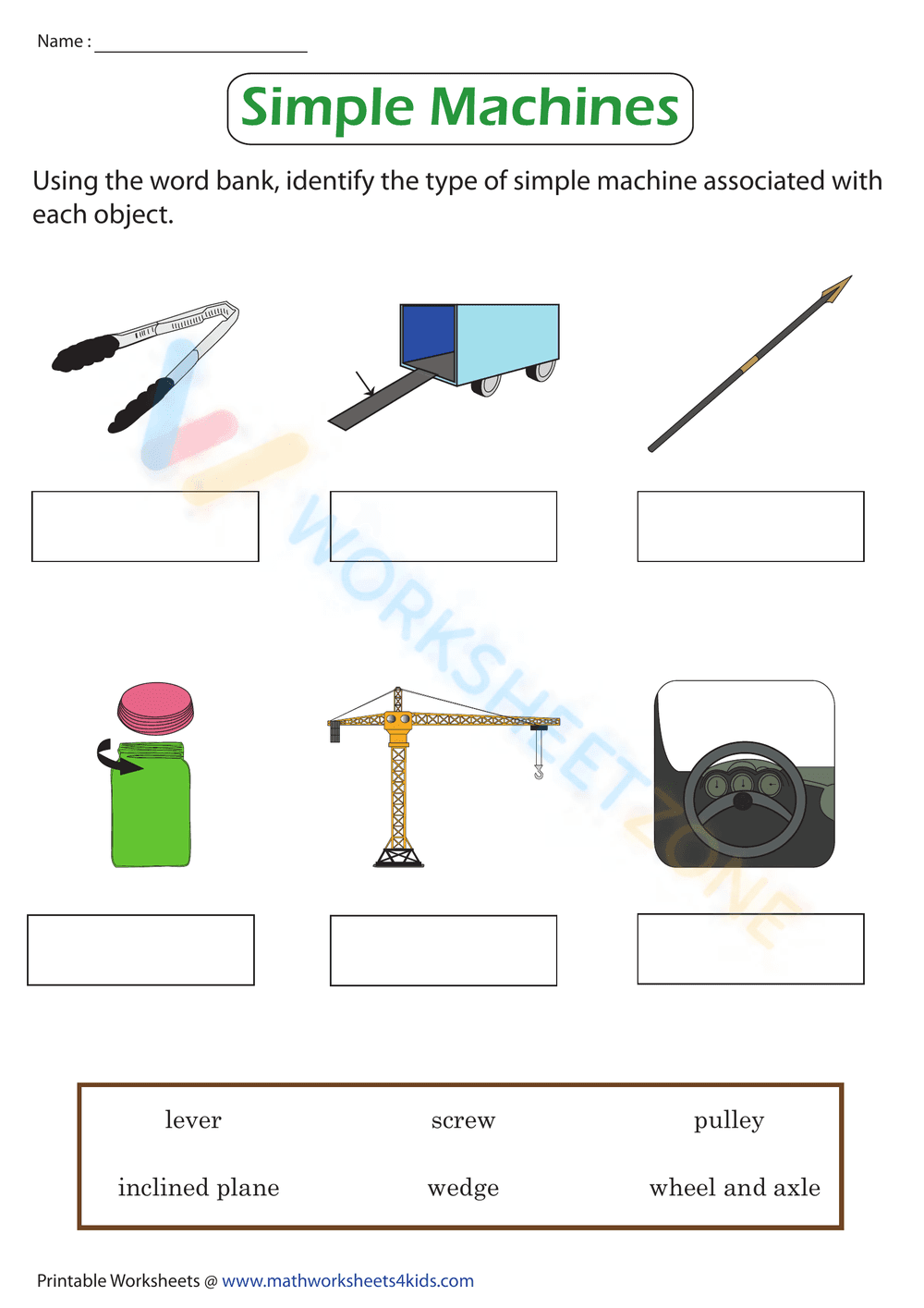


Printable Simple Machines Worksheet | Grade 3 Science
Paste this activity's link or code into your existing LMS (Google Classroom, Canvas, Teams, Schoology, Moodle, etc.).
Students can open and work on the activity right away, with no student login required.
You'll still be able to track student progress and results from your teacher account.
This simple machines worksheet helps students identify the six classical mechanical devices in everyday objects. By matching real-world items to their corresponding machine types, learners build a foundational understanding of physics concepts. The clear visual format ensures students confidently connect science vocabulary to practical applications.
At a Glance
- Grade: 3 · Subject: Science
- Standard:
3-PS2-1— Identify and describe the effects of forces on objects- Skill Focus: Identifying simple machines
- Format: 1 page · 6 problems · Answer key included · PDF
- Best For: Independent practice or review
- Time: 10–15 minutes
This resource features a single student page containing six illustrations of everyday objects, such as a crane and a steering wheel. Students use the provided word bank to label each object with the correct simple machine category: lever, screw, pulley, inclined plane, wedge, or wheel and axle. A complete answer key is included to make grading fast.
Designed for maximum efficiency, this zero-prep activity follows a simple workflow:
- Print (1 minute): Generate copies of the single-page PDF instantly.
- Distribute (1 minute): Hand out the assignment without needing to explain complex instructions.
- Review (2 minutes): Use the included answer key to quickly check student responses.
With a total teacher prep time of under two minutes, this worksheet is an excellent addition to any emergency sub plan.
This activity aligns with 3-PS2-1 by helping students recognize the mechanical systems that apply forces to objects. Understanding these basic mechanisms is a crucial stepping stone for later physics concepts. Both standard codes can be copied directly into lesson plans, IEP goals, or district curriculum mapping tools.
Deploy this worksheet as independent practice immediately following direct instruction on the six simple machines. It serves as an excellent formative assessment; observe whether students confuse visually similar mechanisms, such as the screw and the wheel and axle. Alternatively, use it as a quick morning work assignment. Students should complete the six tasks within 10 to 15 minutes.
This resource is ideal for third-grade students beginning their physical science units. The inclusion of clear illustrations and a word bank provides built-in scaffolding, making it accessible for English Language Learners and students requiring vocabulary support. Pair this worksheet with a hands-on demonstration using real classroom objects to reinforce the visual connections.
Effective science instruction relies heavily on connecting abstract physical concepts to tangible, real-world examples. When students practice identifying simple machines in everyday items, they develop the essential analytical skills required by 3-PS2-1 to identify and describe the effects of forces on objects. According to a ScienceDirect TpT Analysis, instructional materials that incorporate clear visual aids and structured vocabulary supports, such as word banks, significantly improve the retention of domain-specific terminology in elementary science classrooms. By isolating the core skill of visual identification and removing unnecessary cognitive load, this worksheet allows young learners to focus entirely on mastering the six fundamental mechanisms. Regular, focused practice with these targeted, visually supported tasks ensures that students build a robust conceptual framework, ultimately preparing them for more complex engineering and physics challenges in upper elementary grades.


